Buying an electric car or a plug-in hybrid almost always goes hand in hand with purchasing and installing an electric car charger at home, commonly referred to as a wallbox. But before rushing to buy the first charger offered, we should have a clear understanding of a set of concepts and terms to choose the one that best fits our needs.
Technical data sheets and sales staff will talk to us about fast or slow charging, charging powers, connectors, charging modes, and other IP/IK indexes. It may sound strange, but it’s actually quite simple.
Table of Contents (17)
- Types of current: single-phase vs three-phase
- Types of connectors
- The charging modes
- Mode 1
- Mode 2
- Mode 3
- According to charging speed
- According to current
- Alternating current
- Direct current
- Which type of charger suits you according to your car and usage
- Frequently asked questions about electric chargers
- Why is the IP and IK protection rating important?
- What power is needed to install an electric car charger?
- How much does it cost to install a home electric car charger?
- Will the charger be useful in the future if I change my electric car?
- Find your ideal electric car
Types of current: single-phase vs three-phase
We might think that installing a home charger to recharge the car isn’t necessary: a simple electrical outlet would suffice. However, that isn’t entirely the case. In practice, you will need a professional electrician, even if you intend to use a household socket.
And that’s because you’ll need a professional electrician to install a socket with its own circuit breaker. The breaker is an automatic switch, or residual-current device, specific for the outlet we will use to recharge the car. It detects current differences. It is necessary for our safety, protects our installation, and helps charging efficiency. If we don’t have it and there is a voltage difference, for whatever reason, the car will detect that difference and will not charge.

On the other hand, we must be clear that the house current is single-phase alternating current, i.e., 220 or 230 V. It’s the “usual” current, so to speak. Later we will see that from a certain power some chargers require a three-phase installation, that is, with a Spain’s 380 V voltage.
In a single-phase installation, all electrical devices are connected to the same circuit or phase. The power available at home, as contracted, is shared among the devices. In a three-phase installation, devices are separated into three groups and each group is associated with a phase. The contracted power is then divided into three equal parts.
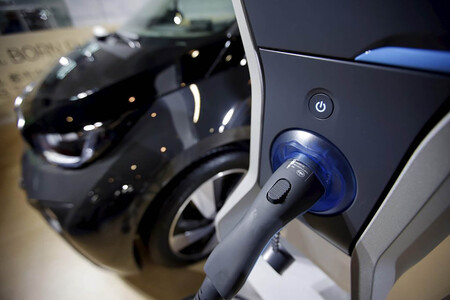
The benefit of three-phase is that a group of devices will always have the same power level and thus won’t have to share power with the rest of electrical appliances. Specifically, in a three-phase setup, our electric car charger will always be able to use the maximum power it needs and not a lower one because it has to share current with, for example, the home air conditioning.
Keep in mind that a three-phase installation implies a higher contracted power than usual, with a notable impact on the electricity bill, of course. It is also somewhat expensive to revert to single-phase if needed in the future.
Types of connectors
Before we start talking about chargers, it’s essential to know the plugs that electric cars use, also called connectors. Because not all EVs use the same plug.
If our electric car is a first-generation model (for example, if we buy one used), it will have a Type 1 plug. Some models with this connector include the first-generation Nissan Leaf, the Chevrolet Volt and Opel Ampera, the first Toyota Prius Plug-In, the first-generation Kia Soul EV, the Renault Fluence ZE, or the first Renault Kangoo ZE.
Conversely, if we are talking about a newer-generation plug-in hybrid, such as a Kia XCeed PHEV or a Peugeot 3008 HYbrid4, these come standard with a Type 2 connector.

Enchufes Tipo 1, Tipo 2 y CCS Combo 2.
In the case of a newer generation EV, whether a Renault Zoe, a Volkswagen ID.3, a Porsche Taycan, or a Tesla Model 3, the car will come equipped as standard with the Combo CCS 2 connector. Additionally, some plug-in hybrids, like the Mercedes A 250e, come with a CCS 2 connector.
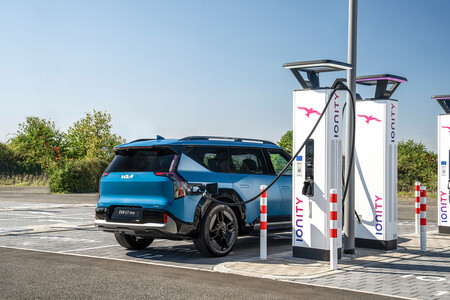
The CCS Combo is basically a plug that combines Type 2 with an integrated additional plug for when we use fast charging on the road, such as at roading charging stations, Ionity networks, and other networks of rapid public charging points.
Charging modes
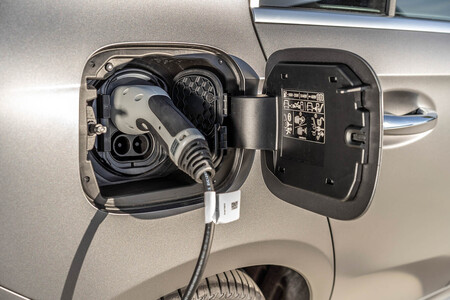
Toma CCS Combo 2 in the plugged car with a Type 2.
In product sheets and charger descriptions, manufacturers often mention charging modes. There are four modes, with Modes 2 and 3 being the ones we need at home or in our parking. It all boils down to safety and control of charging.
Mode 1
Here alternating current (AC) goes directly from the outlet to the vehicle with no control unit in between. This system is currently non-existent in electric cars due to the risk of overheating. It is even prohibited in some countries, such as the United States.
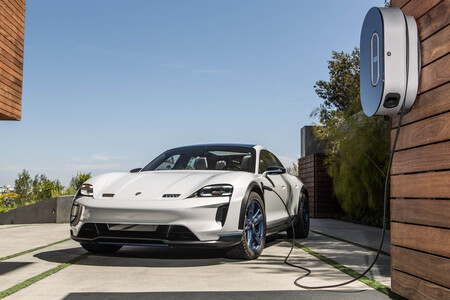
The Porsche Taycan can charge up to 22 kW on AC.
Mode 2
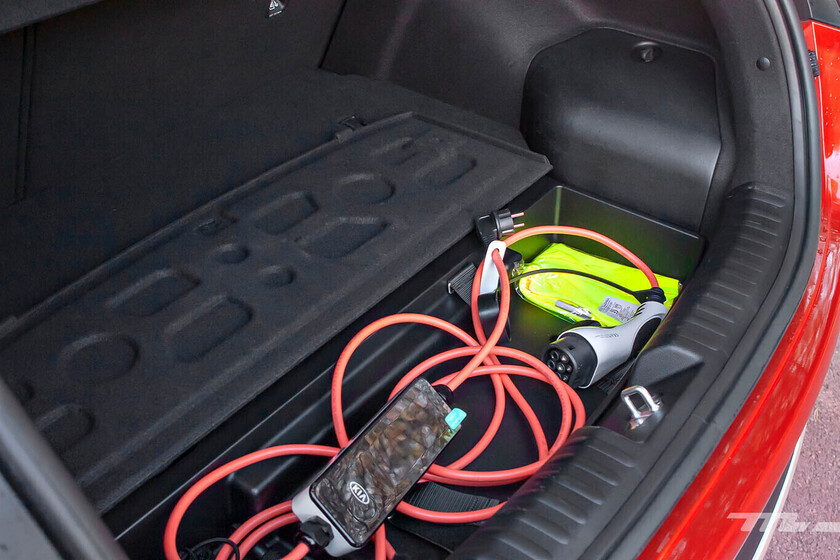
A cable equipped with a charging control unit is used, which stops charging if there is an anomaly in the electrical grid (overvoltage, current difference, etc.). The power can be up to 3.7 kW (AC), regardless of plug type. This cable usually comes standard with all electric cars and plug-in hybrids.
Mode 3
This system features advanced charging control with a communication link between the charger or wallbox and the vehicle. A direct, dedicated charging cable is used, which may be fixed or not to the home charger. The charging power can be up to 22 kW (AC three-phase) in domestic wallboxes.
According to charging speed
|
Slow charging (2.3 kW – 3.7 kW) |
Ideal for leaving the car charging overnight at home (10-20 hours for a full charge). |
|---|---|
|
Semi-fast charging (7.4 kW – 22 kW) |
It is the standard for domestic Wallboxes and commercial centers. It charges the car in about 3-8 hours. |
|
Fast charging (50 kW – 150 kW) |
Common at gas stations or rapid charging networks. It charges about 80% of the battery in roughly 30-45 minutes. |
|
Ultra-fast charging (>150 kW) |
Capable of charging the car in under 20 minutes. Requires compatible vehicles such as the Porsche Taycan or the Tesla Model 3. |
According to current
Alternating current
Home charging of an electric car is done with alternating current (AC). The catch is that EV batteries store energy in direct current (DC). Therefore, electric cars carry an inverter, also called a charger, integrated into their system that must transform AC into DC. Later, we will see that this inverter also helps determine which charger to choose.
Direct current
Fast-charging stations, on the highway, convert the grid’s alternating current into direct current and send it directly to the battery, bypassing the car’s internal inverter. It is the battery’s ability to absorb energy that will influence the recharge time. And that’s what explains why an electric car can charge at powers much higher than at home.
What type of charger suits you according to your car and usage
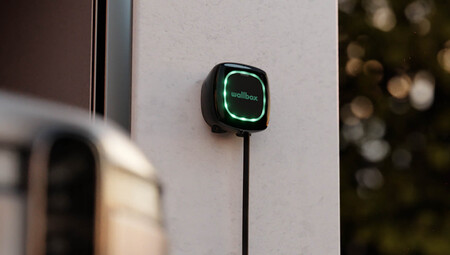
If you don’t use the car daily, or you drive short distances (less than 40 km per day) and your car can charge at 7.2 kW, perhaps you don’t need a 7.4 kW charger. A domestic outlet, up to 3.7 kW, already provides enough range: about 120 to 150 km in 8 hours. Still, a full charge can take more than 24 hours, depending on the car’s battery capacity and its discharge state.
Obviously, the more demanding our needs, the more power we will require from our charger. For example, if you want to have a well-charged battery every morning, even if you drive 50 km a day, and your car can accept charging at 7 or 7.2 kW, a 7.4 kW charger is advisable. It’s also wise if your daily trips are somewhat long, 100 km or more. In four or five hours of charging with a 7.4 kW charger you could reach more than 200 km of range, depending on the car.
|
Available power for domestic chargers |
Single-phase or three-phase current |
|---|---|
|
Up to 3.7 kW |
Single-phase |
|
7.4 kW |
Single-phase |
|
11 kW |
Three-phase |
|
22 kW |
Three-phase |
11 kW and 22 kW are typically recommended for high-end and high-performance cars with large battery capacities. They are ideal for cars like the Tesla Model 3, Model S, Porsche Taycan, or Audi e-tron GT. The latter, for example, already supports up to 11 kW and, optionally, 22 kW.
In short, the ideal is usually to opt for a 7.3 kW charger, which offers the best balance between charging power—and thus charging time—purchase price, and installation cost.
Frequently asked questions about electric chargers
Why is the IP and IK protection rating important?
These two international standard indexes measure the resistance of electrical devices to the elements and to impacts, respectively. If we plan to install the charging point outdoors or under a canopy, for example, this is something to consider. The IP (Ingress Protection) rating measures the sealing effectiveness of electrical devices, including chargers, against intrusion by foreign bodies such as tools, dirt, and moisture.
The rating consists of the letters IP followed by two digits; the higher the number, the better the protection. Sometimes a number is replaced with an X, indicating that the enclosure is not rated for that specification. Both digits range from 0 to 6. A 0 means the charger’s internals would be basically exposed, and 6 means they would be hermetically sealed, so to speak.
The first digit refers to intrusion by solid objects or materials, from fingers or screwdrivers to dust or soil. The second digit refers to liquids, such as ambient humidity or rainwater. The best chargers offer IP65 protection. In any case, all provide adequate protection against weather and rain with an IP54 rating.
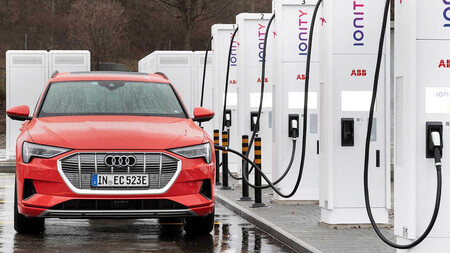
DC fast charging (charging in Mode 4).
By contrast, the IK is the one that measures resistance to impacts. From IK00 to IK10 they indicate the protection levels offered by enclosures of electrical equipment against external impacts. Home chargers typically carry an IK10 rating, the highest.
What power is needed to install a charger for electric cars?
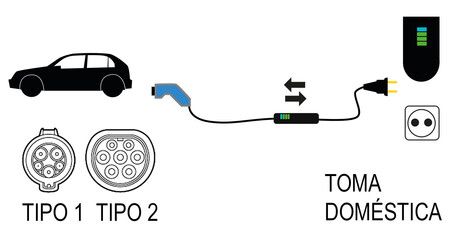
The Mode 2 charging and the compatible sockets, as well as the communication between car and charging unit.
Charging a car depends on several parameters, such as the car’s battery size, its charging capability, the resistance of the cable, and the power of the infrastructure or outlet and how we use the car. Charging a car is about finding a balance between all these parameters to maximize the charging experience.
As we have seen, the car’s plug type is not decisive when choosing a charger; all chargers are available for all possible car connectors. The key is to choose the charger’s power.
The basic idea is that the more power we have, the faster the battery will recharge. But perhaps it isn’t worth having a charger with the maximum power available. The power must adapt to both how we use the car and the maximum charging power the car can accept.
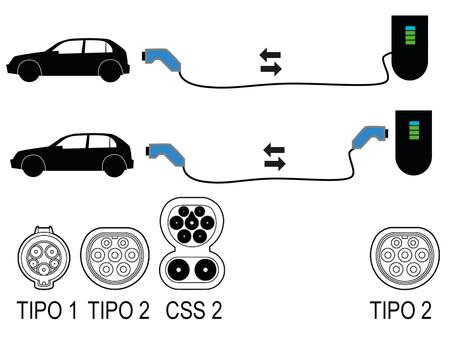
Mode 3 charging and the compatible sockets, as well as the communication between car and charging unit.
Some EVs, like the Peugeot e-208, don’t accept more than 7 kW (a bit more optional). The Hyundai Kona Electric accepts a maximum of 7.2 kW, and if you go higher in the range, the Tesla Model 3 is limited to 11 kW, so installing a 22 kW charger won’t give you a return on the full 22 kW power.
How much does it cost to install a home charger for electric cars?
In some of the more complex installations or when the meter box is far from the charger, the bill can exceed €1,200. It’s impossible to give a fixed price here since it depends on the home or parking where the charger will be installed. For example, a typical installation with about 20-30 meters of cable tends to push the total budget toward €1,600–€1,800. In this guide you can check which brand to buy and the best chargers for electric cars.
Don’t hesitate to request multiple quotes and have the installer visit the garage or parking on-site before deciding. This way, the prices of chargers indicated here are informative and do not include installation unless stated otherwise. Many companies handle the entire process, including the grants processing.
Will the charger be useful in the future if I change my electric car?
What will happen to my charger when I change cars? Will it still be useful? The simple answer is yes, both for plugs and for power, though with a caveat regarding power.
The Type 2 and CCS Combo 2 connectors are standards that all electric cars sold in Europe must comply with. It doesn’t matter the car brand; the plugs are the same. Of course, it’s possible that a standard could change, but such a change is not expected in the medium or long term.
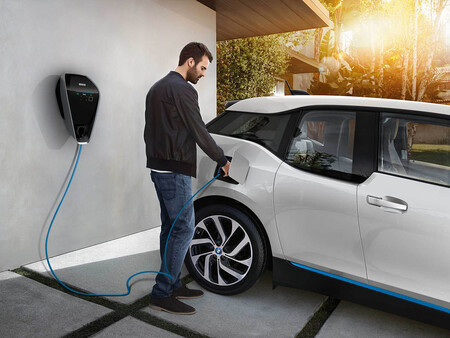
As for power, it’s worth noting. If we opt for a basic 3.7 kW charger, it’s very likely to be insufficient for our next electric car. Batteries keep getting larger, which means a higher charging power is needed to take advantage of them.
If we opted for a 7.4 kW charger, we will still have an acceptable charging power, even for a car that can accept 11 kW.
However, the trend is that manufacturers increasingly offer cars that accept high charging powers. Today, 11 kW or 22 kW powers are optional on the most affordable cars; in the next generation of electric cars, we might see those powers become standard equipment.
Find your ideal electric car
If you’ve considered buying an electric car, this will interest you. We have created the personalized electric car recommender, where besides seeing models that fit your needs you will also get answers to the questions that may worry you most, such as price, range, or nearby charging points.

Looking for your next electric car and feeling overwhelmed by so many options? It’s normal.
More than 45,000 readers have already tried it. And you?
Advice offered by the brand