
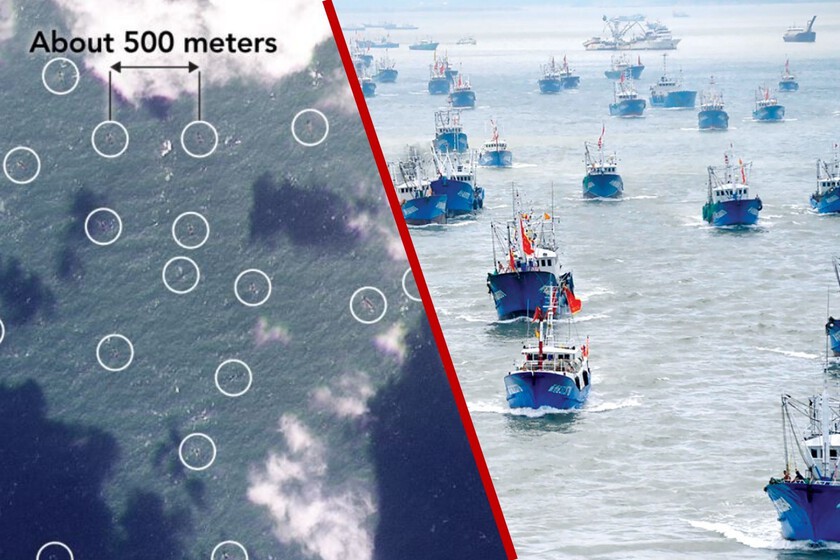
Between December 2025 and February this year, satellite imagery and navigation data painted an unprecedented scene in the East China Sea: up to 2,000 Chinese fishing vessels lined up for hours near the maritime boundary between Japan and China. The formations were so large and dense that some cargo ships had to take risky maneuvers to dodge them or thread their way through.
And this is not new: according to Reuters data, their patrols were active there for 357 days during 2025. Since then China has not reduced maritime pressure in the area. In fact, the Chinese Coast Guard maintains an almost constant presence around the Senkaku Islands, administered by Japan but claimed by Beijing as Diaoyu.
A floating “wall” that looks more like a strategic drill than fishing
Nikkei Asia’s analysis points out that those concentrations detected between late December and January bore no resemblance to ordinary fishing activity. The first major report, recorded on December 25, showed an formation of ships in the shape of an inverted “L” spanning about 470 km north-south and 230 km east-west. To grasp the magnitude, one only needs to remember that in 2016 Chinese concentrations near the Senkaku Islands involved between 200 and 300 ships, and that was already a lot.
Data from the AIS maritime identification system and satellite images at the time confirmed that the vessels remained more than 24 hours practically motionless despite rough weather, conditions that forced other fleets, such as the South Korean, to return to port. In some spots, ships were separated by less than 500 meters. “Given the risk that currents could push them apart, that is not a safe distance,” warned Takafumi Sasaki, a fisheries policy expert at Hokkaido University.
For several Japanese analysts, these movements align with the so-called Chinese Maritime Militia (CMM), a network of civilian vessels that Beijing uses to exert strategic pressure without formally deploying its Navy. The tactic allows saturating maritime spaces, generating “tactical noise” in radars and surveillance systems, and complicating commercial or military movements without crossing the official threshold into open conflict.
Japan fears this has already become part of the new normal in Asia
The worrying part for Japan is that all signs point to none of these episodes being isolated, but rather part of a broader strategy to control the Indo-Pacific maritime environment. Jason Wang, operations director of the geospatial firm ingSPACE, summed up the issue in Nikkei Asia this way: “This affects global maritime transport, not the military sphere.”

Meanwhile, Beijing continues to expand its presence in the East China Sea. The aircraft carrier Liaoning has intensified operations near Okinawa, China has already established a twenty-second facility on its side of the contested waters, and Japan has even quietly asked some fishermen to stay away from the Senkaku to minimize the risk of diplomatic incidents. More than the ships themselves, Japan’s concern is the impression that China is normalizing a new form of maritime pressure across the Indo-Pacific. And without firing a single shot.
Images | Planet Labs, Marine Traffic, Nikkei Asia