About a year ago, I was in Milan test-driving for the first time the Denza Z9GT, a very innovative car that was slated to reach the market in the last quarter of 2025. But that didn’t happen.
That family sedan in a shooting brake body style, which was to arrive in a plug-in hybrid or 100% electric version with around 1,000 HP of power, and with technologies as innovative as parallel automatic parking or a 360-degree turn on its own axis, made possible by its reverse-driven directional rear axle, was destined to revolutionize the market. But that didn’t happen.
It did not happen because after that initial contact with what were still pre-production versions and with specifications for the Chinese local market, the journalists present gave feedback on some aspects we believed should be changed before launching to the market: suspensions that were too soft, a chassis tuning that was overly filtered, and a steering that was not very communicative were the main areas to improve in a car that was liked but didn’t convince.

The Denza Z9GT is a sports shooting brake with the most advanced technology on the market
Then, the BYD group decided to delay the European launch of Denza as its new Premium brand (above there is another brand called Yangwang that will target the luxury segment) because, in addition to those changes, they wanted to do something more. They wanted the Denza Z9GT to be the fastest charging car in the market. At 1,000 kW, they announced while formalizing the delay in Denza’s European launch, which some identified as a weakness of the Chinese manufacturer. Others laughed, thinking that such charging power was impossible.
Now, barely a year later, I have been to China to test a Denza Z9GT and I charged it at a Flash Charging station at 1,500 kW, a power level production cars still do not support because they top out at 1,000 kW, but they have confirmed they could adopt it in a very short time. I’ll tell you about it.
Blade Battery 2.0, the first key
BYD is the world’s largest manufacturer of plug-in cars, both PHEV and EV. That is why they were determined to develop a technology that would remove the biggest current barrier to mass adoption of electric vehicles: charging times and range anxiety. And they have achieved it by leaving the rest of the technologies out of the game. How? With two elements.
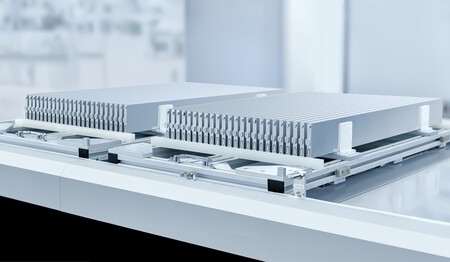
On one hand, with the second generation of their iconic Blade Battery. In traditional batteries, fast charging and high energy density are usually seen as conflicting technical objectives. But it seems BYD has managed to resolve this dilemma by increasing energy density by 5% while significantly speeding up charging.
As this is an extremely technical topic, and honestly I don’t pretend to fully understand it from my perspective as an automotive journalist, I will quote literally what BYD provides us to explain this technology.
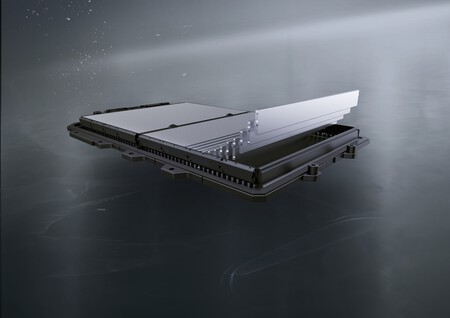
They have developed the “FlashPass” ionic transport system, which pushes the boundaries of what lithium-iron-phosphate (LFP) batteries can do. This system is based on three key technological innovations:
- The “Flash-Release” cathode, with a multinodal particle-size architecture and directional design that allows dense packaging and rapid de-intercalation of ions.
- The “Flash-Flow” electrolyte, which uses a high-precision optimization process driven by Artificial Intelligence (AI) to provide high ionic conductivity and accelerate ion mobility.
- The “Flash-Intercalate” anode, which incorporates a multidimensional lithium insertion structure that enables three-dimensional, high-speed intercalation of lithium ions.
Together, these technologies markedly reduce internal resistance, decreasing heat generation from the source.
Another innovation in the anode, incorporating a high-performance electrode restructuring and graphite particles aligned perpendicularly to the electrode plane, reduces the resistance to lithium-ion transport and allows smoother, faster intercalation, ensuring both Flash Charging performance and the 5% energy-density increase.
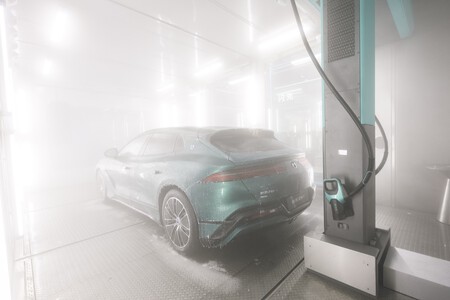
Flash Charging at -30 degrees takes only 3 more minutes to charge the car. Instead of 9 minutes from 20% to 97%, it’s 12 minutes. That’s why at the Beijing Auto Show they had a super freezer with a car at -30 degrees to demonstrate it.
The Blade Battery 2.0 also incorporates a solid-electrolyte interphase (SEI) layer, a key component in any lithium-ion battery. BYD’s solution combines molecular-level engineering with macroscopic structural optimization to achieve an ultrathin layer that enables higher ionic conductivity while remaining dense to ensure chemical stability. It also includes a dynamic self-regeneration technology that balances being “thin yet strong.”
These advances in energy density and charging speed have not come at the expense of safety or durability. In fact, the Blade Battery 2.0 has passed a new series of stringent safety evaluations, including the world’s first test combining Flash Charging with a nail-penetration test without experiencing thermal runaway, even after 500 Flash Charging cycles.
The Blade Battery 2.0 also passed a thermal leakage test without fire or explosion after inducing a short circuit across four cells, even at temperatures above 700°C.
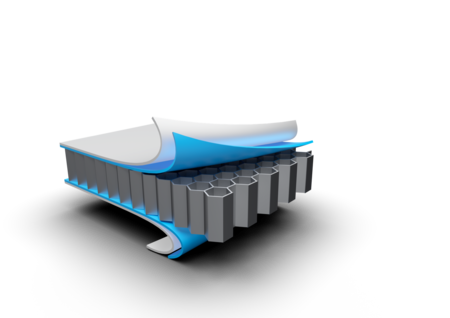
Additionally, the Blade Battery 2.0 enhances the durability of LFP batteries: compared to the original Blade Battery, total capacity degradation is reduced by 2.5%.
Flash Charging: the waiting times for car charging are over
The second key component of BYD’s innovations is the Flash Charger, capable of delivering up to 1,500 kW through a single connector (as per Chinese market specifications). It also features a T-shaped design that eliminates several of the practical drawbacks of the charging process, but we’ll discuss that in more detail later.

You notice it from the first moment: switching to an electric car changes many aspects of driving. Apart from bidding farewell to unfounded preconceived notions, you welcome a driving experience that is comfortable, simple, and relaxed. Those who have tried it know this.
Advice offered by the brand
BYD has already installed 4,239 Flash Charging stations in China (as of March 5, 2026) and expects to reach 20,000 stations in operation before the end of this year. These figures illustrate the speed at which they operate in China, since in Spain, in a year they still cannot even obtain administrative approvals to install a charging station. In Europe they have confirmed 3,000 by the end of this year, some of which will be in Spain, one of the key markets for the Chinese manufacturer.
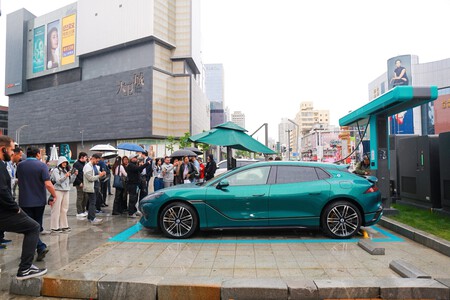
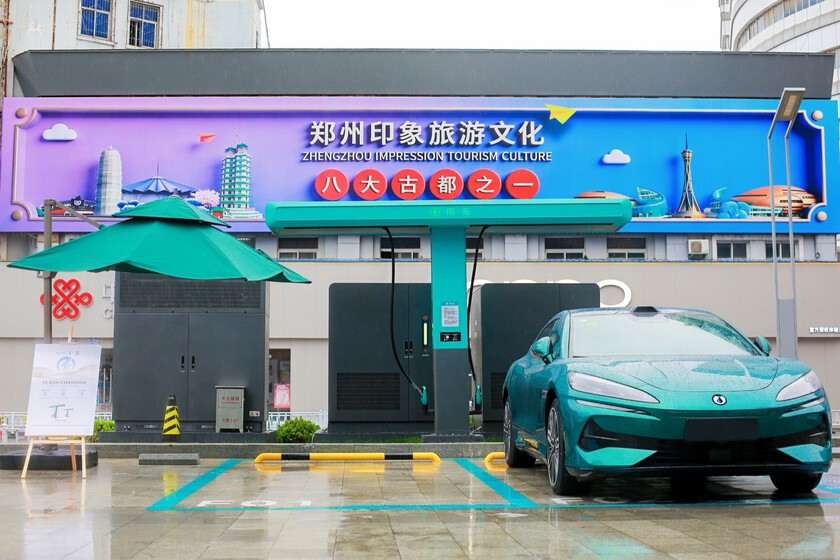
This is one of the Flash Charging stations in Zhengzhou center
The fundamental element of these stations is that they are combined with a ultra-fast energy storage system that helps overcome grid limitations. It uses a battery that recharges at slower speeds and can act as both a reserve to prevent grid overloads and a power amplifier to enable very high-power charges.
In recent years we have seen how many conventional charging stations offer a less-than-pleasant experience for electric car users, as they can be inconvenient and unhygienic, usually located outdoors in inhospitable areas, without services and often without shelter from rain or snow.
Moreover, at fast charging stations the connectors are heavy, and the cables tend to get dirty or wet when they touch the ground. But all of that changes with Flash Chargers, because they are designed with a T shape, which greatly facilitates their use.
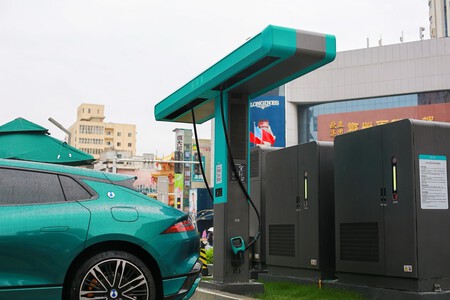
The top part of the T houses rails along which the charging cables move freely, allowing you to place them on either side of the car in seconds, regardless of where the charging port is located. You connect while the cables stay clean and off the ground—wonderful.
The connector is inverted compared to the usual design, so the plug fits into the car’s port in its natural position, which, as is common with fast-charging systems, has a dual connection and a hatch.
Two real Flash Charging experiences
During a China expedition called E-Journey, in which more than 150 journalists and content creators from around the world participated, we were able to witness first-hand how this innovative system works.
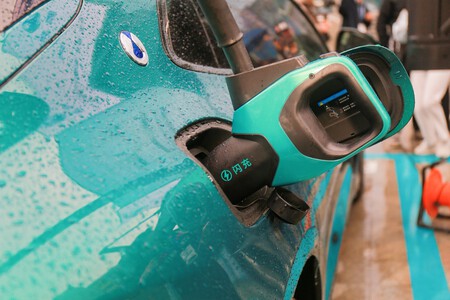
The first time, we did it at BYD’s test facilities in Zhengzhou, where we managed to charge a Denza Z9GT in barely 10 minutes. It was an improvised test, since we were the ones who asked them to bring a car to verify how the system worked without them having planned it.
Within minutes, a Denza Z9GT appeared with little battery, though we don’t know exactly how much charge it had, since they quickly connected it and we saw on the screen it was already at 13% just a few seconds later.
It is impressive to see, whether on the car’s display or the charging station screen, how quickly the percentage climbs and how the car’s range increases. But beyond the power, the real difference is the stability of the charging curve. While conventional chargers show sharp peaks and valleys, here the maximum power remains steady until it surpasses 80%, at which point it begins to drop slightly.
You can go from 10% to 70% in just 5 minutes. And reach 97% in only 9 minutes. In all batteries, the 0–20% and 80–100% ranges take the longest to charge.
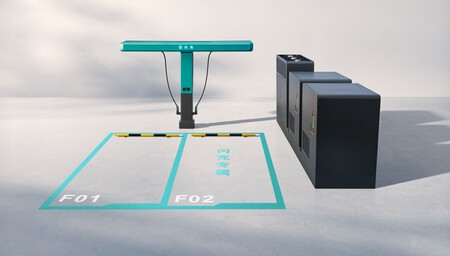
Flash Charging and battery storage
In a little over 10 minutes the car was fully charged, which is a milestone given that this is one of the largest batteries on the market, with a capacity of 122 kWh. I was truly impressed and it showed me that the barriers to traveling relatively normally in an electric car are finally gone—at least as far as charging is concerned.
View this post on Instagram
Nolan Kessler
I focus on performance-driven cars, emerging technologies, and the business forces shaping the automotive industry. My work aims to deliver clear, relevant insights without unnecessary noise, with a strong attention to detail and accuracy. I follow the evolution of mobility daily, with a particular interest in what defines the next generation of driving.