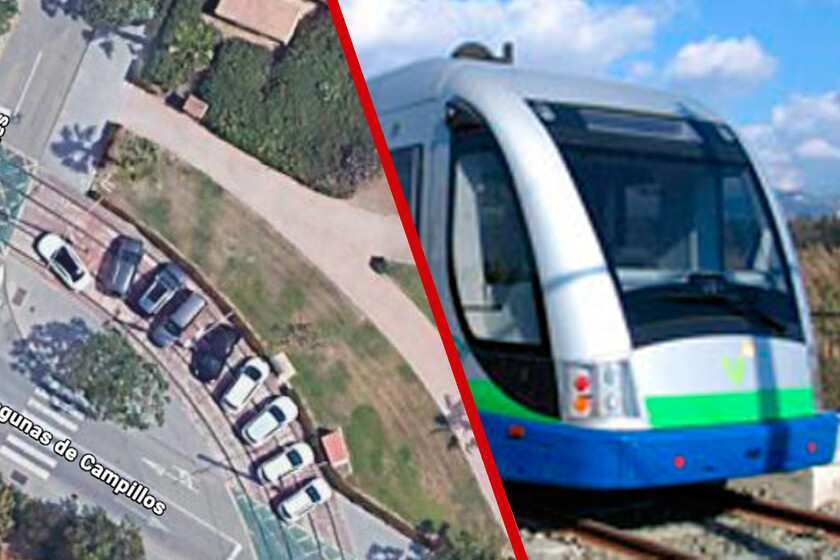
Twenty years will have passed since the Vélez-Málaga tram was inaugurated, linking the town center of Vélez with Torre del Mar. It was unveiled with pomp as the first modern tram in Andalusia, born to promote the use of public transport and improve mobility in the area. It represented an investment of around 40 million euros and has been out of operation for 13 years.
And it seems unlikely to return to service: the City Council has just given up on the European subsidy to reactivate it. Today its facilities have become a makeshift parking lot. Another example of failed infrastructure in Spain with public waste in the equation, such as, for example, the still-to-be-called most expensive roundabout in Europe or the eternally cited Castellón Airport.
Nacimiento y caída de un tranvía deficitario
The Vélez-Málaga tram was a project of the PSOE municipal government: construction began in 2003 and the works were completed in 2006. It was inaugurated in October of that year by the then socialist mayor Antonio Souvirón. The Junta de Andalucía, through the Department of Public Works, was the authority that invited bids and developed the project within its strategy of trams and light metros in the community. The operation would be run by the City Council.
With hardly any passengers. This modern tram had a route of 4.6 km, with a total of nine stops between the center of Vélez-Málaga and Torre del Mar, linking both areas. It took about 17 minutes to cover the line. At its launch, and from the outset, it was projected that 1.2 million travelers would use it each year. But it never reached that figure, not even in its first year of operation when it recorded the highest number of users: 922,135.

And it declined in the following years, until in 2012 it was used by fewer than 700,000 travelers (around 1,800 daily). A figure that barely reached half of what was required for profitability: the annual deficit was then set at 800,000 euros for the City Hall’s coffers.
Closure six years later. In the meantime, the Vélez-Málaga town hall passed into the hands of the Partido Popular. Facing the low number of travelers, the new municipal government decided to close it: on June 3, 2012, this tram made its last journey. Francisco Delgado Bonilla, then mayor, called it “ruinous.”
Beyond being unprofitable, it also meant more investment that ended up in the red: immediately after its inauguration, a second phase began, adding another 1.3 km to the route up to the northern area of Vélez. The work was completed, but this section never entered service. The result was that a year after the trams stopped operating, the carriages were leased for a couple of years to the Sydney metropolitan area (Australia).
The rails, today a car parking lot
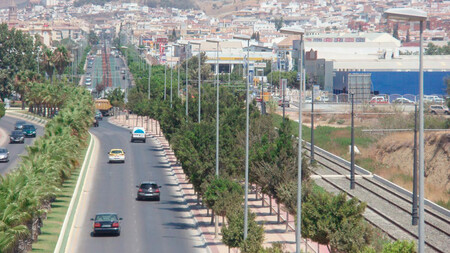
Nearly 15 years have passed since this tram faded into obscurity, leaving its infrastructure—tracks, overhead lines, and stations—useless. Not entirely, however: on the tracks that run parallel to the N-340 it is common today to see parked cars. Specifically in the Torre del Mar area, as we can verify on Google Maps. At the very least, drivers are giving some use to these semi-ruined facilities.
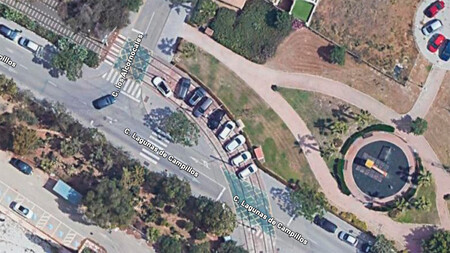
As Beatriz Pérez, vice-president of the Neighborhood Association of Vélez’s Historic Center, tells ElDiario.es: “Now it is an improvised parking lot by residents,” with the overhead lines in place and giving a sense of abandonment. She asks the administration to make a decision: either dismantle it or reactivate it. “We cannot be like this for another 15 years.”
Definitive farewell? The life and death of this tram have been marked by the oscillations of the different municipal governments since 2012. In 2022, under the leadership of the socialist Antonio Moreno Ferrer, it was decided to restart it by approving a 3.7 million-euro allocation from the Next Generation funds. In 2023, leadership at the town hall changed again with the arrival of the PP + GIPTM coalition. Initially they supported continuing with its rehabilitation, but it did not happen. It eventually led to a citizen referendum in 2025: Do the people want the tram?, held in January 2025.

Last summer it suffered what could well be its definitive blow: the City Council announced the decision to permanently renounce the €3.7 million grant from European funds. Among the arguments presented for this infrastructure are a “significant deterioration” and that rehabilitating it would entail “a multimillion-euro structural investment that, undertaken without planning or external backing, could jeopardize the municipality’s budgetary stability”.
Dance of numbers and PP-PSOE battle. The council estimates that such an investment would exceed 15 million euros, in which the Next Generation funds would be a drop in the bucket. They point out that the town has other priorities, for example revitalizing the historic center by building new car parks. They also claim that the public consultation determined that most Vélez residents “do not consider the resumption of the tram a priority”.
This decision drew criticism from the PSOE opposition, insisting that those estimates are far from reality. In a report requested by the Socialists to reactivate the service, commissioned to Inabensa (Abengoa) —one of the tram’s technical concessionaires— and dating from September 2021, it was determined that the cost of bringing this failed tram back to life was 8.2 million euros. The amount that the current municipal government considers “outdated,” presenting now greater deterioration of the facilities and the rising prices of materials.
Meanwhile, the Socialists argue that it would cost the taxpayer less to put it back into service than to keep it idle: the annual cost of leaving it inactive amounts to about 2.0 million euros, compared to the 1.2 million it cost the municipal coffers when it was in service. Be that as it may, the Vélez-Málaga tram is yet another battleground between municipal governments.
Images | City Council of Vélez-Málaga