
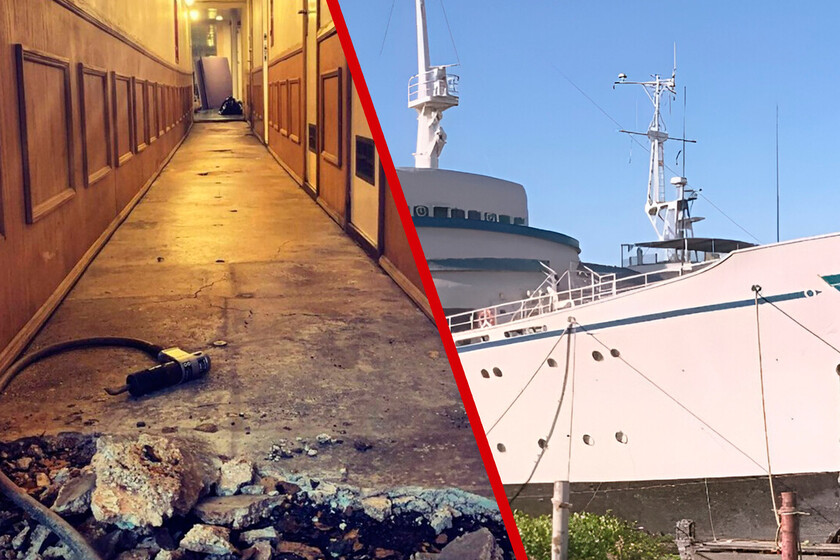
If happiness had a form, it would be a boat. The popular song mentions a truck, but it’s understood that this is what led our protagonist today to purchase a German passenger liner from the 1950s to restore it. A dream in which he invested millions and which turned out not to be the best decision: today the ship remains only a memory.
Renamed as ‘Aurora’, the man who came to possess this immense passenger liner was Chris Willson, a former software developer born in Utah who had amassed a small fortune as a tech entrepreneur. That fortune enabled him to embark on such an unusual investment. But let’s go back to the beginning.
A Million-Dollar Dream That Stalled as a Dream and Ended with the Ship Abandoned
In 2008, Willson came across a boat advertisement on Craigslist, the well-known American buy-and-sell portal. He was struck by how unusual the offer was, so he investigated the vessel. He learned that it had been built at the German shipyard Blohm & Voss in 1955, the first substantial passenger transatlantic liner conceived in Germany after World War II.
After weighing the pros and cons, he decided to take the plunge: he would buy the ship and restore it with the aim of turning it into a floating museum, thereby preserving a piece of postwar German history. A project full of promise and excitement.

“Like remodeling 15 houses”. The ship in question measured 90 meters in length, a respectable size for a transatlantic liner of its era. It boasted 85 cabins, various lounges, dining spaces, and galleries. Beyond its historical value, it had certain attractions: the main one being its use in the filming of ‘From Russia with Love’, the second James Bond film featuring Sean Connery as 007.
Restoring it demanded full-time commitment, so Willson moved there with his partner and project collaborator, Jin Li. After the first night, they shared coffee at a stunning sunrise, which inspired the name: ‘Aurora’. They hauled the ship to the port of Rio Vista, a riverside town in California, where they could rent a docking space.
For 14 years, Willson, Li, and other collaborators threw themselves into the restoration work without any prior experience, doing so in a craftsman-like fashion. “The magnitude was enormous. It’s almost like remodeling 15 houses in one go,” he told CNN. They worked on the cabins, decks, welds, and the ship’s very structure. In total they invested $1 million, though they estimated that to operate it as a museum—à la Queen Mary—would require around $3 million.
This ship is a ruin. Then the problems began. Willson found himself forced to relocate the ship several times as restoration work progressed, increasing the bill. At one of its locations, the Herman & Helen’s Marina in Stockton, California, the odyssey began anew. Local residents and authorities pressured him to move it again, fearing a sinking after a similar incident with HMCS Chaleur, a former Royal Canadian Navy vessel, which had caused environmental pollution.
The relocation would require another million dollars. Although part of the project was funded through crowdfunding, the venture gained considerable attention on YouTube, where a channel documenting the restoration tasks had been created to promote the floating museum. That extra funding was no longer feasible. Willson had no choice but to put the ‘Aurora’ up for sale, hoping someone would pick up the project. A buyer was found, though the identity remained undisclosed; unfortunately, the deal never materialized realization, and the ship effectively died.
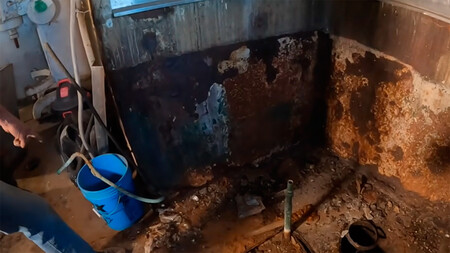
Million-dollar bill. In May 2024, the San Joaquin County Sheriff’s Department announced that the ‘Aurora’ had begun to sink. After years moored without adequate maintenance, the hull started to compromise and water leaked inside through a crack. In addition, diesel and oil leaks into the water occurred. Authorities had to intervene to curb the fluid spill.
In December of the same year, the ‘Aurora’ was towed to Mare Island, north of California, for dismantling: its steel framework was taken apart piece by piece until it disappeared entirely.
The ‘Aurora’ thus remains in memory, but it left one final legacy: a bill totaling $8.2 million for the costs of scrapping and dismantling borne by the Stockton City Council. The council has opened an investigation to determine whether it can recover those costs from the likely responsible parties—namely the ship’s owners: Willson and the mystery buyer.
Images | Stockton city | Aurora Restoration Project