
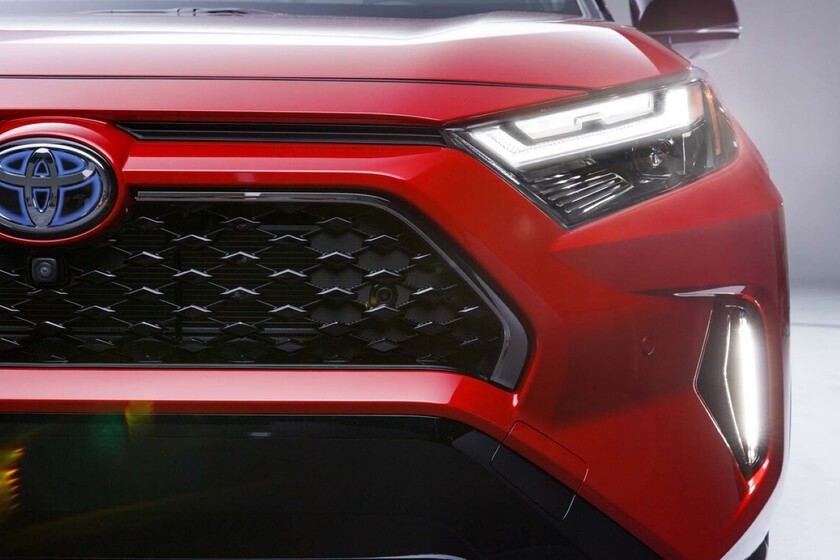
Toyota has trimmed its global production by 3.9% in February, and it has now four consecutive months of decline, according to Reuters. But behind these figures there isn’t a demand crisis or anything of the sort; it’s something far more interesting: one of the world’s best-selling cars, the Toyota RAV4, is moving to a new generation and that is forcing a reorganization of entire plants.
We are talking about a car that has for years been a cornerstone for the Japanese brand in markets such as Europe or the US, where its hybrid versions continue to perform strongly, and that sits at the core of the group’s sales. When a car like this enters a transition, it’s not just one model that changes: the entire industrial machinery behind it moves.
The RAV4 explains Toyota’s decline: why it’s more important than it seems
The most striking data from Reuters is in Canada: production plunged 46.2% in February as plants adapted to the new RAV4. There were also declines in China (-11.5%) and Japan (-2.6%), while the US (+3.4%) and Europe (+3.9%) continued to grow. It’s a localized adjustment, not a global brake.
This type of industrial transitions usually leaves a distorted snapshot in the short term, especially when they affect a model with so much weight. As we noted earlier the RAV4 is one of Toyota’s volume pillars globally (alongside the Corolla or Camry), so when its production tightens, the impact is reflected directly in the group’s figures. And that’s precisely what’s happening now.
Toyota produced 3.9% fewer cars in February, while global sales stood at 737,134 units in February, 3.3% less than a year earlier: we’re talking about a very contained drop compared with the cut in production. In practice, the data point to a short-term misalignment between what can be built during the transition and what the market continues to absorb.
Toyota remains the leader… but it is changing from within
Because all this is happening while Toyota remains at the top of the global market for the sixth consecutive year, ahead of Volkswagen. Only in 2025 did it sell 10.5 million cars between Toyota and Lexus, and up to 11.3 million including Daihatsu and Hino. And that leadership rests on a very concrete foundation: hybrids.
More than 4.4 million cars sold in 2025 were hybrids, while pure electric vehicles barely reach around 2% of the total. It makes sense: Toyota has built its leadership on mature, profitable, and easy-to-fit technology for the customer, while its electric push is still taking off with models like the newly unveiled C-HR+. It’s a strategy that continues to work, especially in the US and Japan, which account for more than 40% of its sales.

Koji Sato, Source: Toyota
But the environment is changing rapidly. China tightens its grip with manufacturers like BYD, which in 2025 surpassed 4.6 million electrified vehicles sold globally, gaining an edge in costs, batteries, and development. That pressure is forcing Toyota to move internally. According to Automotive News, the brand is simplifying processes, reducing complexity and revising standards that for years have raised production costs without delivering real value.
In that context also fits the message delivered by Koji Sato to its network of suppliers: “If things don’t change, we won’t survive.” It’s a statement that nicely reflects the moment the industry is going through, where selling millions of cars no longer suffices; everything now depends on how efficiently you design them, manufacture them, and bring them to market.
Images | Toyota