For years, the environmental penalty acted as a glass ceiling for French carmakers. Building a powerful car meant consigning buyers to a dissuasive tax. Electric power changes the equation. With zero tailpipe emissions, the malus is gone. And so, no more excuse not to have fun.
In Brief
Electrification opens up new horizons for French sports cars, once limited by the eco tax. Models like the Peugeot e-208 GTi, Renault R5 Turbo 3E, and the forthcoming Alpine A110 illustrate this renewal with premium tech specs and pricing. Manufacturers enjoy greater freedom in design, even as new challenges such as battery weight come along. The objective now is to deliver innovative thrills, different yet just as exciting as the GTi icons of the past.
French Sportscars Regain Color Thanks to Electric
Forty years after the 205 GTi, the badge returns on a Peugeot. Unveiled at the 2025 24 Hours of Le Mans, the e-208 GTi has been on sale since the start of the year. It rides on the CMP platform shared with the Abarth 600e and the Lancia Ypsilon HF. And it draws from this shared powertrain a Emotors unit delivering 280 hp and 345 Nm of torque.
The ride height is lowered by 30 mm, the front track widened by 56 mm, and a mechanical limited-slip differential manages traction. The 0-62 mph time is 5.7 seconds, the top speed is limited to 180 km/h (about 111 mph). Price announced: around €45,000.
Not cheap, but that’s the going price today to sell an image. The GTi badge isn’t just about what it denotes; it’s about what it evokes. Peugeot understood that, and the brand’s new leadership under Alain Favey doesn’t hide that this e-208 is only the beginning. A third-generation 208 GTi is already in the works for 2028, on the upcoming STLA Small architecture.
Renault Looks Back and the Result Costs €160,000
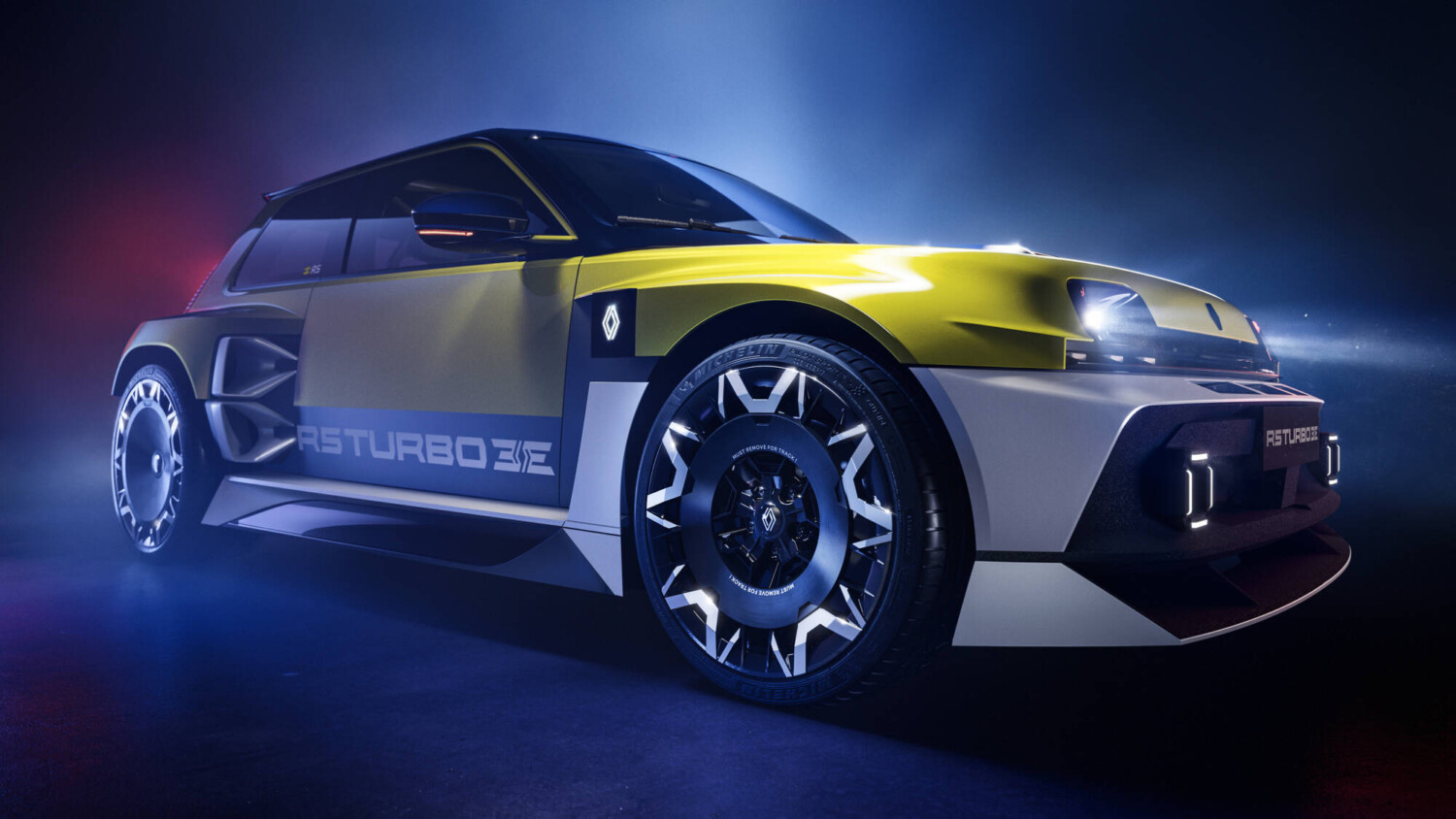
Renault plays a different note. The R5 Turbo 3E isn’t an affordable car. It’s priced at €160,000, limited to 1,980 units, with a €50,000 deposit required to reserve a slot.
It’s a collector’s-level supercar produced in Dieppe, in the competition division that already builds Alpine models. Two motors on the rear axle, 555 horsepower, 0-100 km/h in under 3.5 seconds, 800-volt architecture and DC fast charging at 350 kW.
Real-world range will be modest in high-performance use. As with any electric hot rod, Renault leans into the paradox. What matters is the narrative legitimacy. By channeling the GTi spirit of the R5 Turbo from the 1980s, the brand signs an object that is as much story as it is technology. Deliveries begin in 2027. As of that date, more than 1,000 buyers had already paid deposits.
Alpine is at a turning point. The internal-combustion A110 is fading as its electric successor comes together. The upcoming third-generation Alpine A110 will ride on the Alpine Performance Platform — the same aluminum base as the R5 Turbo 3E, with a 70 kWh battery positioned behind the occupants to preserve the center of gravity.
Alpine Prepares the Next Step by Sharing Costs
Dual motors, power output exceeding the 345 hp of the current A110 R, target curb weight around 1,500 kg. That’s notably heavier than the present car, yet in line with the sport-scene rivals powered by internal combustion.
Estimated range surpasses 480 km in mixed cycles, and the platform is engineered to withstand three sustained laps of the Nürburgring. Deliveries are expected in 2027. This platform-sharing with the R5 Turbo 3E is also a manufacturing response to cost pressures. Building a pure sports car without amortizing it across other models would be economically hard to justify.
The arrival of electric propulsion in the French sport and GTi lineups is therefore not merely a drivetrain change. It’s a reconfiguration of what’s possible. Without the malus, a 280-hp city car can sell at a premium price without additional tax penalties.
Manufacturers regain a freedom of power they didn’t have with gasoline engines—provided they accept the trade-offs, notably the weight of the batteries. The question of feel remains open: can an electric GTi deliver the same sensations as a 205 1.9 with 130 hp on a tight road? Not exactly.
But it can offer other thrills. Peugeot Sport engineers on the e-208, Alpine on the forthcoming A110, and the minds behind the R5 Turbo 3E seem to take the project seriously. It isn’t a guaranteed result, but it’s at least a credible promise.
Comparison Table
| Model | Power | 0-60 mph | Top Speed | Range | Price | Production/Delivery |
|---|---|---|---|---|---|---|
| Peugeot e-208 GTi | 280 hp / 345 Nm | 0-62 mph in 5.7 s | ~111 mph | Unspecified | ≈ €45,000 | On sale early 2025 |
| Renault R5 Turbo 3E | 555 hp | < 3.5 s | Unspecified | Modest in sporty use | €160,000 | Deliveries in 2027; 1,980 units |
| Alpine A110 electric (future) | > 345 hp | Unspecified | Unspecified | > 480 km (mixed cycle) | Unspecified | Deliveries expected in 2027 |
Key Takeaways
- Electric power frees French sportscars from the eco tax.
- Peugeot revives the GTi badge with the e-208 GTi at 280 hp, priced around €45,000 (roughly $50k).
- Renault offers the R5 Turbo 3E, a limited-run electric supercar at €160,000 (about $176k).
- The forthcoming Alpine A110 electric, due in 2027, aims for more than 345 hp and over 480 km of range.
- New models occasionally share platforms—a strategy to control development costs.
- While the sensations differ, the promise of renewed sportiness remains strong for French automakers.
FAQ
Why does electrification enable a revival of French sportscars?
The absence of an eco tax on electric cars frees manufacturers to build powerful models without penalizing buyers on the tax bill.
What are the main specs of the Peugeot e-208 GTi?
The e-208 GTi produces 280 hp, does 0-62 mph in 5.7 seconds, and costs about €45,000.
What about the price and the standout feature of the Renault R5 Turbo 3E?
The R5 Turbo 3E is priced at €160,000, limited to 1,980 units, with 555 hp and 0-60 mph in under 3.5 seconds.
When will the future Alpine A110 electric be available?
Deliveries of the new Alpine A110 electric are expected in 2027, with a target range over 480 km.
Will the driving feel of electric sports cars be the same as their gasoline counterparts?
No, they feel different, but manufacturers are aiming to offer new kinds of driving pleasure and sensations through these new electric models.