
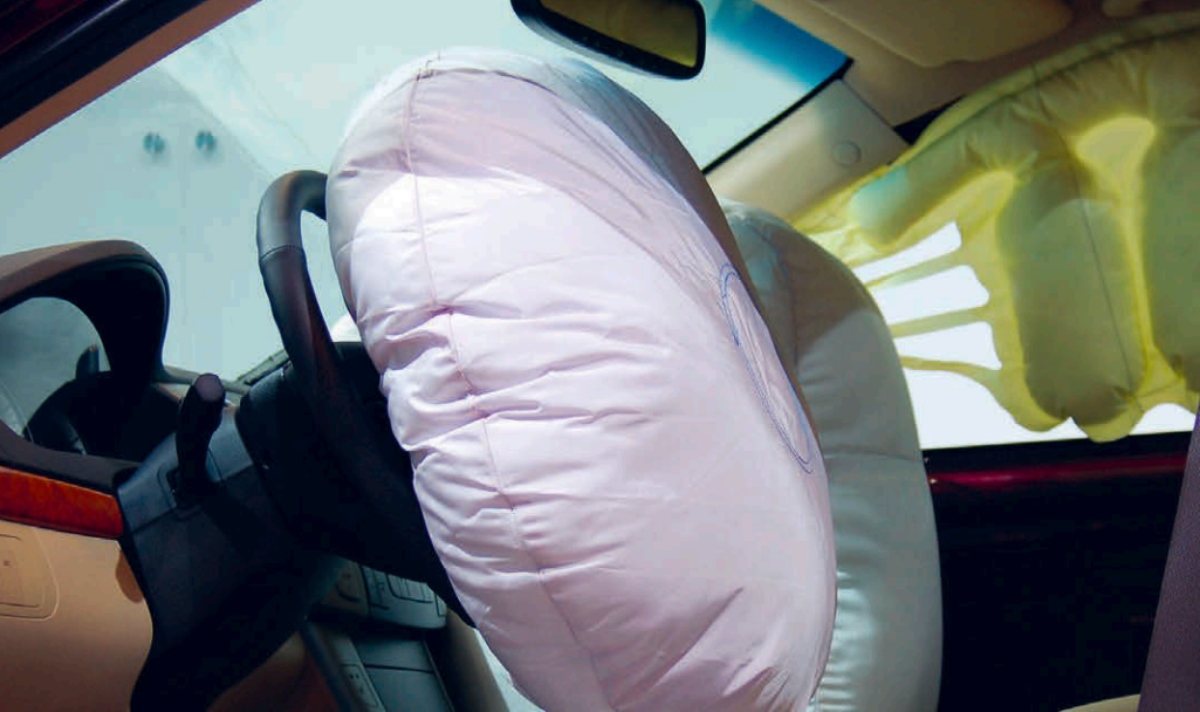
An airbag is supposed to save your life in a fraction of a second. In the United States, some Chinese-made airbag inflators are now accused of doing the exact opposite, to the point that federal authorities are weighing an outright ban on their sale.
After a string of deadly crashes involving replacement airbags installed in vehicles that had already been in a crash, the National Highway Traffic Safety Administration (NHTSA), the federal agency in charge of road safety, issued in early April a preliminary decision pointing to a safety defect in inflators manufactured by a Chinese company. Ten deaths and two serious injuries have already been attributed to these components. The question now is how far this case will go, and especially how many cars are still on the road with these risk-prone parts.
Why the NHTSA is targeting certain Chinese replacement airbags
At the heart of the matter lies the Chinese manufacturer Jilin Province Detiannuo Safety Technology Co., better known as DTN Airbag. In a press release and an investigative report, the National Highway Traffic Safety Administration targets specifically the driver frontal airbag inflators produced by this company in 2021 and 2022. Over the past three years, these components have been linked to 12 crashes on record, including 10 fatalities and two with serious injuries. The agency notes that these inflators were reportedly imported illegally. Where an airbag should expand to cushion the crash, these devices would have exploded and hurled large metal fragments toward the driver’s chest, neck, eyes and face. A scenario reminiscent of the Takata airbag scandal, with the same kind of metal-fragment injuries.
The pattern identified by investigators is particularly troubling. In 10 of the 12 crashes, the DTN inflators had been installed as replacements for the original airbag after an initial crash. Early inquiries point to replacement airbags that may be substandard, or even counterfeit. The models involved in these 12 crashes are the Chevrolet Malibu vehicles manufactured from 2018 to 2022, and Hyundai Sonata models from 2017 to 2019. The U.S. Transportation Secretary, Sean Duffy, describes the situation in stark terms: “Our preliminary investigation into the use of illegal Chinese airbags in repair shops has revealed a troubling trend: these substandard parts kill American families,” he said, as reported by Road & Track. Authorities acknowledge, however, that they do not know how widely these inflators have been distributed, and they cannot confirm that the risk is limited to these two models.
NHTSA investigation and possible permanent ban on DTN inflators
The formal investigation into DTN airbag inflators began in October 2025, following the initial crashes. Federal regulators sent information requests to the Chinese company on December 23, 2025, and March 6, 2026. DTN replied once on February 3, 2026, and then stopped responding. Facing this silence, the NHTSA issued an “initial decision” on April 2, 2026, concluding that a safety defect exists in certain driver inflators supplied by DTN. The decision formally labels the targeted parts as defective. The document notes that the agency must now determine “whether a permanent ban on sales of these inflators in the United States is necessary.” A public comment period was opened through April 17 to gather further comments and information, while the manufacturer still has the opportunity to challenge the agency’s conclusions.
While awaiting a possible permanent ban on these Chinese replacement airbags in the United States, safety regulators remain cautious about the scope of the problem. The Chevrolet Malibu 2018-2022 and Hyundai Sonata 2017-2019 models identified in the 12 crashes are the only vehicles formally documented, but the NHTSA says it cannot confirm the risk is limited to those vehicles. Regulators urge drivers to stay vigilant, especially those whose car has been in a crash since 2020 with an airbag deployment and was subsequently repaired. They recommend obtaining a vehicle history report and asking about the parts used in repairs. Until the number of affected vehicles and the exact reach of any potential ban on DTN’s inflators remains unknown, uncertainty lingers over this issue for drivers nationwide.