
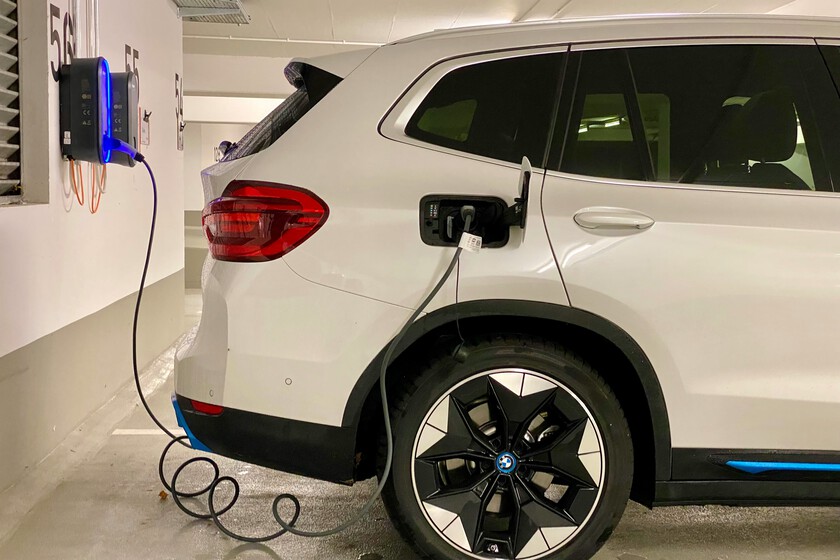
Germany has just crossed a barrier that a few years ago seemed distant: it now exceeds 2.03 million fully electric cars in circulation, according to the Federal Motor Transport Authority (KBA). A figure that confirms electrification is already underway in the industrial heart of Europe and that the change is starting to be visible on the street.
But the full picture has its nuances. The current momentum comes after the slowdown of 2023, when the withdrawal of subsidies sank registrations almost immediately. Since then, the pattern repeats: growth has not been constant and depends largely on public incentives. When purchase subsidies disappear, the market cools. When they return, it speeds up again.
Germany has already taken the plunge into electric cars, but is still far from its target
Specifically, and according to the KBA, the country has 2,034,260 pure electric cars. The leap is enormous when you look back: in 2017 there were barely 34,000. Growth accelerated especially from 2020, driven by subsidies and an increasingly wide offer. The first million did not arrive until 2023, but since then the curve has surged to double in just two years.
That said, context matters. Germany has a total fleet of 49.2 million passenger cars, which means that electrics currently account for only 4.1% of the total. So, even with progress, this technology is still far from dominating the market and from meeting the country’s goals: 15 million electric cars by 2030.
With the current pace, the sector acknowledges that registrations would need to multiply to approach that figure.
The electric market grows… but at the pace set by public subsidies
The German case is quickly understood when looking at recent evolution. After the 2023 slowdown due to the withdrawal of incentives, the market has reactivated with the return of subsidies: up to €5,000 per car within a program that mobilizes around €3 billion. The effect is direct. By 2026, electric cars are already approaching 22% of new registrations, compared with 19.3% the previous year, according to industry data and the KBA.
|
MODEL |
SALES (JAN 2026) |
|---|---|
|
VOLKSWAGEN ID.3 |
116,053 |
|
TESLA MODEL Y |
106,184 |
|
VW ID.4/ID.5 |
97,120 |
|
TESLA MODEL 3 |
81,352 |
|
SKODA ENYAQ |
80,970 |
|
RENAULT ZOE |
79,417 |
|
FIAT 500E |
60,571 |
|
SEAT BORN |
60,256 |
|
SMART FORTWO |
53,341 |
|
VOLKSWAGEN UP |
56,334 |
That growth, however, remains anchored in very specific foundations. Two-thirds of registrations come from companies, while private buyers proceed with more doubts. Access to a charging point remains decisive: owning a garage or a home multiplies the odds of taking the leap, which explains why adoption is stronger in the west and south than in the east of the country, where its share barely reaches 2%.
In that context, the market is already starting to draw its own leaders. The Volkswagen ID.3 leads the fleet with 116,053 units, closely followed by the Tesla Model Y (106,184) and the Volkswagen ID.4/ID.5 (97,120). Behind them appear models such as the Tesla Model 3, the Skoda Enyaq or the Renault Zoe, in a list dominated by European and American manufacturers, while Chinese brands remain far behind, with a share around 2.5%.
Germany advances, but it does so with a clear condition: when subsidies exist, the electric car accelerates; when they are absent, the pace slows.
Find your ideal electric car

If you’ve thought about buying an electric car, this will interest you. We have created the Personal Electric Car Recommender, where in addition to seeing models that fit your needs you will also find answers to questions that are likely to worry you most, such as price, range, or nearby charging points.