
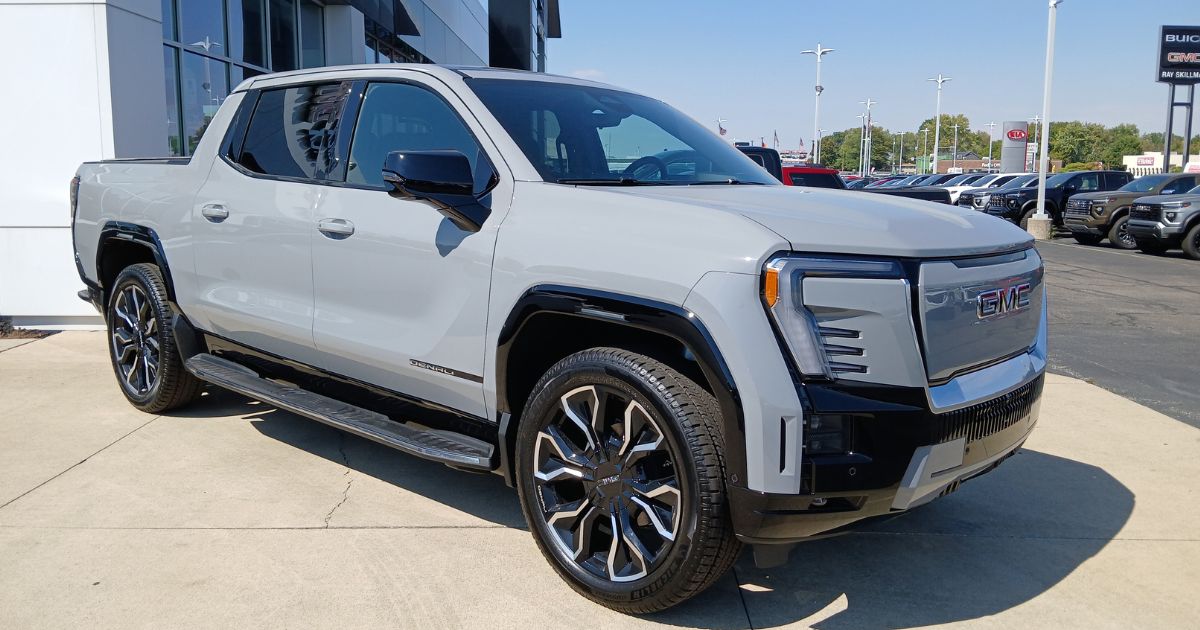
For many drivers, the dream combo looks like this: solar panels on the roof, a home backup battery, and an electric vehicle that charges—and might even feed power back to the house. On paper, the picture is idyllic. The real question, the one that makes people hesitate before signing a quote, is this: does this trio actually save money, or is it mainly a clever engineering concept?
That’s exactly what Jim Reilly, a microgrid specialist and GM Energy employee, is testing in his own home. He paired a residential solar installation, a GM Energy backup battery, and a GMC Sierra EV Max Range with a massive battery of about 205 kWh and bidirectional charging to the house. He began sharing the numbers publicly in a post titled “Energy Dominance,” and his early results are giving people who drive a lot plenty to think about, especially given the current volatility in energy prices.
GMC Sierra EV, solar panels and battery: the energy trio Jim Reilly is testing
In Jim Reilly’s garage, the pickup is no longer just a way to get around. With its roughly 205 kWh Max Range battery, the GMC Sierra EV becomes a true “rolling battery” that integrates with his home energy system. On the roof, residential solar panels generate electricity. A GM Energy backup battery installed at home stores the surplus and takes the lead during outages. And thanks to bidirectional vehicle-to-home charging, the Sierra EV can also send power back to the house when it’s useful.
To explain his approach, Reilly published a very concrete note: “There’s a lot of chatter about how tensions in Iran threaten higher gasoline prices,” wrote Reilly in the original Energy Dominance post. “The cost of a full tank is unpredictable. Here are my calculations for a fill so I can verify this in a few months and see if these figures hold up, potentially convincing more people to switch to an electric vehicle.”
Gasoline (24 gallons at $4/gal): $96 per fill. Public EV charging (200 kWh at $0.48/kWh): $96 per fill. Home EV charging (approx. $0.14/kWh): $28 per fill. Solar EV (if properly sized for your home): $0 (independence locked in, as he put it). In other words, he’s tracing the cost of each type of “fill” to watch how the gap evolves over time, month after month.
How much does a real “full” cost with solar, a battery, and a GMC Sierra EV?
The raw numbers Jim Reilly lays out are hard to ignore. A pickup with a 24-gallon tank (about 91 liters) at an average $4/gallon gas price would require a $96 fill, roughly €90 at current exchange rates. The same energy drawn from a public fast charger at $0.48/kWh would also cost about $96. Recharging at home on the grid, at roughly $0.14/kWh, brings a 200 kWh “full” down to $28, just over €25. And when everything comes from solar, properly sized for the home, the marginal cost of a fill is essentially zero—aside from the upfront cost of the installation.
That math matters more in a world where gas can top $5 per gallon and diesel can reach $7. In such a context, charging a 205 kWh battery at home for under $30 clearly tilts the economics in favor of a large pickup. U.S. estimates suggest the average driver spends roughly $2,000–$3,000 per year on fuel with a conventional vehicle, while an electric vehicle charged with solar energy runs around $200–$300 per year, versus $600–$700 if charged only from the grid. Reilly pushes this logic further: produce your own “fuel,” decide when to recharge, and store the cheapest electricity in both your home battery and your Sierra EV—then reuse it when it fits your schedule.
What the trio changes in daily life
Practically speaking, a typical day in a system like Jim Reilly’s follows a straightforward rhythm. By day, the solar panels power the home’s loads and recharge the GM Energy backup battery. When there’s surplus, that energy is funneled into the GMC Sierra EV parked at home. At night or during a power outage, the stationary home battery can power the house, and the pickup can, in turn, push energy back to the home through bidirectional charging. Across the United States, full installations typically feature around 10 kW of solar, paired with a roughly 13.5 kWh home battery and one or two electric vehicles, delivering savings exceeding $3,000 per year due to lower electricity bills and the near-elimination of gasoline fills.
In this setup, the home’s battery plays a central role in smoothing solar production and avoiding peak-rate electricity purchases. A 10–15 kWh home battery can typically provide the equivalent of 30–50 miles of EV range at night, using energy stored from daytime solar generation. And beyond daily use, there’s the insurance effect: in a prolonged outage, the combined capacity of a fixed home battery and the Sierra EV’s enormous battery can keep a house running far longer than a traditional inverter would allow.
Jim Reilly’s numbers show that, in his case, the trio works “incredibly well.” He notes that he will keep documenting the system’s performance and sharing cost comparisons on his LinkedIn account to see if the gap between gasoline, grid electricity, and solar widens over time. Yet nothing guarantees that every home will achieve the same results: roof area, local sun exposure, the size of the home battery, vehicle capacity, driving patterns, and the electric utility’s pricing plan all weigh heavily in the equation.
For a motorist considering this path, the steps remain very practical. First, talk with a qualified installer to understand what is proposed, how the system would be sized for your home and vehicle(s), and how the agreement would be structured. Then bring that information to a trusted accountant or financial adviser to separate what marketing claims may be from what’s realistically likely in terms of savings and return on investment. Between potential utility incentives (rebates for batteries or electric vehicles, grid-resilience programs) and tax credits that can reach 30% for residential solar in the United States, the goal is to make sure no financial aid is left on the table, as Jim Reilly puts it for his solar energy—“left on the table.”