
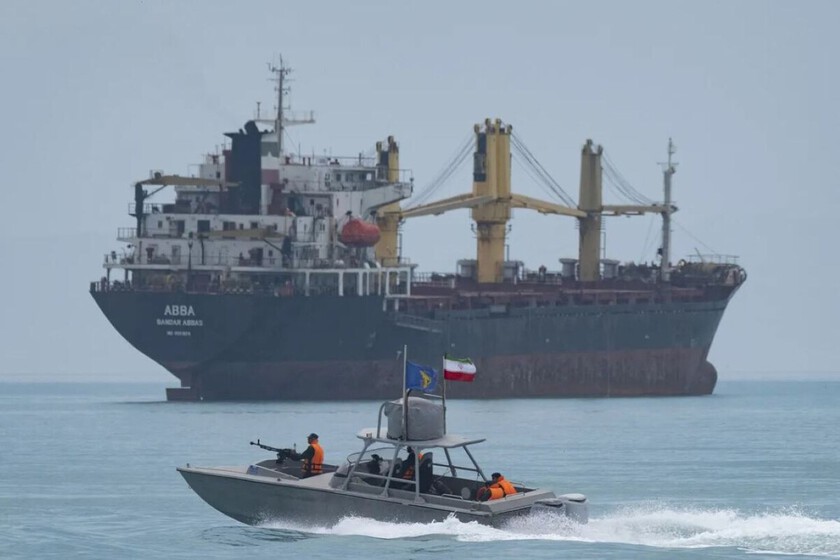
Through the Strait of Hormuz, nearly 20% of the world’s oil passes. Its closure has disrupted one of the planet’s most important energy corridors and has triggered a global countdown with set dates, according to a J.P. Morgan analysis dated March 26.
The report notes that the energy system has entered a “critical phase,” since the last major flow of oil tankers left on February 28, and since then, the market has been living off what was already in transit. It is a silent countdown: oil continues to arrive, but each day there is less. J.P. Morgan illustrates this with a map showing how this supply is being drained region by region as the days go by.
Oil keeps arriving, but each day there is less left and key dates are already on the horizon
J.P. Morgan’s analysis, one of the world’s most influential investment banks and a reference in energy markets. It is not an academic study, but a report closely monitored by governments and major investors that anticipates key trends. The scenario it presents points to a shift: the system has moved from a flow problem to one of stock depletion, where what matters is no longer how much oil exists, but how long it will continue to arrive.
And that window of time is not the same for everyone. In Asia, the first to notice the impact between late March and early April, would be imminent. Shipments from the Gulf take between 10 and 20 days, and in countries like India, where about 90% of imported crude depends on this region, queues at gas stations and occasional fuel shortages have already appeared. The Philippines has declared an energy emergency.
Africa would move into the next phase between April 2 and 5, with demand declines of up to 250,000 barrels per day in low-reserve scenarios and visible effects on daily mobility. As for Europe, the date shown on the map is April 10. From that point, according to the study, Gulf oil arrivals fall off critically. Before that point there is already tension, driven by competition with Asia for alternative shipments.

The United States has a bit more room and is positioned around April 15 as a pressure point, thanks to its domestic production. Australia finishes the calendar around April 20, though there are already signs of fuel stockpiling and problems at gas stations.
Europe and Spain: price first, then real pressure
In Europe and in Spain the impact has already been noticeable for about two weeks; the first symptom is price variation. Brent has risen by nearly 49% in March and has surpassed $100 a barrel. That rise quickly translates to the pump and also to transport, logistics and the overall cost of living (driven by oil products).
In the short term, the problem is not running out of gasoline overnight, but competing for the available supply in a tight market, with Asia absorbing a large share of alternative cargoes. If the situation persists, the scenario scales: J.P. Morgan estimates that the loss of supply could exceed 300,000 barrels per day in April in some regions, rise beyond 2 million in May and approach 3 million in June if strategic reserves do not offset.

At that point, the impact ceases to be purely economic and starts affecting actual availability. In the United States, the effect will focus more on prices and mismatches in refined products in the short term, while Europe, with less domestic production, is more exposed to that second phase. Oil continues to arrive today, but the map makes one uncomfortable thing clear: with each passing day there is less, and the countdown is already running.
Images | J.P. Morgan, Unsplash