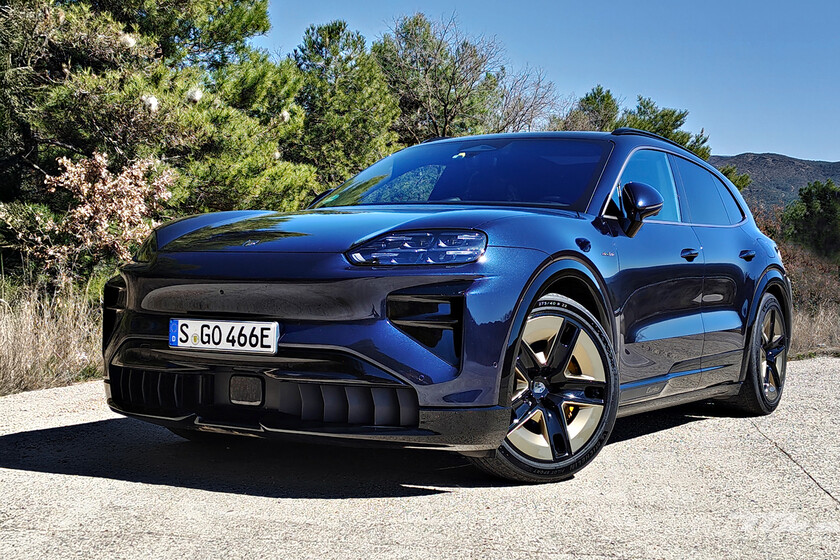
In 2002, some off-road SUVs that looked like Mercedes MLs ventured onto the Basella off-road circuit facilities, just about 70 km south of Andorra. Those MLs were the prototypes of the first Porsche Cayenne. Alongside the 1996 Boxster, the Cayenne saved Porsche. Today, the Stuttgart brand finds itself in a delicate position again (barely turning a profit) and has returned to Basella for the launch of the new electric Porsche Cayenne.
We tested the Porsche Cayenne Electric in both its base version and the Turbo top-of-the-line, one of the most important launches in recent years for the brand.
Reinventing a Winning Formula
The Cayenne is Porsche’s flagship, at least in terms of size. And it saved the company when it launched in 2002. When it first appeared, the Cayenne was almost alone in the market; now even Aston Martin and Ferrari have SUVs. And yet, the Cayenne remains an enormous success within its segment. Since 2002, Porsche has sold more than 1.5 million units; it is a genuine phenomenon.
As a rule, brands apply to the letter the old saying: if it works, don’t touch it. And the Cayenne works very well; literally, of course, and commercially speaking. But Porsche has changed everything. The new Cayenne features PPE electric platform with 800 V architecture, charging power of 390 kW to go from 10% to 80% in 16 minutes, two asynchronous motors with permanent magnets, rear-axle steering, Porsche Active Ride suspension, active aerodynamics and, for the first time in a production car, inductive charging of the traction battery.

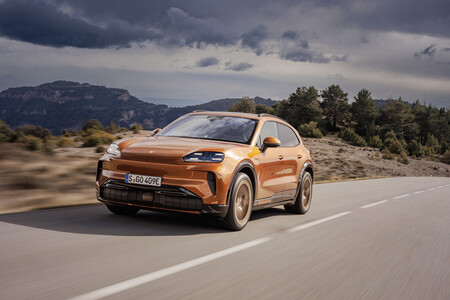
Esthetically, everything also changes. The design is unmistakably Porsche, with kinship to the electric Macan and to a lesser extent the Taycan. Moreover, the car has grown. This electric generation measures almost 5 meters long (4,985 mm) by 2.02 m wide and 1.67 m tall and, above all, a wheelbase of more than three meters (3,023 mm). While it allows for a vast interior space, it also accommodates the 113 kWh lithium-ion battery for 108 kWh usable.
Is the Porsche Cayenne over as we knew it? No. Porsche will maintain and update the gasoline Cayenne in parallel with the electric version.
The Cayenne Electric lineup includes three variants, although on this occasion we only tested the base model, Cayenne, and the top-of-the-line Cayenne Turbo. All are equipped with the same 113 kWh battery feeding two motors.
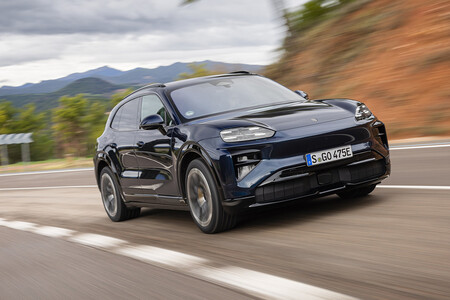
The Cayenne (€108,296) features 442 hp, a 0-100 km/h time of 4.8 s and a WLTP range of 643 km. The Cayenne Turbo (€€169,124) represents the range’s peak with 1,156 hp, 0-100 km/h in 2.5 s, standard Active Ride suspension and a WLTP range of 624 km. Between them, the Cayenne S (€130,654): 666 hp (0-100 km/h in 3.8 s) and 651 km WLTP range.
What is it Like to Drive It?
Let’s start with the base model, the Cayenne Electric, plain and simple. Could one be content with the entry version, or is it unworthy of wearing the Porsche badge? In reality, it’s very good in a relaxed way, without giving up a hint of sportiness, because it doesn’t fall apart if you step on it. And that is exactly what, in the end, many people want from a luxurious and striking SUV like this.
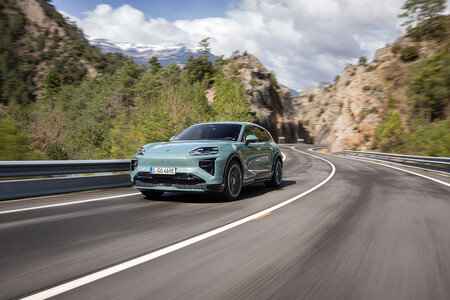
And while the suspension is fairly firm, the car remains very comfortable. There is hardly any body roll and the body movements are very, very controlled. The steering is light, yet precise and direct. In short, it handles like a Porsche, with that unique mix of precision, safety, nobility and, at the same time, daily usability and comfort.
In Sport mode, we hear the gurgling of a V8, quiet at idle and rising with how heavy our right foot is, but never annoying or truly loud. Obviously, and although it’s quite accomplished and convincing, it’s a synthetic sound, but it reminds you that you’re behind the wheel of a Porsche.
The Cayenne Turbo Electric, on the other hand, steps up a notch and moves toward the engineering masterclass realm. With all-electric powertrains, and even more so for a megasized SUV like this (weighing a little over 2.5 tons), you expect weight to be an issue as soon as you tackle the first curves.
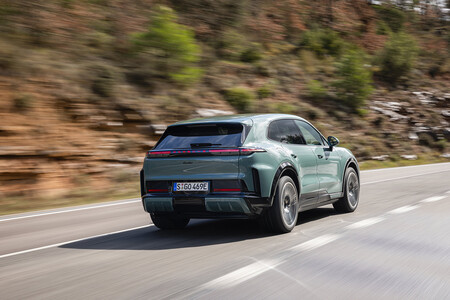
It isn’t the case here thanks to the magic of Porsche Active Ride. In addition to an active and adaptive suspension, this system controls the car’s movements in milliseconds, individually controlling each damper and removing traditional anti-roll bars. It keeps the car perfectly level during hard braking, acceleration and cornering, counteracting physical forces. Simpler: the car stays flat through corners, whatever pace we’re driving. It can even lean into curves, like a motorcycle if necessary.
The front end is direct, precise and the car never dives its nose into tight entry-angle corners or tends to go straight due to inertia. The rear-axle steering erases those effects, and the Cayenne Electric even displays a certain agility. In the end, you forget you’re behind the wheel of an SUV and, with the fake V8 sound, you don’t remember it’s an electric. Even the brake feel, carbon-ceramic in our test car, is practically identical to that of a gasoline model.
And just like the gasoline Cayenne, this electric version isn’t afraid to tackle mud. The optional off-road pack increases ground clearance to 25 cm and improves approach and departure angles to 25° (18.8° without the pack).
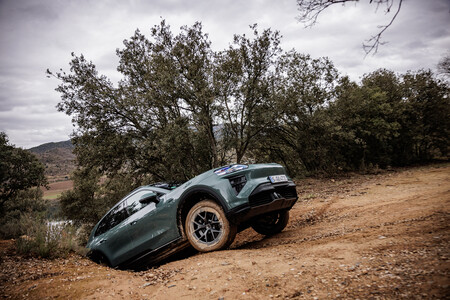
And while off-road practice isn’t the primary reason to buy the car, the Cayenne Electric is more capable off the beaten path than its gasoline brother. The ability to independently distribute torque to each wheel in every situation (on steep slopes or across bridges) is like using a cheat mode in off-road driving.
How about consumption and range?
On this first contact, the consumptions for both the Cayenne and the Cayenne Turbo were quite high, never dipping below 21 kWh/100 km. That’s somewhat predictable, given the level of throttling. The brand lists WLTP ranges averaging from 576 km to 643 km for the Cayenne Electric and between 564 km and 624 km for the Cayenne Turbo. In practice, you should expect around 530 km of real-world range on a full charge.
A Vast, Luxurious Interior with Screens, Lots of Screens
The Cayenne is also, and almost above all, a family car. The interior of the Cayenne follows the “more screens” trend. The instrument cluster and the curved central display, spilling over into the center console, deliver more information and have more controls than we actually need to drive.
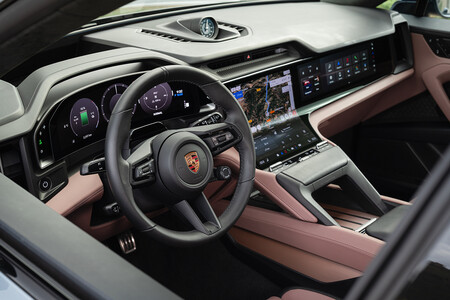
Despite controls being 99% digital (only part of the climate control has physical buttons), they are very easy to use and the system has almost no lag; it’s very fast. Optionally, a third screen for the passenger can be ordered. It’s independent and lets them view the car’s information they want, watch YouTube or play video games, for example.
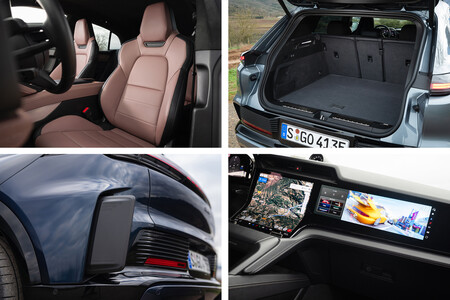
Generally speaking, the materials and perceived onboard quality are excellent, it shows, and there is plenty of storage space. With a wheelbase of over three meters, the rear-seat space is more than generous. A two-meter-tall adult sitting behind a two-meter driver will be very comfortable; the onboard space is simply huge.
Curiously, in such an imposing car, the boot isn’t exceptional. The 781 liters of capacity Porsche quotes are essentially up to the cover. Up to the tonneau, you’re looking at a trunk of under 500 liters. There is also a 90-liter front trunk for charging cables, for instance.
Pricing and Options for the Porsche Cayenne Electric
The electric Cayenne operates in a category of luxury electric SUVs priced above €100,000, with few rivals. While some, like the BMW iX, can surpass €100,000 in certain versions, only the Mercedes EQS SUV sits in the same price range. The onboard luxury of the Cayenne is very different from Mercedes’ approach; it has a more technical, traditional Porsche vibe, whereas Mercedes offers a more bling-bling luxury with a cockpit-like screen.
Moreover, Porsches are highly customizable, and this model is no exception. If you go overboard with options, particularly tech options like the Active Ride suspension or carbon-ceramic brakes, the bill starts to rise quickly. In the case of the Cayenne Turbo Electric, it’s very easy for the car to end up over €220,000, i.e., in the territory of a Bentley Bentayga or a Lamborghini Urus.
Porsche Cayenne Electric: Our Assessment
The Porsche Cayenne has always been a very good car, a benchmark in its segment. And this electric version does not break with that tradition. Now, in its electric form, it is as desirable as the gasoline model. Compared to the latter, it adds an extra touch of exclusivity and a design that makes the current model look 30 years older.
Behind the wheel, it manages to be one of the best SUVs on the market. Equipped with the Active Ride system, it’s even better in that regard than the Lamborghini Urus, the current reference. And that’s saying something for an electric model. To top it off, it’s also very capable off-road.
The interior, with space worthy of a minivan, has managed to stay on the right side of minimalism despite the omnipresence of screens, while perceived quality remains very high. In short, the electric Cayenne is a complete car: practical, powerful and full of technology at the service of passengers.
Find Your Ideal Electric Car
If you’re thinking about buying an electric car, this will interest you. We’ve created the Personalized Electric Car Recommender, where in addition to seeing models that fit your needs you’ll also get answers to questions that may worry you the most, such as price, range, or nearby charging points.