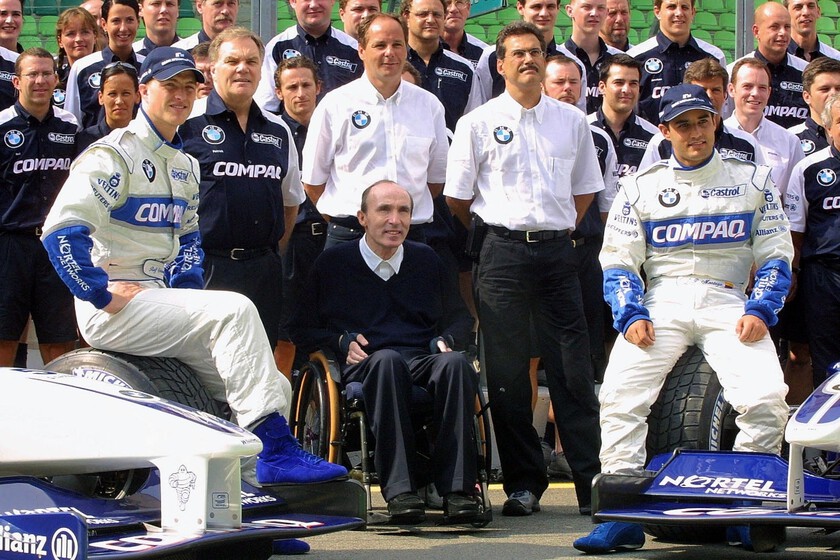
To the younger readers, and even to some who are getting on in years, this fact may surprise you: only Ferrari and McLaren have won more Constructors’ World Championships in Formula One than Williams. Yes, those blue cars that now crawl at the back of the grid were once a machine for winning titles, and all thanks to Frank Williams.
The legendary mechanic who became a garage boss to build one of the greatest teams in the entire history of Formula 1 died five years ago (on November 28, 2021) at the age of 79. His legacy, a team with a unique philosophy where no driver repeated as world champion, basically because Williams did away with them when they won and became divas.
Seven drivers won the world championship with Williams and none repeated

In Williams Racing, things were clear from the outset: the important thing is the car and the team; the driver is merely a burden that sits between the steering wheel and the engine. With that philosophy, and with essential backing from Patrick Head at the technical helm, Frank Williams began as just another garage hand, but ended up being the garage boss.
The success of Williams was instantaneous. They entered Formula 1 definitively in 1978, by 1979 they were world runners-up and in 1980 they won the drivers’ and constructors’ championships. The Australian Alan Jones was Williams’ first world champion, but he wouldn’t stay long: a year later he was out of the team.
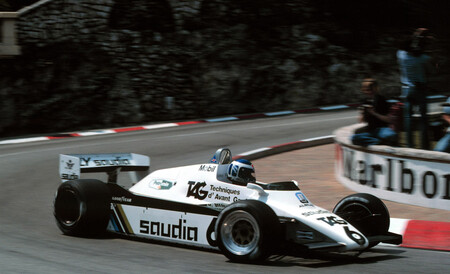
That was Williams: they did not tolerate a driver who believed more than he should simply because he had won a world championship with one of their cars. In 1981, still with Jones in the team, there was an internal dirty war with the Argentine Carlos Reutemann, who was surpassing him. In the end, Williams won the constructors’ championship, but lost the drivers’.
Frank Williams had no qualms about getting rid of both and winning the 1982 world championship with Keke Rosberg at the helm. Williams was riding high, but by that season a small slump had already appeared that lasted only three years, until 1986, when Williams teamed up with Honda and could compete also in the turbo era.
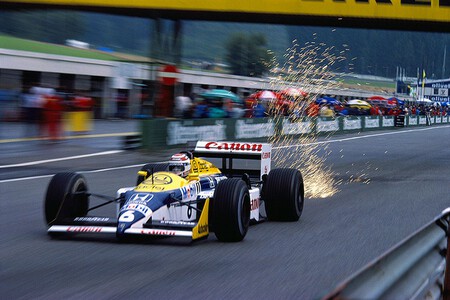
There fell the third Constructors’ title, but the Drivers’ title slipped away due to that tragic blowout of Nigel Mansell in Australia. We would have to wait another season, but in 1987 the third Drivers’ World Championship did arrive, courtesy of Nelson Piquet, and the fourth Constructors’ title as well. And again, to wait, because Honda left for McLaren.
One of the sport’s greatest inspirations with a legacy that will live on forever.
Rest in peace, Sir Frank Williams 💙 pic.twitter.com/IsbAKWz0uW— Atlassian Williams F1 Team (@WilliamsRacing) November 28, 2021
Williams endured with dignity the years of McLaren’s dominance, and even nearly snatched Ayrton Senna’s 1991 title from him with Mansell. That season’s end hinted at what was to come: the era of Williams’ greatest dominance, only interrupted by the tragic death of a legend and the birth of another.
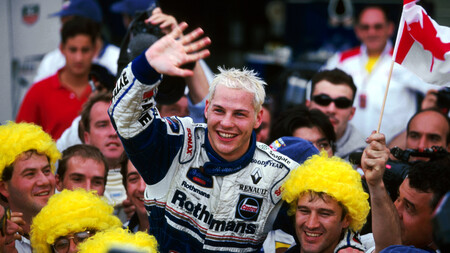
In 1992 Nigel Mansell swept to finally claim his long-awaited world title at 39. Williams’ mechanical superiority was undeniable even for the mighty Senna, and when Mansell chose to move to the IndyCar realm, Alain Prost, then retired, saw his own sky open to secure his fourth world title.
That is how it happened: Prost took the title in 1993 with an almost crushing dominance, perhaps even more so than Mansell’s. But then he retired in the face of what was coming: Williams had recruited Ayrton Senna for the 1994 season.
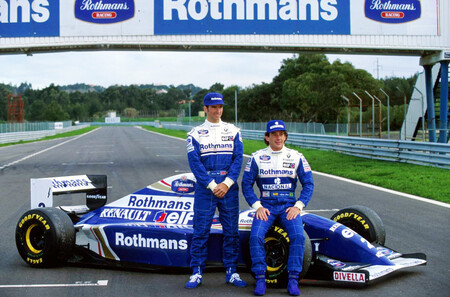
Senna suffered his tragic accident. On May 1, 1994, that date was forever marked as the most memorable in Formula 1 history, and not for the better. Senna died, leaving a giant void in the world championship and, even more so, in Williams. Damon Hill tried to take on Ayrton Senna’s role, but it was too soon to deprive Michael Schumacher of a world title.
Still, they won the Constructors’ title. In 1996, with Schumacher at Ferrari, the picture had cleared enough for Hill to win his world title. But he was promptly fired by Williams, who had no intention of meeting his economic demands.
1997 would be Williams’ last great year. Jacques Villeneuve, a supposed rising star of Formula 1, won the world title in his second season. It seemed the birth of a driver of the era, but two years later he was racing for BAR-Honda. Williams could not tolerate his demands after failing to win a single race in 1998.
And since then, the most absolute and unexpected drought. Williams’ story became a slow decrescendo in which there was only one real path to winning the world title. It happened in 2003 with BMW as a partner, but the rivalry between Juan Pablo Montoya
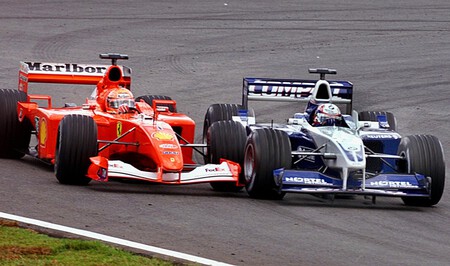
In 2004 the famous walrus nose designed by Antonia Terzi (also deceased in 2021) arrived. That engineering disaster marked the beginning of Williams’ decline. Since then there were only two more triumphs, and save for a miracle, Pastor Maldonado’s Barcelona victory might stand as Williams’ last win.
Williams had already finished the V8 era in a distant position, but with the hybrid era they seemed to rise again, thanks to Mercedes. It was a mirage. The team returned to reality and ended up at the point where the family had to sell the outfit to Dorilton Capital.
In 2025 there was a small revival, finishing the season in fifth place and having Carlos Sainz on the podium twice: in Azerbaijan and Qatar. Now comes a relapse with only 12 points in 20 Grands Prix.
With the death of Frank Williams, a historic chapter of Formula 1 closed for good. Williams continues, but it is no longer our Williams. Now it is Atlassian Williams F1 Team.