In Brief
In Milan, engineer Thomas de Wolf created a miniature car powered by the movements of a goldfish named Blub, using a camera-and-computer-vision system. This setup, in which the fish’s aquarium is part of the vehicle, earned Blub a Guinness World Records title for the greatest distance traveled in one minute by a fish in a motion-sensing vehicle. The project, playful and tech-forward, showcases in a lighthearted way how motion detection can reshape mobility, hinting at future applications for human mobility assistance. The moment was celebrated on the Italian television program Lo Show dei Record, captivating audiences and judges.
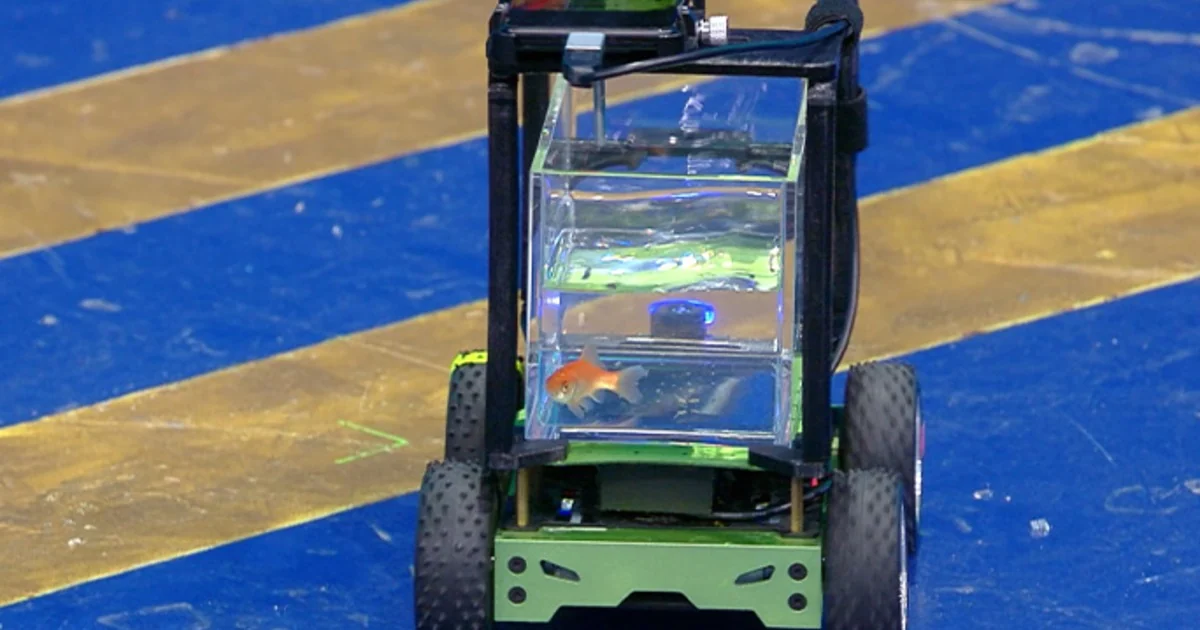
On an Italian television set, a small car starts to roll, aquarium on board, with no human driver at the wheel. The vehicle moves forward, backward, turns right and then left, guided only by the movements of a goldfish calmly swimming in its bowl.
Behind this almost surreal scene are Thomas de Wolf, a Dutch computer engineer, and Blub, an Italian goldfish chosen for its bright color. Together, they secured a Guinness World Records–recognized record for the greatest distance traveled in one minute by a fish in a motion-sensing vehicle. An oddball feat, but also a very tangible showcase of what technology can do when you decide to let a simple fish take the wheel…
A World Record for a Goldfish Really at the Wheel
The record attempt took place in Milan, on the set of the show Lo Show dei Record, in front of a live audience and cameras. The objective was clear: Blub would cover at least five meters in sixty seconds in its integrated car, with the aquarium and the rolling chassis acting as one. In the end, the duo far surpassed that target, traveling a distance of 12.28 m in one minute.
To verify the figure, the official referee, Sofia Greenacre, counted how many times a colored mark on each wheel touched the ground, in order to measure the distance to the centimeter. At the end of the attempt, host Gerry Scotti exclaimed, admiringly: “I don’t know if this will be a world record, but we have clearly seen something very cute and very futuristic.” A way to sum up the moment when a simple goldfish briefly found itself, for one minute, in the driver’s seat.
How the Tiny Car Really Lets the Goldfish Drive
The car designed by Thomas de Wolf is built around an aquarium mounted on a motorized chassis, steered by a camera and computer-vision software. Each time Blub moves toward a side of the tank, the camera detects its position and the car moves in that direction—forward, backward, left, or right. The system works only with a highly lively goldfish, so the camera can clearly distinguish its silhouette underwater. “Usually, my work is fairly monotonous, so I wanted to create something that would entertain people, turning my serious work into something fun,” Thomas de Wolf explained. For him, “the goal is to show people what can be achieved with this kind of technology, even when it isn’t strictly ‘serious’.”
The idea sits in the tradition of Fish Operated Vehicle platforms, where an aquarium sits atop a wheeled chassis connected to a camera, sometimes to a LIDAR sensor and an onboard computer. Researchers at Ben-Gurion University of the Negev have, for example, trained six goldfish to steer such a vehicle toward a colored target, at speeds of under 1.5 km/h, by learning to correct their trajectory from session to session. In these experiments, as in Blub’s car, you literally witness a scene in which a goldfish drives a car thanks to sensors translating its movements into wheel commands. Host Gerry Scotti noted that such technology could someday help people with physical disabilities, and Thomas de Wolf echoed the sentiment: “I’d love maybe to one day help people with mobility problems,” he added. After the certificate was issued, Thomas de Wolf smiled, aloud: “How am I going to explain to Blub that it now holds a world record?” as the organization approving such feats announced: “Congratulations, you’re both officially amazing!”
Comparison Table
| Distance covered in 1 minute | Goal set | Speed of similar experiments |
|---|---|---|
| 12.28 meters | 5 meters | Less than 1.5 km/h |
Key Takeaways
- A goldfish named Blub steered a mini car from its aquarium using computer-vision technology.
- The engineer Thomas de Wolf designed this system, blending an aquarium, a camera, and a motorized chassis.
- The duo beat the Guinness World Record for the distance traveled in one minute by a fish in a motion-sensing vehicle, totaling 12.28 meters.
- The experiment aired live on a Milan TV set under official supervision.
- This playful yet innovative project also aims to illustrate the mobility and assistance potential of the underlying technology.
FAQ
How does the goldfish drive the car?
The fish swims in an aquarium mounted on a car; its movements are tracked by a camera, which then steers the vehicle in the corresponding direction.
What record did Blub break?
Blub covered 12.28 meters in one minute, earning the Guinness World Records title for the farthest distance driven by a fish in a motion-sensing vehicle.
What technology does the little car use?
The car combines a motorized chassis, a camera, a computer-vision system, and an aquarium to detect and track the fish’s movements.
Does this concept have scientific value?
Yes. It builds on research into “Fish Operated Vehicles,” illustrating how animals can interact with technology, with potential mobility-aid applications.
Where and when was this record set?
The record was validated in Milan, on the Italian program “Lo Show dei Record.”