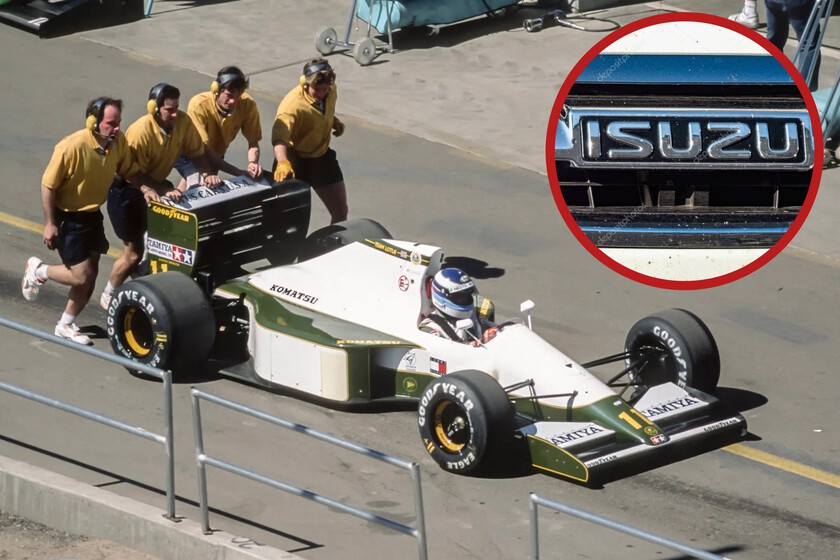
Of all the brands that have ever graced Formula 1, Isuzu may be one of the ones that has the least in common with the big circus. The Japanese are specialized in diesel engines and industrial vehicles, but few know that they once built a Formula 1 engine. It happened purely out of curiosity, not with the aim of competing, but it turned out so well that someone wanted their engines.
A Lotus with an Isuzu engine reached the Silverstone circuit, and the data indicate that the Japanese had built an engine as good as the Honda that dominated Formula 1 at the time. Peter Collins pressed to keep them, but Isuzu wasn’t interested in Formula 1 and stored away in a garage one of the best engines of the moment.
“Es la primera vez en mi vida que veo un motor de F1 que es bueno desde el principio”
This story sprang from a simple scientific curiosity. Isuzu wanted to know what they could achieve beyond diesel engines. In secret, quietly, they developed a 3.5-liter naturally aspirated V12 gasoline engine compatible with Formula 1 regulations. “Isuzu only wanted to test the design and engineering of their gasoline engines,” says one engineer involved in the project.
But then someone asked a logical question: Where would this car stand relative to the rest of the Formula 1 manufacturers? By late 1990 the engine was finished and put on the test bench. The result was astonishing: 637 HP at 12,000 rpm. After some adjustments, Isuzu managed to reach 755 HP at 13,500 rpm.
To put this into perspective, it was estimated that Honda, the brand that was dominating Formula 1 alongside McLaren, had an engine that reached a maximum of 760 HP. In other words, on paper, Isuzu had unintentionally created an engine almost as good as the best in Formula 1. How could anyone resist testing it on the track?

And so July 31, 1991 arrived. Since Isuzu had a commercial agreement with Lotus, which competed in Formula 1, it wasn’t difficult to find the team with which to carry out that test. In addition, Lotus had mounted a Lamborghini V12 engine, so the old chassis didn’t even require too many adjustments to fit the Isuzu. It was called Lotus 102C.
The incredible thing is what happened on the track. The Lotus stayed six seconds behind Ayrton Senna’s best times with the McLarens. It may seem outrageous, but it isn’t. In Silverstone’s qualifying, with the Lotus running the Judd V8 engine that it used in 1991, and with Mika Häkkinen at the wheel, they had fallen five seconds behind pole. Six seconds on the first day Isuzu was on track was a success.
Ver esta publicación en Instagram
Peter Collins, the Lotus director at the time, verbalized it: “This is the first time in my life that I see a racing engine that starts well from the first try. The time was good, we could complete the number of laps without any problem. Not only the engine, but the other Japanese accessories worked wonderfully. I think it could be possible to form a team to go to Formula 1″.
The glove had been thrown. The Isuzu engine was powerful and reliable. During the rest of the test days at Silverstone, impressions grew ever more favorable. But the Japanese mindset is sometimes hard to bend, and Isuzu’s reply was blunt: “We have no intention of spending more money on developing the engine or a racing team. We only did the Silverstone test because we had the budget allocated to the test bench”.
Isuzu took its engine, brought it back to Japan and locked it away in a garage. There ends the story of what could have been the best Formula 1 engine of the ’90s. We will never know.
Images | Lotus, Isuzu