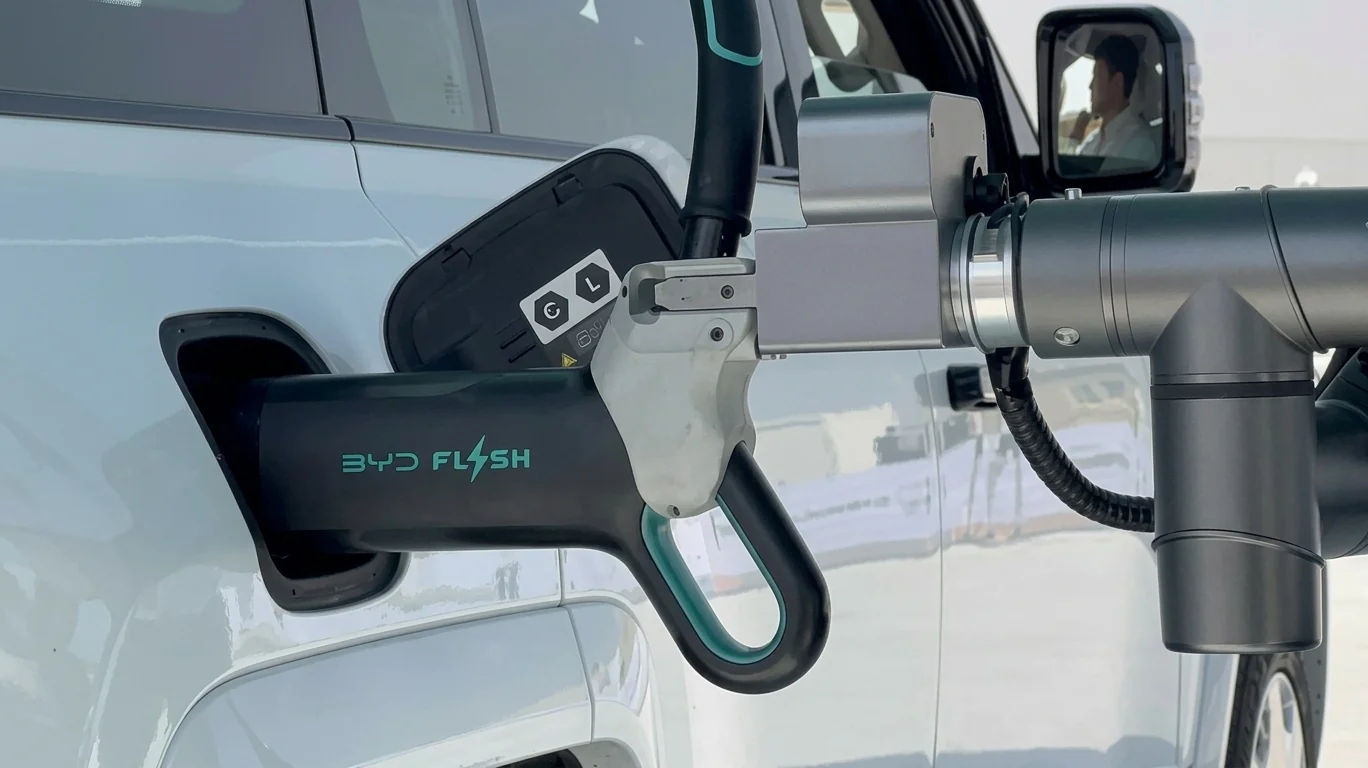
BYD has just unveiled, during a major press presentation in the United Arab Emirates—alongside its ultra-luxury new sedan, the Yangwang Altior—a robotic arm capable of recharging an electric vehicle with no driver intervention.
A completely reinvented on-station charging experience
This new, one-of-a-kind device, named Flash, autonomously detects the charging port on the vehicle’s body via a visual-recognition system, opens the hatch, seizes the connector and inserts it, then withdraws and closes the port once the operation is complete. Such technology has already been widely deployed in China for internal-combustion cars requiring a full fuel fill, but not yet for electric vehicles. A force-feedback control, drawn from industrial robotics, lets the arm modulate the pressure applied and eliminates the need for any manual alignment. The demonstration also showcased an automatic parking function: a single press of a button is all that’s needed for the car to maneuver to the charging berth and connect to the arm. Additionally, the charger can accommodate multiple connector standards, a valuable capability given that formats vary by market (Type 2 in Europe, NACS in the United States, CHAdeMO in Japan…). During the test, the output power reached 1,000 kW! BYD claims this could allow drivers to recover hundreds of miles of range in just a few minutes. It’s worth noting that this figure was measured on-site and does not guarantee availability in France or elsewhere.
The first Flash stations expected in Europe by year’s end
The station on display isn’t merely a charging outlet: it’s a full installation that combines solar panels, storage cabinets, and a charging port, with stored energy serving to absorb peak power without putting excessive strain on the local electrical grid. On the commercial front, BYD aims to deploy 20,000 Flash stations in China by the end of 2026, including the tenthousand already in service in Shenzhen, to cover 325 cities. In Europe, the manufacturer plans 100 chargers by year-end and 3,000 stations by March 2027, starting its rollout in Germany. A note of caution: these deployments concern the Flash stations themselves and not merely the robotic arm, but rather the high-power Flash superchargers capable of delivering up to 1,000 kW. Yet for such speeds, electric vehicles must be compatible. The 1,000 kW chargers are already in production in China, but without the automated arm system for now. The robot in question has, to date, only been shown in the United Arab Emirates. No commercialization timetable has been announced for China—or even Europe. But given BYD’s market clout, one suspects progress may come sooner rather than later.