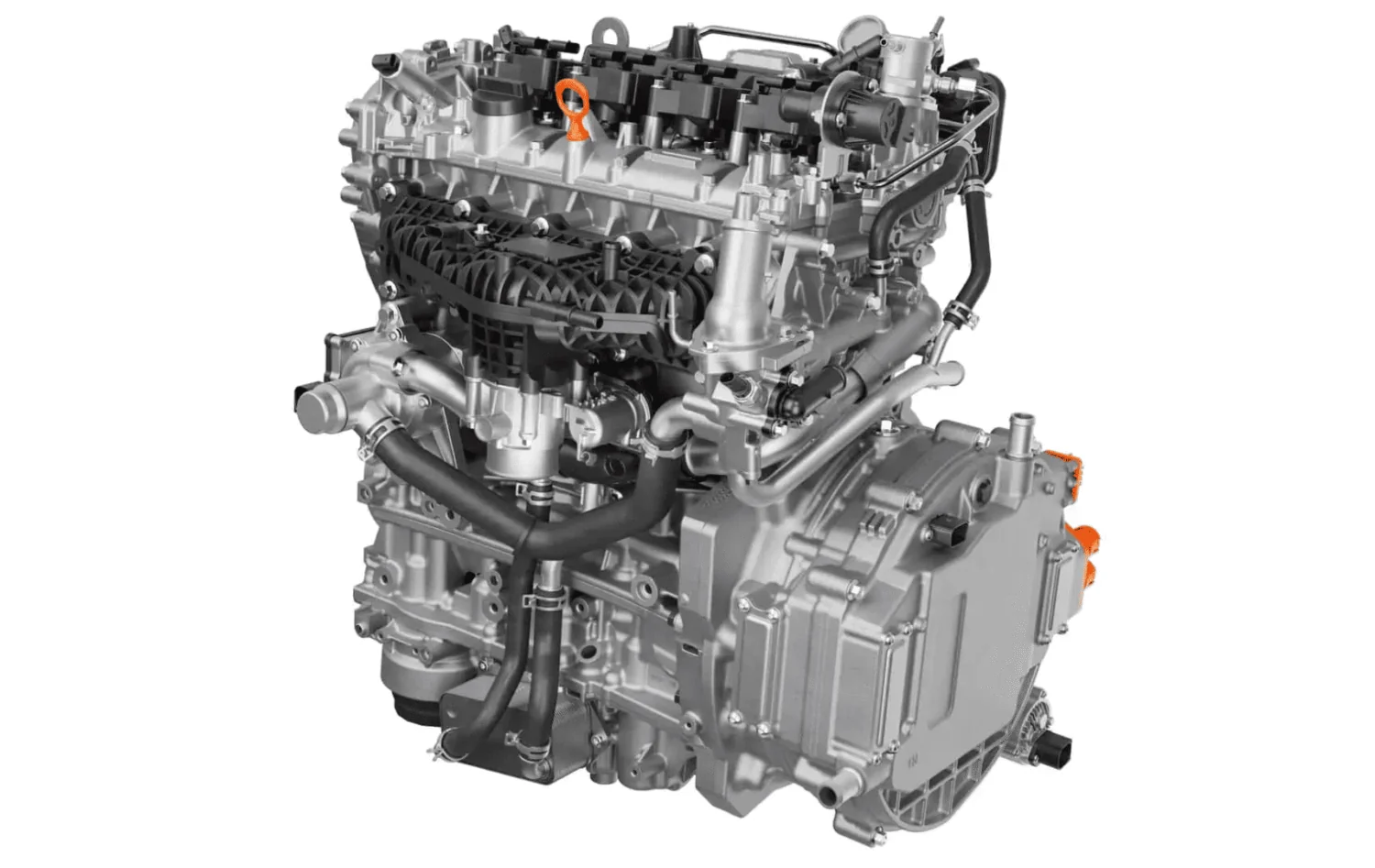
Turning a gasoline engine underwater seems almost unimaginable. Yet Horse Powertrain has developed a 2.0-liter four-cylinder gasoline engine specifically engineered to handle water fords. Named B20, it promises intriguing capabilities for future hybrid SUVs and pickup trucks.
Horse B20: A Gas Engine That Can Run Underwater
Water is usually one of the worst enemies of an internal combustion engine. If water infiltrates the cylinders, mechanical damage can be catastrophic. This is precisely the problem Horse Powertrain intends to solve with its new B20, a powerplant designed for off-road vehicles capable of facing exceptionally harsh conditions.
This 2.0-liter turbocharged four-cylinder engine has an astonishing feature: it can keep running when submerged up to 1.10 meters deep. To achieve this, engineers developed a sealed architecture meeting the IPX8 standard. Electrical components, sensors and connectors have also been adapted.
But the engine doesn’t stop at water protection. Its electronic control system can recognize immersion scenarios and adjust its operation. Depending on the conditions, it can limit power or alter throttle response to preserve the drivetrain. A particularly interesting approach for future off-road capable vehicles.
Up to 252 horsepower for future hybrid SUVs and pickups
The Horse B20 isn’t just a water-resistant engine. It also offers compelling specs for relatively heavy vehicles. Depending on configuration, it develops between 190 and 252 horsepower, with torque ranging from 300 to 380 Nm. Its weight is listed at only 130 kg.
This mill uses the Miller cycle, direct injection and several systems aimed at boosting efficiency. Horse notes a peak thermal efficiency of 48.4%. The engine was designed for different electrified architectures: conventional hybrids, plug-in hybrids and range-extended electric vehicles.
Its capabilities aren’t limited to ford crossings. The manufacturer also claims it can maintain stable power under heavy load, especially on grades reaching 100%, i.e., about a 45-degree incline.
Note, however, that this immersion resistance applies to the engine and does not guarantee that a vehicle can traverse any stretch of water. The maximum depth will also depend on the mechanical installation and other components. Still, this innovation could facilitate the development of future off-road hybrids.