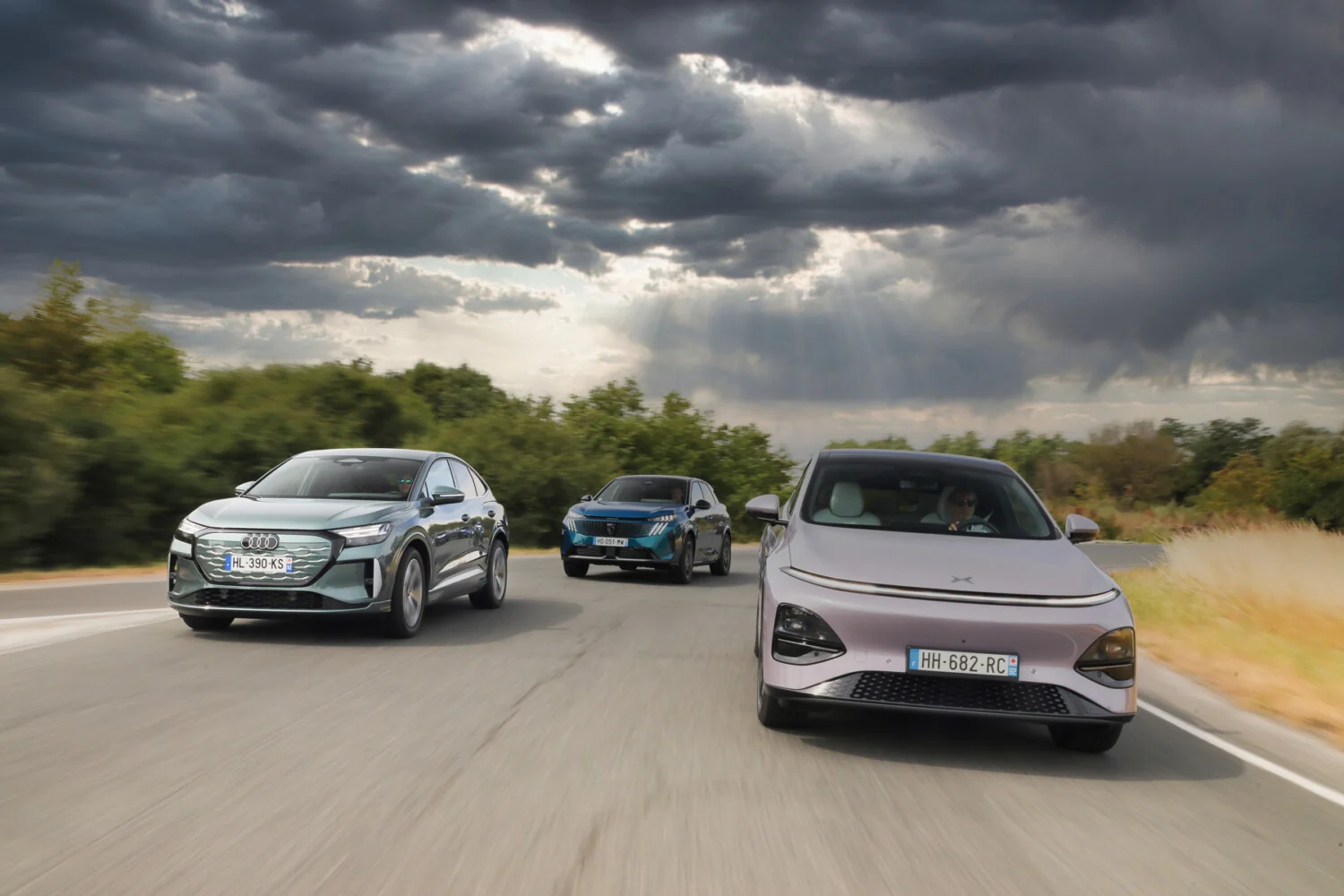
First launched in 2021, the Audi Q4 is a cousin to the Volkswagen ID.3 (and ID.4 and ID.5), sharing the same platform but positioned a notch higher in the lineup, as Audi tends to do. It received a facelift at the end of 2025, but let’s address one thing up front: no, that refresh doesn’t move it to an 800-volt architecture, it stays at 400 V, which means it can’t access the fastest charging speeds. Its updates are thus “limited” to new bumpers, gains in range and efficiency, and a dashboard layout that echoes Audi’s newer “Q” models (the Q3 and Q6) with a large curved digital display. The Q4 is also considerably cheaper than at launch (proof that not everything goes up!) and is listed at €46,990 with its 286 hp motor, including in the Sportback version (typically pricier), just below the threshold that would exclude or grant the EU subsidy. A boost for electric passenger cars manufactured in Europe, which is the case with this Q4. We’ll revisit this in more detail in the “Budget” section. To counter it, we chose the Peugeot 3008 Electric (the E-3008) in its long-range battery version (the one made in France) with a WLTP range of 701 km, reduced to 545 km according to our measurements, still an excellent score. The other challenger is Chinese, and its strong point is simply its charging speed—the best on the market today: 10 to 80% in just 12 minutes, if you can find the right charger; we’ll come back to that as well… Let’s go!
Audi Q4 vs Peugeot E-3008 vs Xpeng G6: life on board?
It’s inside that the revised Q4 has progressed the most, adopting a large curved display like Audi’s latest models. Gone are the two separate screens and the row of physical climate-control buttons beneath the central display; climate functions remain visible but now live within the screen. The area in front of the driver, serving as the instrument cluster, appears, like in the Q3, somewhat underutilized with broad black bands at the top and bottom, giving the impression that only a small portion of the screen is actually used.
Resolution has improved, as has the touch responsiveness, and the organization is easier to grasp. A few shortcuts are offered and the constant top-right icon to deactivate the speed-limiter alert is appreciated.
The interior quality is quite respectable, but beware: our test car was the S Line trim loaded with options. A less well-equipped version may feel less refined. In the Peugeot 3008, you’ll find a grand curved screen as well but it’s narrower, which immediately conveys a more cramped sensation, confirmed by the cockpit feel at the driver’s station.
Under the central screen you still find the “toggle switches,” customizable (or so it seems) elegance touches that feel pleasant, but the screen animations, response times, and graphics look dated. If you’re running Android Auto, you lose direct climate control access—disappointing. On the plus side, the steering-wheel paddles for adjusting regenerative braking come in handy, offering four levels of regen (Audi also provides four with paddles).
Crossing from Europe to Chinese territory, you’ll notice you’ll spend much more time hunting for exterior mirror adjustments in a menu and via steering-wheel controls; not intuitive, unless you’re a Tesla veteran. There’s also no glove box—despite a misleading crease along the lower dashboard that makes you think there is one. Everything, or almost everything, goes through the central screen (not always very responsive, by the way), including regen level adjustments and even the action of opening the charging port. Getting the car started in Level 2 semi-autonomous mode is done with the shift lever: again, something a Tesla owner would find normal, but others…
Nevertheless, if the G6’s ergonomic quirks initially unsettle you, a week aboard will help you adapt to just about everything. Or almost: the radio reception was notably weak, whether in a tunnel or out in the countryside, where others keep a signal. And what about the Android Auto dropouts at toll barriers?
Still, the G6 manages to deliver: it offers the best overall presentation and the most space in the rear seat, along with a much richer standard equipment package that contributes to onboard comfort. The Audi is the least generously equipped as standard but is only marginally less roomy than the Xpeng.
By contrast, the Peugeot 3008 feels cramped for rear legroom compared with its rivals, as if it belonged to a lower segment. And those 20 dm3 more of trunk space don’t close the gap for passengers. So the French contender finishes last in this “Life on board” section, behind the German, with the Chinese taking the lead despite some ergonomic issues.
Audi Q4 vs Peugeot E-3008 vs Xpeng G6: on the road?
Let’s start this chapter by noting that each of these SUVs weighs over 4,700 pounds (2.1 tonnes): don’t expect ballet-like performance. Yet two of them stand out—one for the right reasons, the other for the less favorable ones. The 3008 is the heaviest and it definitely shows at the wheel, delivering more inertia and more body movement. When you poke it, it doesn’t feel at ease, though it remains safe in all conditions. The upside is that it’s the most comfortable at smoothing out road imperfections, at both low and high speeds. It also accelerates the slowest, due to its weight plus its lower power and torque.
None of the three delivers the typical EV kick in the pants, but the French one does even less so. The standout in the right direction is the Q4, as is typical for most vehicles on the MEB platform (ID.3). Switching from the 3008 to the Audi gives a pleasant sense of liveliness (relatively speaking), quicker throttle response and smoother transitions, all while maintaining a solid level of comfort.
Best of all, it’s the most capable, thanks to its stout 560 Nm torque: it “flings” from a standstill to the kilometer mark in nearly 3 seconds faster than the 3008. It naturally claims first place in this section with ease. In second place comes the G6, positioned between the two on every front: less dynamic in chassis feel than the Q4 but more than the 3008, accelerates slower than the first (except in revs) but better than the second, and sits in the middle for comfort with firmer low-speed suspensions but better sound insulation.
It’s the most enjoyable on the highway, despite less capable driver-assist features: Level 2 semi-autonomous driving can be easily disrupted, not always resuming control after a lane change, for example. It finishes second in this chapter, ahead of a 3008 that’s less fun to drive and less capable overall.
Audi Q4 vs Peugeot E-3008 vs Xpeng G6: budget?
This section has a clear winner: the Xpeng G6. It costs noticeably less than its rivals (€22,015 cheaper than the Q4 with options!), while offering more equipment, the same range, and dramatically faster charging: from 10 to 80% in just 12 minutes, among the fastest available today, provided you can locate a charger that can fully exploit the car’s potential (up to 451 kW).
In fact, there aren’t any in France right now, but Ionity and Electrify America are already pushing up to 400 kW, for example. Even on a 200 kW charger, the G6 charges faster than the others and remains within the charger’s limits up to 80%: remarkable! About charging times: on a Paris-Nice trip, starting from 40% battery, the trip planner predicted four stops totaling 55 minutes (13 + 17 + 12 + 13 minutes), while the 3008 indicated only three stops totaling 1 hour 33 minutes.
The French car stretches out its stops thanks to a superior measured range of 545 km, about 60 km more than its rivals. On the flip side, it’s the slowest to recharge and also consumes the most. But if the 3008 is pricier than the Chinese, it still remains reasonably priced when compared with the Q4, which still costs more by over €10k before options.
And there’s more: Audi employs a tactic of offering the S Line trim as an option (€15,000!), leaving the base model at €46,990, just under the ceiling that unlocks the enhanced EU subsidy. Audi isn’t alone in using this trick: Peugeot has done it before, but not this time with its 3008 (strangely…), while DS has just revived the idea on its new Number 7.
We chose to include the “S Line option” in the base price, noting that our test car adds another €11,350 in “real” options. A note about charging speed: the Q4 stalls at 29 minutes to go from 10 to 80%, and it didn’t benefit from the facelift to approach the best on the market—too bad for the premium positioning! To crown it all, the German is the only one offering a minimum two-year warranty, with the other two at seven or eight years. In short, it finishes last in this “Budget” section, by a comfortable margin.
Audi Q4 Sportback e-tron Performance 286 hp / 82 kWh S Line: what it brings?
- Comfort and handling
- Interior space
- A pleasant interface
Audi Q4 Sportback e-tron Performance 286 hp / 82 kWh S Line: what it lacks?
- Price
- Standard equipment
- Charging speed
Peugeot E-3008 231 hp / 104 kWh GT: what it brings?
- Autonomy
- Comfort
- Made in France
Peugeot E-3008 231 hp / 104 kWh GT: what it lacks?
- Rear legroom
- Outdated multimedia
- Charging speed
Xpeng G6 RWD Long Range 295 hp / 80.8 kWh: what it brings?
- Charging speed
- Interior space
- Sound insulation
Xpeng G6 RWD Long Range 295 hp / 80.8 kWh: what it lacks?
- Questionable ergonomics
- Low-speed comfort
- Screen responsiveness
Audi Q4 vs Peugeot E-3008 vs Xpeng G6: verdicts?
On the road
- 1st: Audi Q4 Sportback
- 2nd: Xpeng G6
- 3rd: Peugeot E-3008
Life on board
- 1st: Xpeng G6
- 2nd: Audi Q4 Sportback
- 3rd: Peugeot E-3008
Budget
- 1st: Xpeng G6
- 2nd: Peugeot E-3008
- 3rd: Audi Q4 Sportback
The Auto Journal’s pick: Xpeng G6 RWD Long Range 295 hp / 80.8 kWh
So it’s the Chinese winner, and not just because of its significantly lower price: it’s also unbeatable on charging speed, highly livable, well-presented, and the most generously equipped. The Q4 hasn’t progressed enough to match it and remains far too pricey. As for the 3008, it has superb range and is made in France, but that isn’t enough!
Find our comparison between the Audi Q4, Peugeot E-3008, and Xpeng G6 in Auto Journal issue no. 1218, dated October 1, 2026.