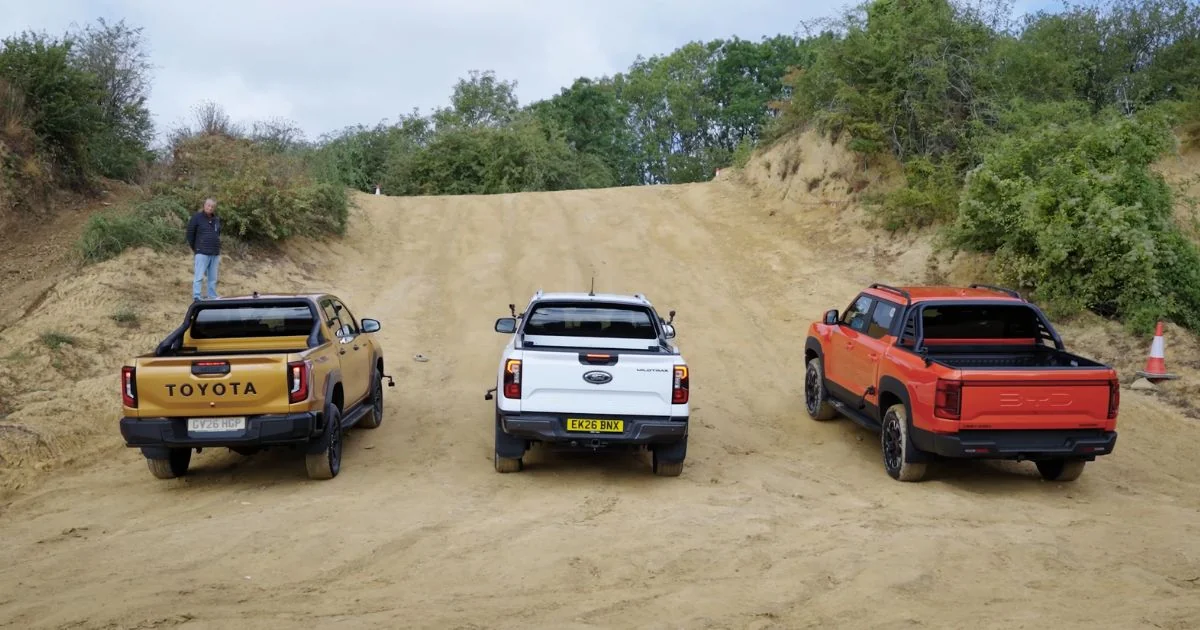
On paper, the poster reads like a generational clash in the making. A brand-new Chinese plug-in hybrid pickup going head-to-head with two off-road legends. To settle the showdown, the carwow YouTube channel laid out a tough, private-course comparison. Six off-road challenges, either timed or scored, were designed to push these pickups to their limits. And at the end, only one winner would emerge, thanks to a straightforward scoring system.
The lineup features a Toyota Hilux 2.8-liter diesel delivering 204 hp (about 150 kW) and a Ford Ranger plug-in hybrid making 281 hp. On the other side of the course, the all-new BYD Shark pairs a 1.5-liter turbo petrol engine with two electric motors to produce 436 hp. On paper, the Chinese pickup looks like the favorite for this duel. Yet off-road, power alone isn’t always enough. And this BYD Shark vs Toyota Hilux vs Ford Ranger showdown will prove that, test after test.
BYD Shark vs Toyota Hilux vs Ford Ranger: a heated carwow comparison
The video went live on October 29, 2026, on the carwow channel, with Mat Watson behind the wheel. In less than 24 hours, it had racked up roughly 707,000 views—a telling number for enthusiasts of trail-busting machinery. The concept is simple, almost schoolhouse in its clarity, but devastatingly meaningful for off-road fans. In each test, the winner earns three points, second place gets two, and the last-placed vehicle earns a single point. A disqualification costs a round, and certain missteps can even shave a point off the final tally.
Technically, the Hilux sticks with the classic workhorse pickup formula. Under the hood, the 2.8-liter diesel four delivers about 500 Nm of torque. It relies on a transfer case with low-range gears and a locking rear differential. The Ford Ranger PHEV leans on a 2.3-liter turbo petrol paired with an electric motor, for a combined 281 hp. Its torque peaks around 697 Nm, and it also features a short-gear setup and a locked rear differential. The BYD Shark posts the most eye-catching specs, with 436 hp and roughly 650 Nm of torque. It combines a 1.5-liter turbo petrol with two electric motors and carries a 32.2 kWh battery. This setup gives it roughly 55 miles (about 88 kilometers) of electric-only range, but it also weighs in at around 5,970 pounds (2,710 kg). It must, however, do without a low-range transfer case—the drive is controlled electronically. It distinguishes itself with independent rear suspension and a ground clearance of about 9.1 inches (230 mm). Its wading depth is rated at 27.5 inches (700 mm), a figure that should reassure water‑for‑dinghy enthusiasts alike.
Six off-road tests to settle BYD Shark, Hilux and Ranger
The first showdown takes the form of a hill-climb sprint, with all three pickups lined up for a forward surge. On the course, the gaps look tight, but the Toyota Hilux takes the win, followed by the Ranger, and then the Shark. The tally after this round stands at three points for the Hilux, two for the Ford Ranger, and a single point for the BYD Shark. Some observers noted the Hilux’s climb was restarted, a minor procedural hiccup that sparked a brief debate but didn’t really shake the overall progression of the duel.
“For the second test, we’re going to test maneuverability, ground clearance, and agility,” explains the carwow host. “We’ll thread this wooded zone, take a tight turn near a tree, and descend a slope,” he continues. “Then we’ll skirt a bump, crest a dip, and pass back under the gateway. The official will time us, but he’ll also watch closely,” he warns. “If any car is damaged in any way (…), it will be disqualified.” On this twisty course, the Hilux posts a time of 23.24 seconds, unchallenged, and grabs another three points. The Ford Ranger is disqualified this time, while the BYD Shark avoids penalties and leaves with two points. After two rounds, the Chinese newcomer has barely kept the score respectable, and the trio remains bunched together.
The third challenge then imposes a climb up a set of steps, followed by a descent down another staircase. The goal here is not speed; it’s the finesse of driving and the ability to maintain traction. The BYD Shark handles this very well and pockets two points, while the Hilux manages one. The Ranger, by contrast, loses a point from its provisional total. Next up is a straight-ahead dirt run, where the Shark lets its horsepower do the talking, outpacing the Ranger while the Hilux brings up the rear. At this stage, the Shark and Hilux sit on eight points each, with the Ranger at six.
The fifth test involves descending a slope as slowly as possible, yet crossing the finish line ahead of the others. The Hilux emerges as the fastest down the hill, with the Shark close behind. The Ranger completes the descent in reverse gear, awarding itself a bonus for the clever approach. The final ascent is a rocky, slippery climb where maintaining traction is key. The Ford Ranger conquers this last obstacle, with the Hilux taking second and the Shark struggling to find enough grip and finishing last. In the final tally, the Ford Ranger claims 13 points and the duel goes to the Ranger. The Toyota Hilux and the BYD Shark finish tied on 11 points each. One more favorable outcome elsewhere on the course could have flipped the top spot, showing how close this trio really was.