In Brief
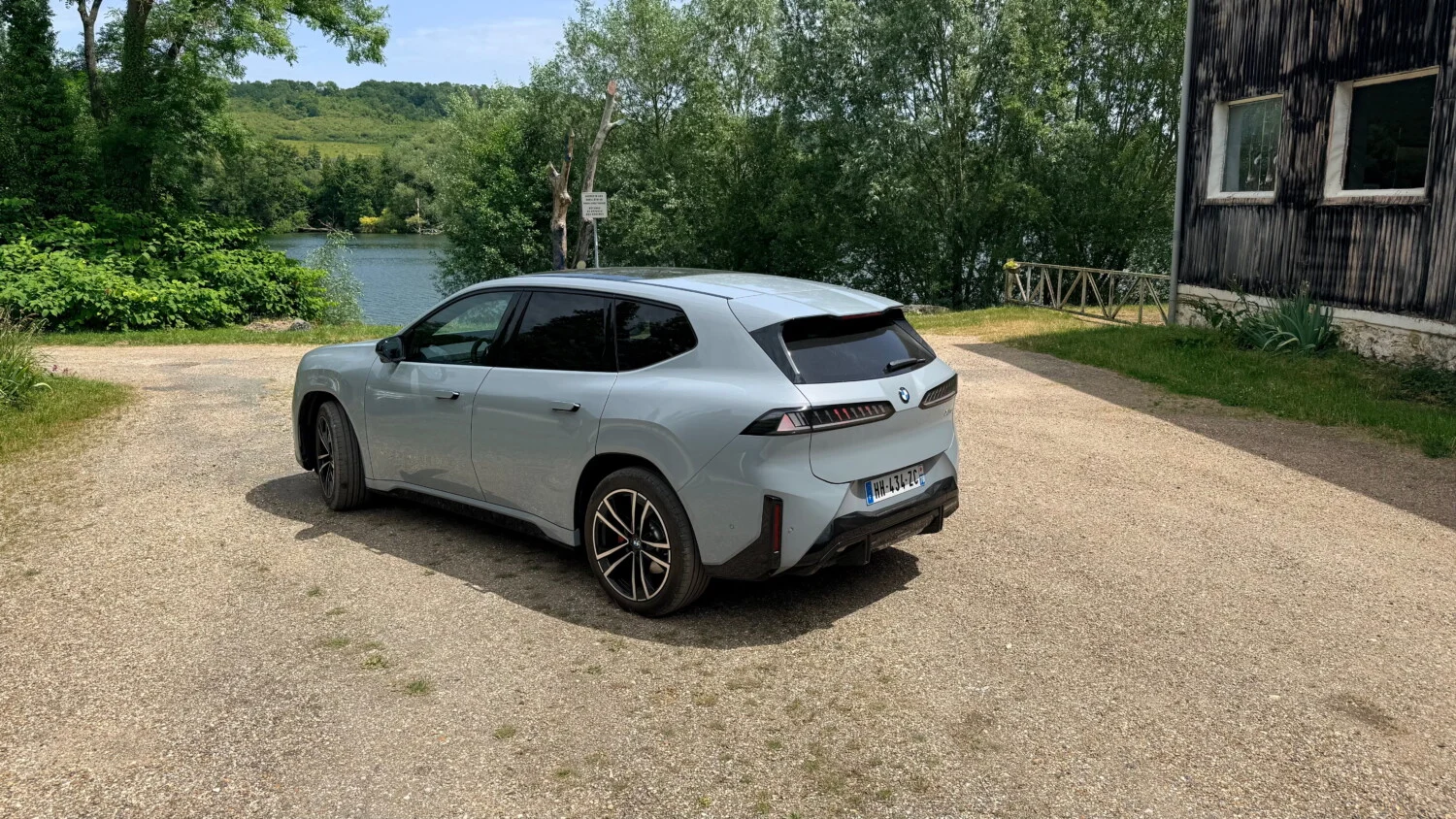
The BMW iX3 50 xDrive inaugurates the new Neue Klasse platform, delivering standout real-world range and efficiency. Used as a family SUV for a week, it established a relaxed charging routine thanks to its highway manners and its autonomy, which makes the usual EV constraints fade away. Its driving dynamics, comfort, and the craftsmanship put into its build make it a true BMW, while pushing the boundaries of premium electric vehicles. Finally, the price starts at about $95,000 for the model we tested.
With the Neue Klasse platform, BMW leaves no doubt about its ambitions. Reclaim leadership in the premium electric segment. New styling, 800-volt architecture, ultrafast charging, and a record-breaking range on paper—check all the boxes for the iX3 50 xDrive. But the real revolution may not be what you expect. For a week, we used it like any family SUV, weaving daily commutes, business trips, and long highway stints. So, what’s the verdict after 1,000 kilometers?
Day 1: Old Habits Die Hard
Range anxiety has become an obsession. Before every departure, even for EVs, drivers glance at the gauge, mentally tally the distance, and anticipate a potential recharge. An automatic reflex we eventually internalize. Even when driving the market’s most capable models.
Getting behind the wheel of the new BMW iX3, we instinctively repeated that ritual. A full battery, a GPS-recorded route, range generously displayed in the BMW Panoramic Vision. Everything seemed set for a calm start. Yet, it wasn’t the promised number that struck us. Although 747 kilometers (roughly 463 miles) can be impressive, that’s not what mattered in the days to come.
Because very quickly, the range became… a non-issue. This new generation of iX3 no longer rests on a platform merely adapted for electric propulsion, but debuts the eagerly awaited Neue Klasse architecture.
A foundation conceived entirely around electric propulsion, marking a break comparable to what the original 3 Series represented for BMW in its era.
New electronics, new motors, a next-generation battery, 800-volt architecture. In short, BMW’s engineers started from a clean slate with a clear objective. To improve efficiency above all. And that shows from the very first kilometers.
Range that Shifts Habits, Even at BMW
On paper, BMW quotes up to 800 km of range (WLTP, depending on version). A flattering figure, as always defined by the WLTP cycle. In reality, it’s the iX3’s exceptional efficiency that makes the biggest impression.
In urban use, consumption drops to below 15 kWh/100 km. On the highway, it hovers around 17 kWh/100 km. And it barely breaks above 22 kWh/100 km, only on motorways. A demanding exercise for a midsize SUV like the iX3.
Measured against a usable battery of roughly 109 kWh, these numbers imply nearly 630 km (about 392 miles) on a mixed route and around 298 miles on highway. More than a single figure, it’s an autonomy that redefines how the vehicle can be used.
During the first two days, we kept monitoring the battery indicator. By the third day, we realized we hardly glanced at it anymore. On day four, a detour of several dozen kilometers didn’t raise a single concern. Electrification in BMW finally regains that spontaneity that internal-combustion models have offered for years.
Perhaps the greatest compliment you can pay this Neue Klasse version of the iX3 is precisely that.
A BMW Before It’s an Electric Car
Another surprise concerns the driving behavior. For years, BMW’s electric models have proven efficient—sometimes very quick. But they had lost a portion of what gave the brand its charm. Make no mistake: with the iX3, that sensation is nearly back in full.
Despite tipping the scales at more than two tons, the German SUV demonstrates surprising nimbleness in its responses. The steering is precise, without overbearing assist; the front end readily plants the car into corners, and body motions stay well controlled. Not theatrical, but a steadiness that immediately inspires confidence.
Even the braking deserves note. BMW has significantly refined the transition between energy recovery and hydraulic braking. The result: the pedal remains naturally progressive, without the abrupt or awkward feel some rivals still exhibit. A detail? Not really. It’s that transparency that helps you forget you’re driving an electric vehicle.
And let’s not overlook the regenerative braking auto mode. In other words, the iX3 decides for itself when to harvest energy as you lift off the accelerator—and, more importantly, by how much. In a straight line, the iX3 glides on. As a curve or another car approaches, regenerative braking intensifies.
Quiet operation also contributes to the overall impression. At steady speeds, only a touch of wind noise appears on the highway, while the suspension effectively filters irregularities without ever giving the sensation of floating. The balance between comfort and control is worthy of BMW’s finest work.
Day 5: The iX3 Tested on the Highway
This is often where electric cars show their limits. At 130 km/h (about 81 mph), energy use rises, range falls more quickly, and charging becomes a recurring obligation. But nothing unusual here.
The iX3 doesn’t perform miracles. The laws of physics apply to everyone. Yet it dramatically delays the moment you’ll need to search for a charger.
With nearly 480 km (about 298 miles) of real highway range, long legs on a single charge become feasible. Even more, with the right destination charging, you could stretch to almost a full trip, crushing the last few percent of the battery.
And when charging is finally required, the new 800-volt architecture dramatically reduces wait times. On a rapid charger, a few tens of minutes can be enough to set off again with hundreds of kilometers ahead.
Again, what changes everyday life isn’t raw performance alone, but the sense of freedom it provides.
A New Philosophy
The cabin mirrors this zero-to-new-start mindset. BMW’s dramatic Panoramic Vision display replaces the traditional instrument cluster. It projects essential information onto the base of the windshield. The effect is striking, and you acclimate to it far faster than you’d expect.
The central screen retains sharp resolution, and the new operating system feels particularly responsive. Some controls have migrated to touch, which may require a brief adjustment period for longtime BMW traditionalists.
Interior space has grown, especially for rear occupants, and the cargo area accommodates a family’s needs without trouble. True to the brand’s reputation, build quality appears flawless, with carefully executed joins and a clean, understated presentation that stands out against the busier interiors of some rivals.
After a week behind the wheel, it’s clear: the new BMW iX3 doesn’t merely improve on BMW’s earlier electric models. It changes how we think about range. And that’s one of the first times. Especially with that much power. Mercedes’ CLA Electric nudged the same idea a bit earlier, but in a lower segment.
Is the iX3 a True Revolution in Its Entirety?
Indeed, its acceleration is impressive, its charging among the fastest on the market, and its efficiency sets a new benchmark in the category. But the iX3’s real triumph lies elsewhere. For the first time in a long while, we used an electric SUV without structuring our days around the battery.
We set off, drove, meandered a bit, and charged only when it made sense. Not because it was urgently necessary.
All this in a SUV that can deliver thrills with its 471 horsepower. And still offer the kind of comfort that has become BMW’s hallmark. One caveat remains: this technology isn’t cheap yet. The model we tested starts at about $95,000. It’s the price you pay to eliminate the electric-stress in a BMW.
Ultimately, perhaps this is the Neue Klasse’s true revolution: making you forget it’s electric and focusing on one thing—it’s first and foremost an excellent BMW.
Comparison Table
| Feature | BMW iX3 50 xDrive Value |
|---|---|
| Estimated range | Up to 800 km (WLTP, depending on version) |
| Real mixed-range | About 630 km |
| Real highway range | About 480 km |
| Urban consumption | < 15 kWh/100 km |
| Highway/road consumption | ≈ 17 kWh/100 km |
| Highway consumption | ≈ 22 kWh/100 km |
| Usable battery | ≈ 109 kWh |
| Power | 471 hp |
| Test model price | Starting at about $95,000 |
The Essentials to Remember
- The BMW iX3 50 xDrive embodies the new Neue Klasse platform, tuned for electric propulsion.
- Real mixed-range around 630 km and up to about 480 km on the highway.
- Very low consumption for a SUV: under 15 kWh/100 km in urban driving (about 24 kWh/100 miles in the US system).
- 800-volt architecture enables fast and efficient charging.
- Dynamic road behavior and high-level comfort.
- The driving experience makes you forget you’re driving an electric vehicle, in a true BMW manner.
- Starting price for the tested model: about $95,000.
FAQ
What is the real highway range of the BMW iX3 50 xDrive?
It reaches about 480 kilometers (roughly 298 miles) on highway trips at legal speeds.
How much does the BMW iX3 50 xDrive consume in city and on road?
In city driving it drops below 15 kWh/100 km; on highways it hovers around 17 kWh/100 km.
What are the strengths of the Neue Klasse platform?
It offers an 800-volt architecture, ultrafast charging, and improved efficiency, delivering comfort and record-breaking range.
Does the BMW iX3 50 xDrive offer a good driving experience?
Yes—it’s a blend of precise handling, comfort, quietness, and responsiveness, with the characteristic BMW feel.
What is the price of the new BMW iX3 tested?
The test model starts at about $95,000.