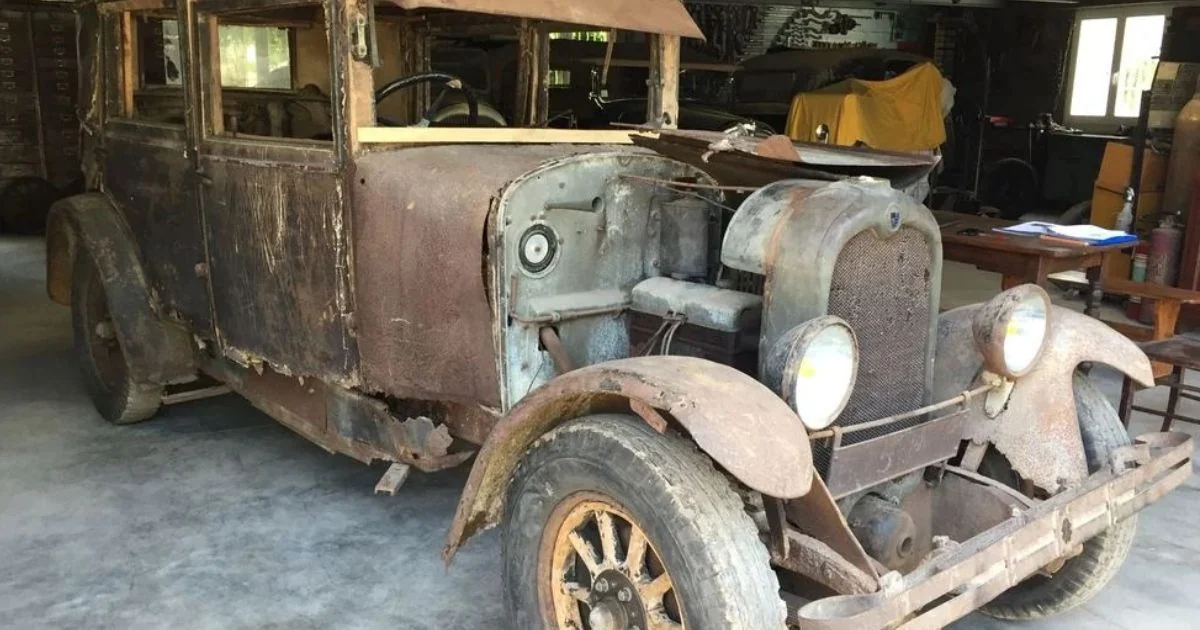
Hidden at the back of a dimly lit garage, the silhouette had gathered dust and oblivion. The owner was seriously weighing sending it to the junkyard when Givors enthusiasts stumbled upon it in 2021. Before them stood a worn yet complete French sedan from the 1920s—a 1927 Fasto A2, a car nearly erased from memory, with only one other fully intact example known to exist.
This story unfolds in Givors, in the Rhône region. The Groupement Associatif des Collectionneurs du Patrimoine Technique (GACPT) stepped forward to rescue this rarity. The Fasto brand, for Fabrication Automobile de Saint-Ouen, is believed to have produced only about fifty cars. Roughly fifteen A2s left the workshops between 1926 and 1928. The A2 model debuted at the Paris Motor Show in 1926, promising to deliver the comfort, luxury and performance of the likes of Berliet or Rochet-Schneider, but at a more accessible price. Nearly a century later, the Givors car enters restoration, with the stated goal of seeing it running for its hundredth birthday in 2026.
A 1927 Fasto A2 saved at the last minute in Givors
Before joining the volunteers’ workshops, this Fasto A2 lived a fairly ordinary life. It was purchased in 1934 by a family who used it as their daily driver into the 1950s. Then it was tucked away in an underground garage, where it remained for decades without being on the road. When the building changed hands, its owner contemplated scrapping it. A member of the GACPT was alerted, and everything changed from that moment.
Reading the serial number, the enthusiasts realized they were looking at a unique piece of French automotive heritage. The Fasto brand reportedly built only about fifty cars, and roughly fifteen were A2s. Today, historians count only three A2 chassis, with this Givors car being the sole one still complete. In its era, the FASTO A2 made its mark in competition, including the 24 Hours of Le Mans in 1927. The marque also fielded all-female crews for the Paris–La Baule rally, a rare move for the time. On public roads, this sedan targeted the prestige-car market, competing with Berliet and Rochet-Schneider. Its engine was known for economy and it started without a crank handle, paired with a four-speed gearbox—nearly a rarity at the time.
A restoration of the Fasto A2 that revives a century of history
Since its rescue, the restoration of the Fasto A2 has been led by the GACPT, with support from the Fondation du patrimoine. The project has secured a €30,000 grant from the Fonds de soutien aux métiers d’art. The total budget runs close to €86,700, covering parts, specialized labor and organizational costs. Two craftspeople—a trained upholsterer and a veteran restorer of classic vehicles—work alongside the volunteers. They are bringing the mechanics, electrical system and running gear back to life. The Weymann-style body, renowned for its technical complexity, must be entirely rebuilt before receiving new upholstery. The Foundation sees this as a tribute to an era when innovation and elegance went hand in hand in automotive design.
A precise timetable has been set for this extraordinary project. In the spring of 2024, the car will be fully dismantled to assess every element of the chassis and the frame. The autumn of 2024 will be devoted to reworking the Weymann body and the upholstery. The craftsmen will use materials as close to the original as possible. The project is slated to wrap up in 2026, the car’s centennial year, when it will be presented to the public. This effort showcases the crafts of the automotive trades and demonstrates how a small group of enthusiasts in Givors can rescue a nearly erased piece of French automotive history.