Volkswagen is gearing up for the return of an iconic model we know well: the Volkswagen Up!
After the ID.Polo, it’s time for the ID.Up
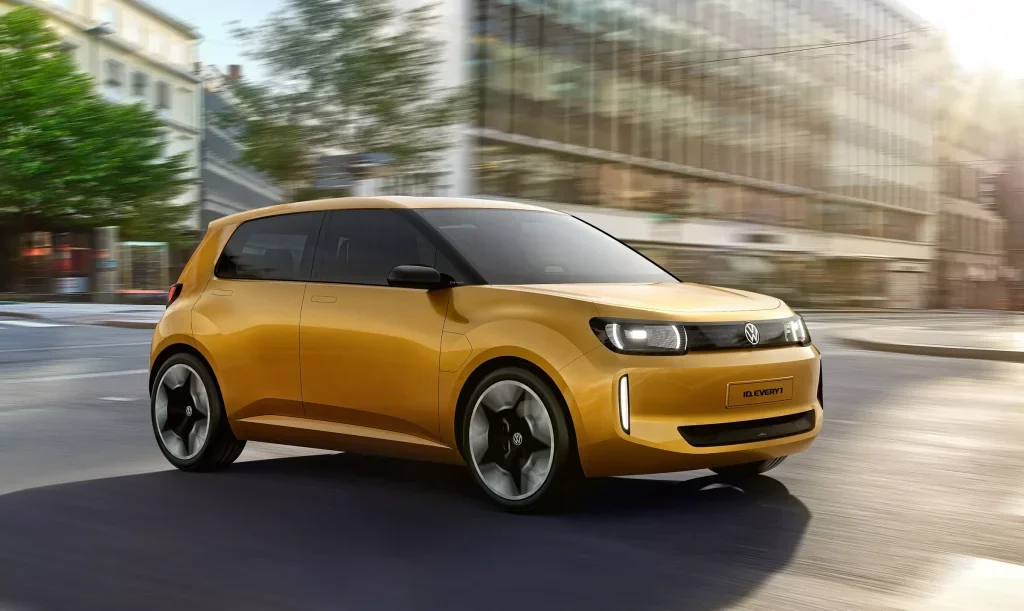
This A-segment mini city car was launched in 2011 to compete with the small European benchmarks of the era: Renault Twingo, Ford Ka, Suzuki Ignis, Citroën C1, Toyota Aygo, Peugeot 108. Initially purely combustion-powered, it gained a 100% electric version two years later, in 2013, and enjoyed a near uninterrupted run until 2023, when it was shelved. Now that Volkswagen has introduced its big sister, the new ID.Polo, the German group has all the cards in hand to focus on developing the future 100% electric Up, which will be named ID.Up. This choice fits Volkswagen’s broader strategy: moving away from numbers toward evocative names, as with the ID.Polo or the new ID.Tiguan. We already know a few leaks about it, since Volkswagen revealed in 2025 a concept of a pre-series, called ID.EVERY1, which previews the upcoming ID.Up for production. If we trust it, the future ID.Up should measure around 3.88 meters in length and 1.81 meters in width. It is noticeably longer than the old e-Up (3.60 meters), but of course shorter than the new ID.Polo (4.05 meters). The other challenge for a vehicle of this size is, of course, the price: Volkswagen is aiming at around €20,000, which fits the segment since the Twingo starts at €19,490.
300 kilometers of range
To achieve this without sacrificing profitability, the automaker has made economical technical choices. The production version is expected to use LFP batteries, a chemistry cheaper than the NMC technology widely favored by European automakers, and to benefit from the software architecture stemming from the joint venture with the American Rivian. The electric motor should develop 70 kW, or 95 horsepower, for a WLTP range approaching 300 kilometers. Despite its affordable positioning, the brand’s head of technical development, Kai Grunitz, assures that the car will be “a true Volkswagen,” in its comfort and its handling. We will not fail to test that claim in the on-road reviews. Production is slated to begin mid-2027 at the Palmela plant in Portugal, for a final model reveal at the IAA Mobility show in Munich in September 2027. Competition will naturally be fierce: the city car will take on Renault Twingo, as well as the forthcoming Fiat Koala and Citroën 2CV, and likely future Chinese models that will appear by then. With its ID.Up, Volkswagen will need to prove it can still build a popular and affordable car. All will depend on its pricing.