Let’s be realistic. Alpine faces a challenging mission ahead. The French brand of the Renault Group has spent decades building its reputation around a very specific idea of the sports car: lightness, agility, and a special connection between the driver and the machine. The Alpine A110 is probably the best modern example of that philosophy, but expanding the family means exploring very different territories. And doing so, moreover, in the midst of the electric era, is a challenge within reach of very few.
The Alpine A390 is the answer to that challenge. A five-door, five-seat fastback that aims to transfer the brand’s DNA to a car much larger, heavier, and more versatile than the small sports car. Now, with the arrival of the Alpine A390 GTS as the most powerful and sporty version, that proposition gains a new dimension: more power, a battery ready to withstand demanding driving, and tuning that also seeks to persuade those who truly enjoy driving fast to be convinced.
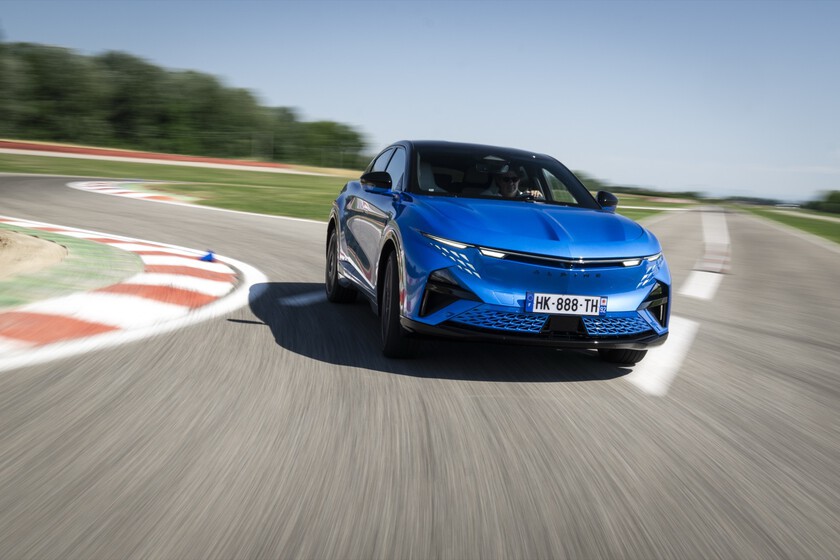
Recently we travelled to Italy to get behind the wheel of this new version, both on open roads and at the Vairano circuit. And it is precisely on the latter setting where the A390 GTS shows that behind its electric fastback body there is much more than flashy acceleration figures. Because yes, it is a car with 470 HP that accelerates from 0 to 100 km/h in 3.9 seconds, but what really matters is how it makes you feel at the wheel.
Exterior design: a GTS that could look more special

The Alpine A390 is a car with a very marked aesthetic personality. Its fastback body, with a silhouette that seeks to combine the proportions of a coupe with the practicality of a family vehicle, moves away from the brand’s traditional image of the sports car. It is larger, taller and much bulkier than an A110, but it retains some features that allow you to recognize its origin.
With 4.62 meters in length, 1.89 meters in width and a height around 1.53 meters, the A390 has a substantial presence on the asphalt. It is not a car that hides its dimensions, although the designers have worked to make the silhouette visually more compact than you might expect from its proportions.
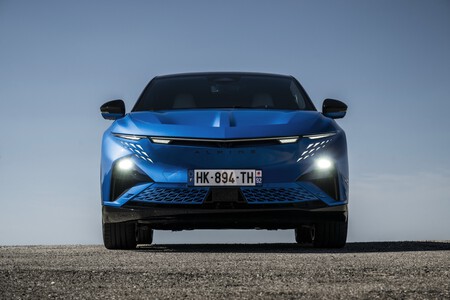
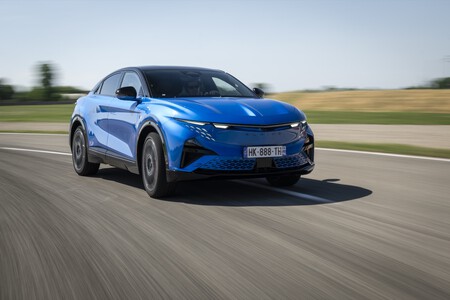
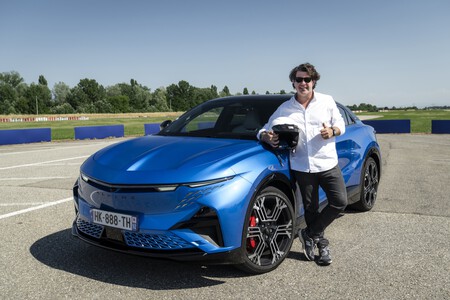
The front is one of the most distinctive areas. The light signature, formed by small illuminated triangles that Alpine calls Cosmic Dust, provides a recognizable and quite techy image. Geometric shapes also appear in the bumpers, with motifs that evoke mountains and that serve as a reminder of the brand’s Alpine origin. It is a design language different from that of other electric sports cars, less aggressive in some details, but with enough distinctive elements to build a visual identity and clearly, not to be confused with any other car.
The hood presents different volumes and aerodynamic solutions, while the side silhouette is probably the most interesting part of the whole. The roofline slopes toward the rear, the rear glass is inclined and curved as in the A110, and the relatively contained glass surfaces help create that fastback sporty image. The handles integrated into the rear doors and the gloss-black fender arches also contribute to a cleaner overall look.
The front is one of the most distinctive areas. The light signature, formed by small illuminated triangles that Alpine calls Cosmic Dust, provides a recognizable and rather techy image. Geometric shapes also appear in the bumpers, with motifs that evoke mountains and serve as a reminder of the brand’s Alpine origin. It is a design language different from that of other electric sports cars, less aggressive in some details, but with enough distinctive elements to build a visual identity and clearly, not to be confused with any other car.
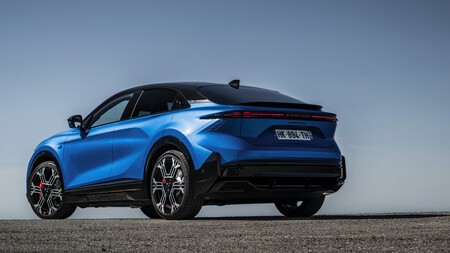
However, in the case of the GTS, the 21-inch Snowflake wheels in gloss black with a diamond-cut finish and the six-piston front brake calipers in Rouge Racing are some of the elements that reinforce its character. The Michelin Pilot Sport 4S tires developed specifically for the model complete a setup clearly oriented toward performance.
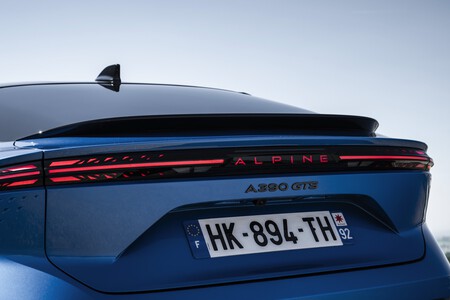
However, here appears one of the aspects that I like the least about the car. I would have preferred the A390 GTS to be more visually differentiated from the A390 GT. We’re talking about the most powerful and sporty version of the range, a model that aims to represent the maximum expression of the A390’s capabilities, and I miss some aesthetic traits that would make it look a bit more special.
It’s not that the A390’s design is unattractive, quite the opposite, but the mechanical and dynamic leap between the two versions would deserve a more evident visual translation. The wheels and specific details are there, but the overall image remains very close to the GT. For those who also want a sports car in terms of what it conveys when parked, a more marked differentiation would have been welcome. Yes, adding a bold spoiler that disrupts the harmony could be a solution.
Interior: sportiness without renouncing comfort
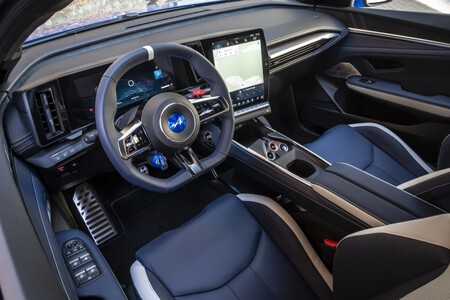
The cabin of the Alpine A390 GTS follows a philosophy different from the exterior. Here, the aim is to blend a sporty ambience with a refined presentation and equipment that allows the car to be used daily without missing too much of a conventional touring model.
The driving position is oriented toward the driver, and the control station combines two screens: a digital instrumentation of 12.3 inches and a vertical central screen of 12 inches. Both feature Alpine-specific graphics and allow you to consult both the usual vehicle information and different parameters related to sporty driving.
I think it’s wise that Alpine has preserved physical controls for some functions, especially for the climate control. In a car that aims to deliver an intense driving experience, being able to adjust certain elements without navigating through many menus is particularly useful.
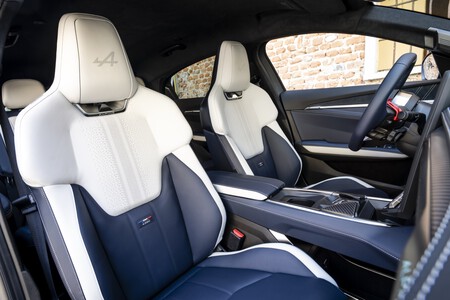
The sporty seats developed by Alpine in collaboration with Sabelt are another of the GTS’s distinctive elements. They are upholstered in two-tone Nappa leather, offer electric adjustment, heating and a massage function. The mix of materials and colors helps create a more exclusive atmosphere, while the Alcantara-covered roof adds an extra touch of sophistication.
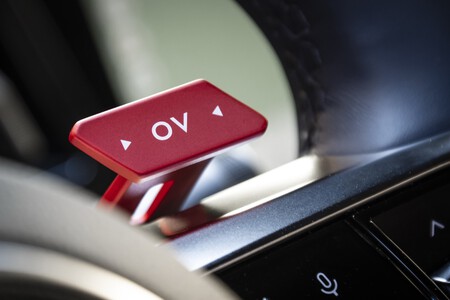
The raised center console brings back some features inspired by the A110, especially the transmission controls. It’s a small nod to the brand’s tradition within a car that, by concept and size, plays in a completely different league.
And the A390 is not trying to be a radical two-seater. Its five doors allow comfortable access to the cabin, the rear seats provide space for two side-by-side passengers and the boot capacity is 532 liters. These features are important to understand the car’s approach: a vehicle to enjoy driving, but that can also serve as the main family car.
In terms of equipment, the GTS includes as standard the Devialet XtremeSound system, with twelve speakers and a subwoofer, in addition to the Driving Pack of driving-assisted features and the Alpine Telemetrics Expert system. The latter allows checking acceleration, braking, temperatures, G-forces and other parameters that become particularly interesting when driving on a circuit.
Three electric motors and 470 HP for the sportiest version
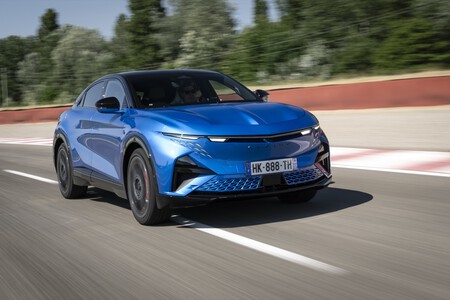
The main difference between the Alpine A390 GT and the GTS lies beneath the body. The latter uses three electric motors, one at the front and two at the rear, delivering a combined 470 HP and a maximum torque of 824 Nm.
The mechanical layout is not a minor detail. The front motor and the two rear ones provide all-wheel drive, but they can also independently manage the torque reaching each rear wheel. It is the basis of the Alpine Active Torque Vectoring system, a technology intended to compensate part of the inertia of a car that, due to its size and weight, is far from the values of an A110.
The A390 GTS weighs a minimum of 2,121 kg, a substantial figure for a car bearing the name of a brand specialized in sports cars. However, Alpine has worked on mass distribution, with 49% of the weight on the front axle and 51% on the rear, in addition to placing the battery low to reduce the center of gravity.
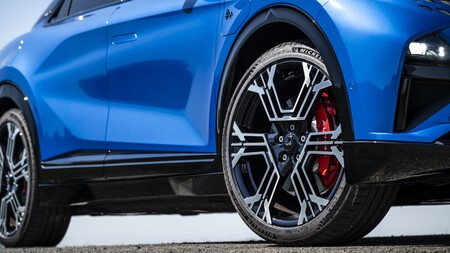
The specific suspension uses hydraulic bump stops, while the steering aims to deliver a direct response. In the braking department, there are 365 mm front discs with six-piston monoblock calipers, a setup in line with the performance of the package.
The figures are impressive. The A390 GTS accelerates from 0 to 100 km/h in 3.9 seconds and hits a top speed of 220 km/h. These figures place it in a very serious territory, but Alpine insists that the experience should not be reduced to straight-line acceleration.
And after driving it, I understand perfectly why.
Behind the wheel of the Alpine A390 GTS: a feel that convinces
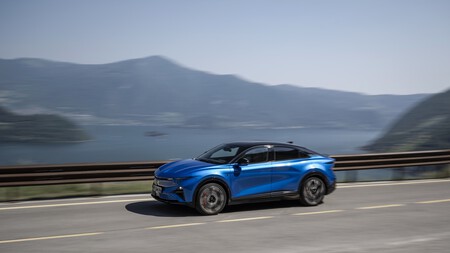
Our test in Italy allowed us to see how the A390 GTS responds on the road before taking it to the Vairano circuit. It’s an interesting combination because it helps understand the car’s two faces: on one hand, its ability to function as a daily usable sporty fastback; on the other, the work the engineers have done to ensure that an electric vehicle of this size has a fun behavior when pushed.
The first thing I liked is the overall feel of the car. The steering has a direct response and allows precise placement of the vehicle, while the chassis tuning conveys that sense of connection that is so important in a sports car and which, unfortunately, is so rare to find in modern electric cars.
Power alone is not enough: you need the car to respond to your commands in a natural way, so you can anticipate its reactions and so the whole thing doesn’t feel like a heavy mass to control.
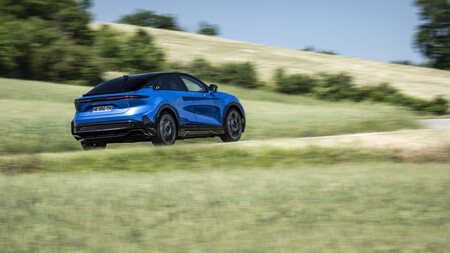
In this sense, the A390 GTS left me with a positive impression. There’s clear work to ensure that the response of the three motors, the steering and the chassis form a coherent whole. The torque distribution between the rear wheels plays a fundamental role, because it allows you to modify the car’s attitude depending on what happens in each corner.
Brake modulation is also important. In an electric car of this kind, combining regenerative braking with conventional braking without the driver noticing odd transitions is essential to maintain control. In track driving, being able to modulate the braking with precision helps you position the car before entering the corner and then manage the weight transfer afterward.
The feeling is that Alpine has tried to make the A390 GTS not merely a fast car, but one that invites you to drive. And that difference is fundamental.
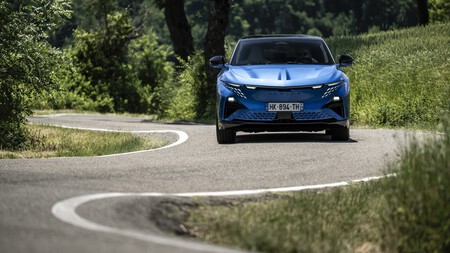
Evidently, the dimensions and weight do not vanish by magic. The A390 cannot reproduce the lightness sensations of an A110, nor would it be reasonable to demand that. But the response of the mechanical package and the work done on the chassis ensure you are not constantly thinking about the kilos you’re carrying, especially on the road.
That tactile feel is what I value most about this first encounter. Rather than simply offering a forceful acceleration and huge traction, the Alpine tries to involve the driver in what’s happening between the wheels and the asphalt.
And it’s on the track where that philosophy makes total sense.
Vairano Circuit: when you discover that the Alpine behaves like a rally car
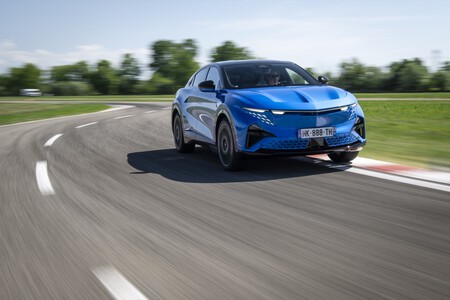
The most interesting part of this test took place at Italy’s Vairano circuit. It’s there that the Alpine A390 GTS stops being merely a very powerful electric fastback to reveal a facet that isn’t so obvious when you look at it from the outside, but makes sense if we recall Alpine’s rally successes of yesteryear.
On track, after playing for several laps with the car and its different driving modes to try to understand it, what surprised me most is how it responds when you start playing with weight transfers and inertia.
Rather than simply tracing corners with near-sterile efficiency, the A390 GTS allows you to adopt a much more active driving style, seeking to induce the car to rotate and even slide in a controlled manner.
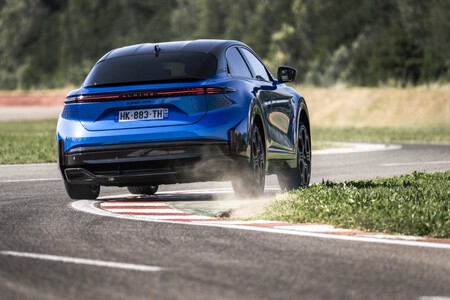
On track, the Alpine A390 GTS is driven almost like a rally car. Not because it has the size, weight, or agility of a genuine competition car in that discipline, but because of how it invites you to use inertia and the power delivery of its three motors to modify its trajectory.
You enter the curve, you play with mass transfer and you take advantage of the rear’s response to make the car rotate. Then, with the accelerator, you can continue shaping its attitude and seek that small slide that turns a curve into something more than a simple sequence of high-speed meters.
It’s a driving style that requires understanding what the car is doing, anticipating its reactions, and using the controls with intent. And that is precisely what I value most in a sports car today: that not everything is reduced to hitting the accelerator and letting electronics sort it out to go on rails. Here, that doesn’t happen.
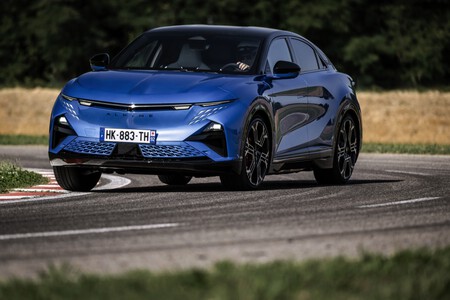
The key lies in the Alpine Active Torque Vectoring system. The two rear motors can independently distribute torque between both rear wheels, adjusting the car’s response according to steering input, speed, and driving conditions. The system operates in about 20 milliseconds, aiming to improve agility and reduce tendencies to understeer or oversteer.
But beyond the technical explanation, what matters is what you perceive from the seat. The A390 GTS has a reactive capacity that helps counteract the inertia of its body and allows the driver to intervene in the trajectory rather than simply waiting for the car to complete the turn. In this sense, that connection with the whole and the steering we highlighted at the start of this test is the key.
The different driving modes modify the behavior of the stability control, traction, and torque vectoring systems. The Track mode, specific to this version, is designed to exploit the car’s possibilities in a closed environment. It’s also possible to turn off the electronic stability control, an option that makes sense when you want to explore the dynamics of the package more freely on a track or when you want to burn through a set of tires so that in photos and videos there’s more smoke than anything. Marvelous.
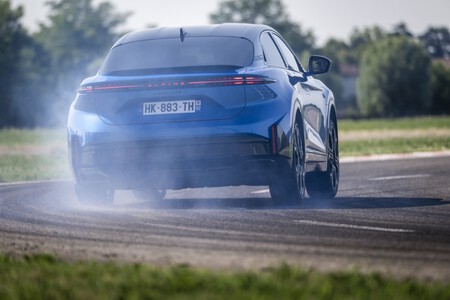
The key is in the Alpine Active Torque Vectoring system. The two rear motors can distribute the torque independently between the two rear wheels, adjusting the car’s response according to the steering input, speed and driving conditions. The system works in about 20 milliseconds, aiming to improve agility and reduce tendencies to understeer or oversteer.
But more than the technical explanation, what matters is what you perceive from the seat. The A390 GTS has a reactive capability that helps counteract inertia of its body and allows the driver to intervene in the trajectory rather than waiting for the car to finish the turn. In this sense, that connection with the whole and the steering highlighted at the start of this test is the key.
The various driving modes modify the behavior of the stability, traction and torque-vectoring systems. The Track mode, specific to this version, is designed to exploit the car’s possibilities in a closed environment. It is also possible to disable stability control, an option that makes sense when you want to explore the dynamics with more freedom on the track or when you want to burn through a set of tires to create more smoke than anything in photos or videos. Wonderful.
And this is where the A390 GTS shows that Alpine hasn’t settled for building a fast electric car. The brand has worked to ensure that power has a dynamic application and that the driver can enjoy the process of driving fast.
The best part is that the car allows you to play with its movements. You can seek a more aggressive entry into a corner, provoke rotation and use the push from the motors to manage the slip. It’s not the lightness of an A110 that defines this experience, but the ability to use a heavy, powerful car in a much more expressive way than one would expect.
For those who have driven the various versions of the A110, a parallel came to mind while I was driving it: this moves similarly to the standard A110, with a controlled slide, which is part of its character and DNA, and it does not ride on rails as the A110 R did.
Obviously, its dimensions and weight don’t vanish by magic. The A390 cannot reproduce the lightness of an A110, nor would it be reasonable to demand that it could. But the response of the mechanical package and the work done on the chassis ensure you aren’t constantly thinking about the kilos you’re carrying, especially on the road.
That’s precisely the feel I value most in this first contact. Rather than simply offering a powerful acceleration and a huge amount of traction, the Alpine tries to involve the driver in what is happening between the wheels and the asphalt.
And it is on the track where that philosophy makes total sense.
Vairano Circuit: when you discover that the Alpine handles like a rally car
The most interesting part of this test took place at the Vairano circuit in Italy. It’s there that the Alpine A390 GTS stops being merely a very powerful electric fastback to reveal a facet that isn’t so evident when you look at it from outside, but makes sense if we recall Alpine’s rally successes from the past.
On track, after playing for several laps with the car and its different driving modes to try to understand it, what surprised me most is how it responds when you start to play with weight transfers and inertia.
Instead of simply tracing curves with almost sterile efficiency, the A390 GTS allows you to adopt a much more active driving style, seeking to make the car rotate and even slide in a controlled manner.
On track, the Alpine A390 GTS drives almost like a rally car. Not because it has the size, weight, or agility of a true rally car, but because of how it invites you to use inertia and the power delivery of its three motors to modify its trajectory.
You enter the curve, you play with mass transfer and you take advantage of the rear’s response to make the car turn. Then, with the accelerator, you can continue working on its attitude and seek that small slip that turns a corner into more than just a sequence of meters traveled at high speed.
It’s a driving style that requires understanding what the car is doing, anticipating its reactions, and using the controls with intention. And that is precisely what I value most in a sports car today: that not everything is reduced to stepping on the accelerator and letting electronics sort it out to stay on rails. Here, that does not happen.
La clave está en el sistema Alpine Active Torque Vectoring. Los dos motores traseros permiten repartir el par de manera independiente entre ambas ruedas, ajustando la respuesta del coche en función de la dirección, la velocidad y las condiciones de conducción. El sistema trabaja con una rapidez de unos 20 milisegundos, buscando mejorar la agilidad y reducir las tendencias al subviraje o al sobreviraje.
Pero más allá de la explicación técnica, lo importante es lo que percibes desde el asiento. El A390 GTS tiene una capacidad de reacción que ayuda a contrarrestar las inercias de su carrocería y permite que el conductor intervenga en la trayectoria en lugar de limitarse a esperar que el coche complete el giro. En este sentido, esa conexión con el conjunto y la dirección que destacábamos al comienzo de esta prueba, es la clave.
Los distintos modos de conducción modifican el comportamiento de los sistemas de control de estabilidad, tracción y vectorización del par. El modo Track, específico de esta versión, está pensado para explotar las posibilidades del coche en un entorno cerrado. También es posible desconectar el control electrónico de estabilidad, una opción que tiene sentido cuando se quiere explorar con mayor libertad la dinámica del conjunto en circuito o cuando quieres fundirte un juego de neumáticos para que en las fotos y los vídeos se vea más humo que otra cosa. Maravilloso.
And it’s here where the A390 GTS proves that Alpine hasn’t settled for building a purely fast electric car. The brand has worked to ensure that power has a dynamic application and that the driver can enjoy the process of driving quickly.
The best part is that the car allows you to play with its movements. You can seek a more aggressive entry into a curve, provoke rotation and use the motor push to manage the slip. It isn’t the lightness of an A110 that defines this experience, but the ability to use a heavy, powerful car in a much more expressive way than you would expect.
For those who have driven the various versions of the A110, a parallel comes to mind while driving it: this moves similarly to the standard A110, with a controlled drift, which is part of its character and DNA, and it doesn’t ride on rails as the A110 R did.
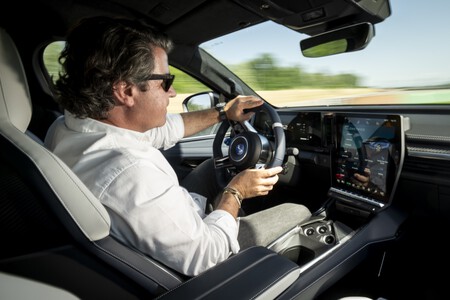
Of course, we’re talking about track driving, in a controlled environment with space to explore the car’s reactions. That’s not something to transfer to public roads. But as a demonstration of the capabilities of its chassis and torque-management system, the experience is highly revealing.
Leaving Vairano with that sensation is probably the best argument this GTS has to justify its name. Because power and acceleration figures can impress on paper, but getting a heavy electric car over two tons to invite you to play with inertia is something much harder. In fact, I had only found it in the last year in its rival on paper with the same surname, the Porsche Macan GTS, which is saying a lot.
Range and recharge: a sports car for travel
All this is great, but to be honest, I doubt anyone would buy this car to use it on track days. That’s why the Alpine A390 GTS must also meet the needs of those who want to use it as a daily car, a car for everything. It features an 89 kWh usable battery capacity and an official WLTP range of up to 503 kilometers with the 21-inch wheels and the standard Michelin Pilot Sport 4S tires.
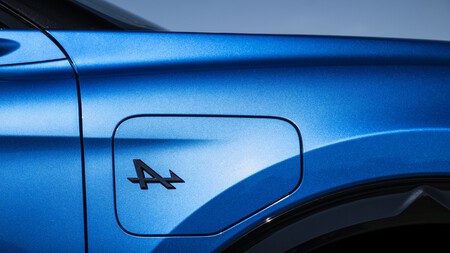
That figure can rise to 551 kilometers with 20-inch wheels and the corresponding tire setup. As always, and as also happens with combustion cars, real-world range will depend on factors such as speed, temperature, route, and especially driving pace in a car of this type.
The battery supports DC charging of up to 190 kW. Alpine states it can go from 15% to 80% in less than 27 minutes under the right conditions, with an average power of 135 kW during that interval.
These figures are reasonable for a performance-oriented electric car, though it’s worth noting that the approach isn’t solely about efficiency. Here the priority has also been delivering power in a sustained manner, even when the battery isn’t fully charged, something especially important if you drive aggressively.
Standard equipment includes a heat pump and a Google Maps-based route planner, which takes into account the battery’s state and charging needs to organize trips. A big help.
In short, the A390 GTS is not trying to be a circuit sports car masquerading as a family vehicle. It’s a model that aims to offer high performance without sacrificing the ability to travel with passengers and luggage. And that duality is an essential part of its proposition.
Alpine A390 GTS: price and appraisal
The Alpine A390 GTS is available in Spain from 78,000 euros, with standard equipment that includes the three electric motors, all-wheel drive, the Sabelt sport seats, the Devialet XtremeSound system, the Driving Assist package, and Alpine Telemetrics Expert.
It’s a significant figure, but so is the level of power, technology and equipment it offers. Its 470 HP and 824 Nm of torque make it a very fast car, though I think its main argument isn’t pure performance, but the work done to make it enjoyable to drive.
After testing it on the road and at the Vairano circuit, I’m left with the feel of the whole. The steering, the response of the motors and, above all, the ability to play with inertias and provoke controlled slides make the A390 GTS have its own dynamic personality.
It isn’t an electric A110, not a bigger A290, nor does it pretend to be. Its size and weight place it in another category, and it would be unfair to judge the car solely on what it cannot offer against the small sports car. The question is whether Alpine has managed to translate part of its philosophy to a much larger and more practical format.
My answer, after this first encounter, is yes. The A390 GTS has a feel I liked and shows that an electric car of this kind can offer more than blunt acceleration and immense traction. On the track, especially, it can reveal a surprisingly playful facet that you’ll really enjoy behind the wheel.
The Alpine A390 GTS cannot be as light as an A110, but it does prove that Alpine’s sporting spirit doesn’t have to disappear when electric motors arrive and two tons of weight are involved. And that, even in a five-seat car designed for travel, there’s still room to enjoy driving in a sporty way, feeling real connection with the chassis and the steering, something that isn’t found in most of today’s Chinese-made electric SUVs sweeping into European markets. A European brand? Perhaps. But equally, Alpine’s challenge remains as big as we began with.