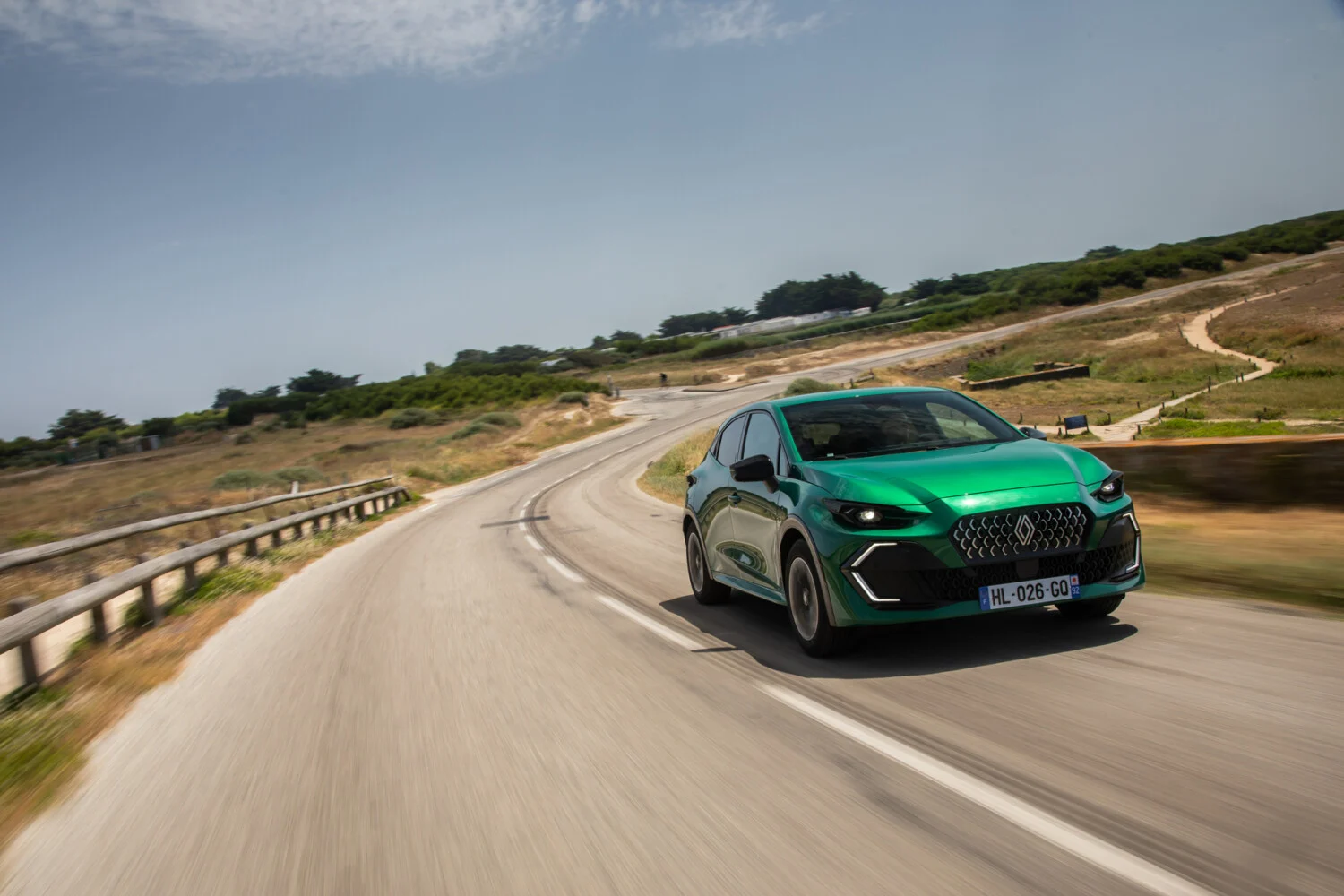
In Brief
The Renault Clio 1.2 Eco-G 120 hp Techno stands out for its bi-fuel gasoline/LPG powertrain, delivering highly affordable running costs alongside good on-road manners. Its 120 hp engine, paired with the EDC automatic transmission, makes for a pleasant drive, with total range that can approach 1,400 km. The only practical concessions are the reduced trunk space and the automatic gearbox requirement, offset by a genuine daily fuel economy thanks to LPG.
In these days of battery adulation in every form, resisting it almost feels like dissent!
Renault Clio 1.2 Eco-G 120 hp Techno: a motor that’s starting to feel familiar
Alongside the 115 hp TCe variant (pure gasoline) and the 160 hp E-Tech (hybrid), this Eco-G 120 hp Clio marks itself as the maverick: Renault and Dacia are the only makers currently offering versions compatible with the famous liquefied petroleum gas. To skip it would be imprudent, given the relative popularity of this alternate fuel (about a 10% rise in LPG-equipped model sales in Europe last year) that some still deem old-fashioned. It nevertheless accounted for nearly 15% of Clio V sales (despite a broader motor range), and, in these days of pricey fuel, a roughly €1 per liter LPG price could alone be enough to bring LPG back into style. Hard to be more pragmatic since the E85 flex-fuel option has almost disappeared from new cars. Like the Captur and the Symbioz, the Clio VI also employs the 1.2 Eco-G, an engine introduced earlier this year at Dacia as well. This motor is becoming familiar: it’s derived from the well-known 3-cylinder HR12 (used across the group in various variants), here optimized to sip both leaded gasoline and LPG alike (injectors, cooling…).
Note that it couples to the Clio with the 6‑speed dual-clutch EDC automatic, unlike its Romanian cousin.
Renault Clio 1.2 Eco-G 120 hp Techno: driving remains as enjoyable as ever
Too bad a manual would have allowed pricing to dip under €20,000. The LPG Clio nonetheless keeps the same price as the gasoline TCe 115 hp version with the same transmission, at €21,900 for the entry Evolution trim. First major selling point: the payback at the pump is immediate. It also escapes the penalty tax, with a CO2 rating of 106 g/km. At the wheel, there’s no giveaway hint. Only the LPG indicator, at the bottom of the gauge cluster, reveals the fuel that powers the small “three-patter.” Startup still occurs on gasoline, but the switch to LPG happens automatically and imperceptibly a moment later.
Manual mode choice remains possible, via a button on the left side of the steering wheel (to preserve LPG reservoir, for example). Beyond that, the 1.2 Eco-G delivers the same performance as its TCe equivalent with one difference: LPG-fed, the Eco-G develops 120 hp and 200 Nm of torque, i.e., 5 hp and 10 Nm more than when running on unleaded.
The difference at the wheel is modest: 0–60 mph takes about 9.8 seconds (vs 10.6 s). And the advantage is only moderately noticeable compared to its Clio V predecessor, whose 1.0 Eco-G managed 100 hp and 170 Nm. Not exactly quick, this engine still provides enough punch to enjoy the Clio VI’s already engaging handling.
Renault Clio 1.2 Eco-G 120 hp Techno: the EDC transmission, hesitant, doesn’t help
Agile and precise, the French hatch remains one of the most enjoyable city cars to drive today, regardless of its powertrain. Its weight, just a touch higher than the simple TCe 115 hp, stays reasonable (approx. 2,765 lbs vs 2,652 lbs in the baseline, per our scales). One caveat tempers the enthusiasm: the 1.2 isn’t noted for isolation, and the lack of a balancing shaft (unlike the variants used in the Austral and Rafale) translates into a rougher feel at low revs. Vibrations and droning on takeoff are a bit too noticeable in city driving. The EDC, being hesitant, doesn’t help. The picture clears at highway speeds, where the whole package demonstrates a smooth, agreeable cadence for long-distance miles. In short, the Renault city car shows its best when it comes to racking up highway kilometers…
The exercise suits the Eco-G perfectly: range, combining the 39 L of gasoline and the 50 L LPG bottle (40 L in the previous generation) pushes the total toward the 1,400 km mark advertised by the maker (about 1,359 km in our measurements). For diesel nostalgics, that’s a notable payoff.
Renault Clio 1.2 Eco-G 120 hp Techno: a concession of… size
That extra fuel tank, however, comes with a price in practicality. The trunk’s double floor is eliminated, reducing capacity to 230 dm3. That’s far from the 350 dm3 of the gasoline-equipped Clio TCe 115 hp (which enjoys a more generous flat-floor trunk) and even shy of the 290 dm3 offered by the hybrid. No spare wheel is included, even as an option; you’re limited to a tire repair kit. Fortunately, that’s the only practical impact tied specifically to LPG. Inside, the cabin remains essentially identical to the other powertrains and keeps its modern styling. Occupant space isn’t its strong suit—the rear seat offers only adequate room.
Some buyers will accept these compromises given the dramatically lower cost of ownership. LPG does entail roughly a 25% higher fuel consumption versus gasoline (we measured about 7.4 L/100 km vs 5.7 L/100 km), but this is quickly offset by the price gap at the pump (roughly €1.02 per liter LPG vs €2.03 per liter unleaded at the time of our test). On those terms, the fuel budget sits at about €7.55 per 100 km for LPG, versus €11.57 per 100 km for gasoline—a clear win. There’s a small, almost anecdotal note worth mentioning: we used less 95 octane with the Clio Eco-G 120 hp than with its TCe 115 hp sibling (a tiny 0.1 L/100 km difference) that warrants verification with more models, but it’s there. Even the Hybride E-Tech 160 hp, though thrifty, remains pricier to operate daily at €24,600 base.
Renault Clio 1.2 Eco-G 120 hp Techno: the pros?
- Transparent dual-fuel operation
- Low running costs
- No price penalty relative to the TCe 115 hp
Renault Clio 1.2 Eco-G 120 hp Techno: the cons?
- Significantly reduced trunk volume
- Automatic transmission only
- Less refined isolation of the 3‑cylinder engine
Auto Journal’s verdict: 4/5
Provided you accept a penalized trunk and the mandatory automatic gearbox, this Eco-G Clio is the most recommendable model in the range for the fuel savings it enables.
Renault Clio 1.2 Eco-G 120 hp Techno: in numbers
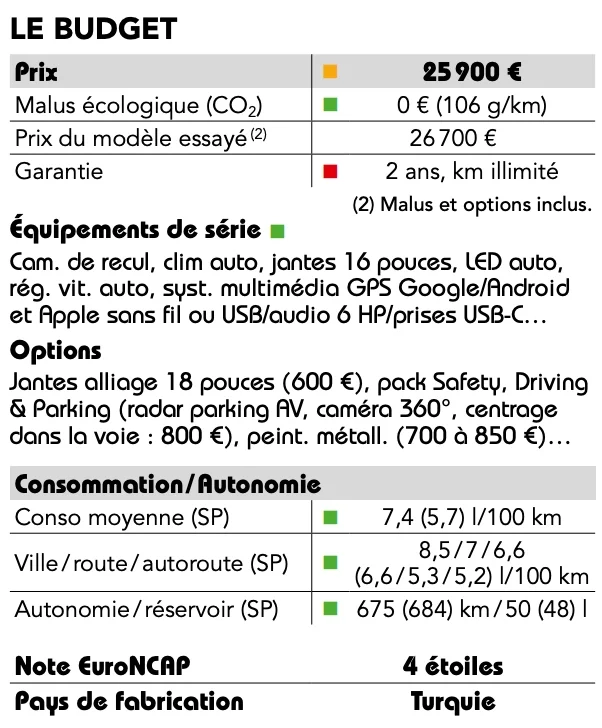
Find our test of the Renault Clio 1.2 Eco-G 120 hp Techno in Auto Journal issue #1217, dated September 17, 2026.
Comparison Table
| Version | Power (hp) | Torque (Nm) | 0-60 mph (s) | Mass (kg) | Trunk (L) | Consumption (L/100 km) | Price (€) | Max Range (km) | CO2 (g/km) |
|---|---|---|---|---|---|---|---|---|---|
| Clio 1.2 Eco-G 120 LPG | 120 | 200 | 9.8 | 1253 | 230 | 7.4 (GPL) / 5.7 (gasoline) | 21,900 | 1,359 | 106 |
| Clio TCe 115 hp | 115 | 190* | 10.6* | 1203 | 350 | 5.8 (gasoline)* | 21,900 | NC | NC |
| Clio E-Tech 160 hp Hybrid | 160 | NC | NC | NC | 290 | Very efficient | 24,600 | NC | NC |
| Clio V 1.0 Eco-G | 100 | 170 | NC | NC | NC | NC | NC | NC | NC |
* Data approximate or inferred from the text.
Key Takeaways
- Bi-fuel gasoline/LPG with attractive running costs and an announced total range up to about 1,400 km.
- 120 hp and 200 Nm of torque, slightly higher than the gasoline variant with similar hardware.
- Real-world LPG consumption around 7.4 L/100 km, with LPG price roughly half that of gasoline (about €1.02 vs €2.03 per liter during the test).
- Trunk heavily reduced to 230 L due to the LPG tank, versus 350 L on the gasoline version.
- 6-speed automatic EDC is mandatory; no manual option.
- Purchase price identical to the Clio TCe 115 hp (€21,900 in base trim), with no punitive tax.
- Some caveats: limited sound insulation and roughness in urban use.
FAQ
What are the advantages of the LPG engine on the Clio Eco-G 120 hp?
The LPG engine delivers real fuel savings, seamless dual-fuel operation, and a low running cost without any upfront price premium versus the gasoline version.
What is the trunk capacity of the Clio Eco-G 120 hp?
The Eco-G’s trunk holds 230 L, which is smaller than the gasoline versions (350 L) or the hybrid (290 L).
What is the fuel cost per 100 km with LPG?
The LPG fuel budget is about €7.55 per 100 km, versus €11.57 per 100 km for gasoline, based on the test data.
What are the downsides of the Eco-G 120 hp?
The main drawbacks are the reduced trunk space, the mandatory automatic gearbox, and the less refined isolation of the 3-cylinder engine, especially in city driving.
Can the Clio Eco-G switch between gasoline and LPG at will?
Yes—the switch between fuels can be done manually using a control on the left side of the steering wheel.