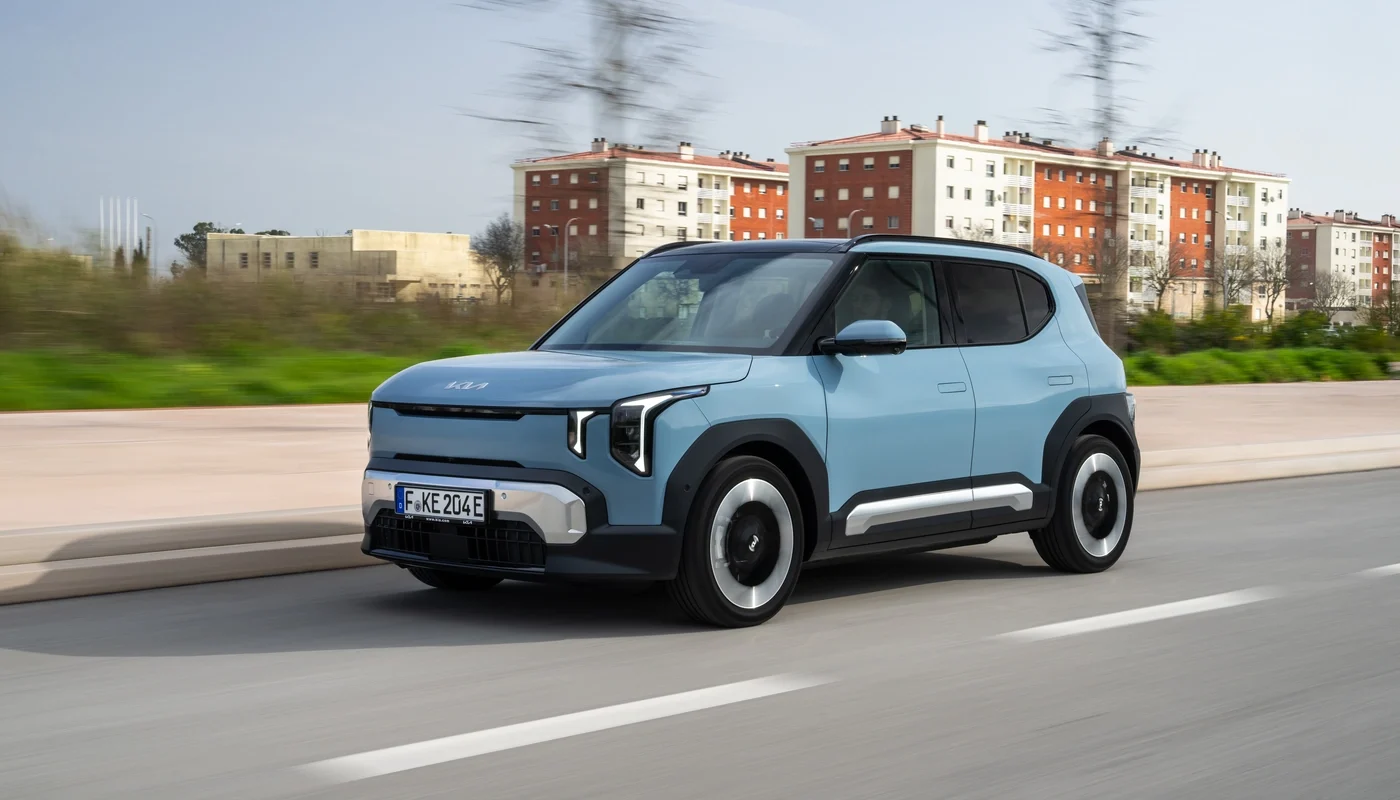
Kia EV2: Overview and In-Cabin Life
The Kia electric lineup sticks to a simple naming scheme: EV for “Electric Vehicle” and a number that signals size. The EV9 is therefore the largest in the range at 5.01 meters long, while at the opposite end, the EV2 is the smallest at 4.06 meters, about 24 centimeters shorter than the EV3. The Korean brand is, in fact, currently the smallest electric SUV on the market, just below the Mini Aceman at 4.08 meters and well under a Renault 4 E-Tech (4.15 m), its direct rival. It offers two battery sizes, two powertrains and four trims for a total of six versions available. Each battery has its own motor pairing with a quirk: the smallest battery gets the most power… On the trims side, the leanest option is named “Light,” which doesn’t promise lavish equipment… But it allows the EV2 to start at €26,670 with the small battery, excluding the enhanced CEE premium of at least €3,500 depending on your income. And yes, that’s the good news: this Korean SUV is “eco-rated” and thus eligible for this bonus, and even for the premium in its long-range version thanks to its Europe-made battery. At the listed price of this variant, you can then deduct between €4,700 and €8,100 depending on your income. That brings it under €30,000 for several of its versions, including with the larger battery.
Kia EV2: Available Powertrains
147 hp / 42.2 kWh: The smallest battery uses LFP (lithium‑iron‑phosphate) technology, which is cheaper but comes with lower energy density compared to NMC (nickel‑manganese‑cobalt) and is more sensitive to cold. However, the lifespan of this battery type is longer. Our measurements peg the average range of this model at 290 km, but only 210 km on a highway cycle from 100% to 0% charge, i.e., 147 km from 80% to 10%. In short, it’s not a great long-haul traveler, especially since the charging time sits at 29 minutes to go from 10% to 80%, because this EV2 doesn’t feature the 800‑volt architecture of its larger sisters EV6 or EV9. On the motor side, surprisingly, this smallest battery is paired with the most powerful electric motor, delivering 147 hp. It’s not a sports car by any means, but with the higher power and lighter weight (about 60 kg less than the other version), the EV2 147 hp is logically the most “performant” in the lineup, with brisk daily acceleration.
147 hp / 42.2 kWh
135 hp / 61 kWh: The version with the “big” battery uses NMC technology, favoring higher capacity, hence better range, but at a higher cost. Our measurements show an average range of 375 km, with 420–430 km on urban and combined use, but only 275 km on a highway run from 100% to 0% charge, i.e., 192 km from 80% to 10%. Again, this is primarily for travel, with the 10–80% charging time advertised at 30 minutes. The motor here outputs 135 hp, which has to move about 60 kg more. Performance naturally dips but remains adequate. The difference is most noticeable at higher speeds (a top speed of 160 km/h) with a less eager top-end. Nothing truly problematic, though.
The Auto Journal’s Pick: Kia EV2 135 hp / 61 kWh
The choice of motor/battery pairing hinges mainly on how you’ll use it: if it’s your second car, the smaller battery is plenty. Otherwise, opt for the larger one, which remains more practical for longer trips. The performance gap isn’t huge, since the EV2 isn’t built for outright performance. (€33,320 before options and before the minimum enhanced CEE premium of €4,700)