In Brief
The 1989 Chevrolet Camaro Carralo showcased in Texas is a rare Camaro-based conversion crafted by Knudsen Automotive. Its distinctive styling evokes video game supercars, featuring a fiberglass body while retaining certain original elements. Powered by a 5.7-liter V8 (L98) and showing under 90,000 miles, this rare piece is offered at $18,500. With an estimated production run of about a hundred units, it has become a coveted curiosity among collectors. It draws interest not only for its unconventional look but also for its place in GM’s history of semi-official derivatives.
Coming across the Craigslist listing, one might think it’s a hoax. A white aged Camaro with oversized fenders, a nose that looks like a pseudo-supercar, an improbable rear borrowed from late‑80s American TV show coupes: all of it recalls those generic video game cars—closer to a designer’s fantasy than a registered production model.
Truth be told, the mix is striking. Under the GM pony car roofline, the bodywork seems redesigned by someone who spent too much time on GTA‑style titles, grafting pieces from known cars. And yet, this creation isn’t a digital mod: it is a genuine Chevrolet Camaro Carralo from 1989, currently for sale in Texas, a rare piece that makes you want to look a little closer at what lies beneath this dot-pixel silhouette.
A 1989 Chevrolet Camaro Carralo That Looks Like It Stepped Right Out of a Video Game
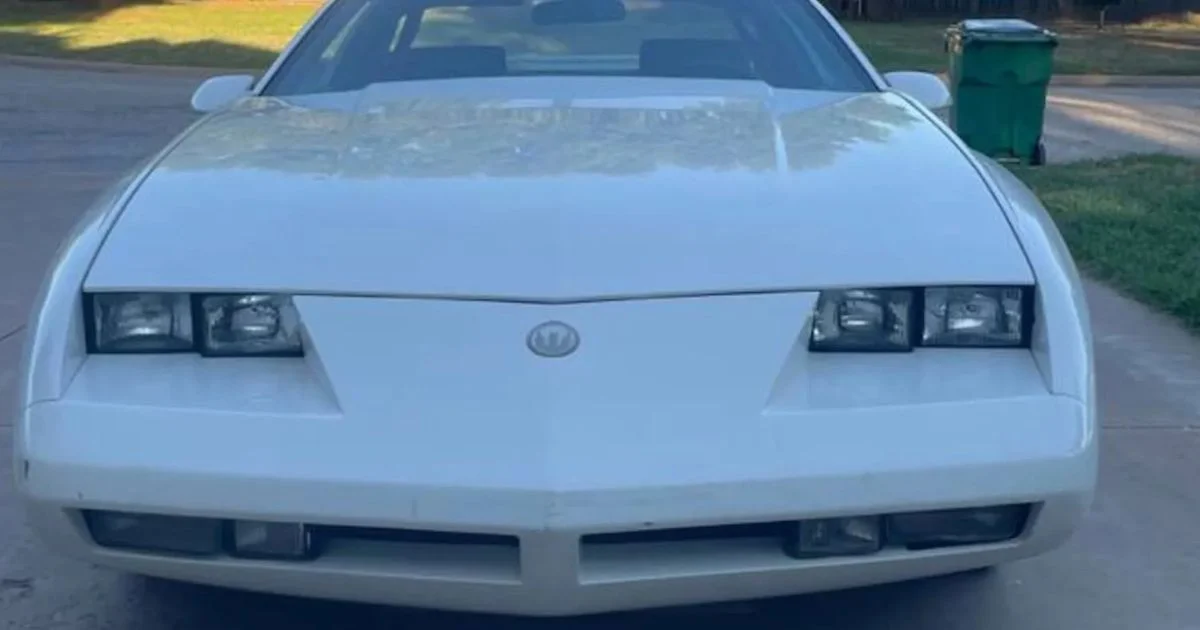
Behind this modest name lies a conversion done at the time by Knudsen Automotive, a small shop based in Omaha, Nebraska. The concept: take a third-generation Camaro on the F‑body platform and replace everything below the beltline with a fiberglass body, while keeping the roof, rear glass, and the Camaro’s signature T‑tops. The result is instantly recognizable as the base model, but the rest gives the impression of encountering an unreleased TV-show car, straight out of a parallel catalog.
Up front, you’ll find the rectangular Camaro headlights grafted onto a sharply pointed nose that evokes more a contemporary Pontiac Firebird than a Chevrolet coupe. The fenders widen, the rocker panels stretch, and faux louvered vents complete the setup—a perfect fusion of late-80s design cues. At the rear, the taillight band and the diffuser recall what you might see on certain American makes like the Plymouth Duster, further reinforcing the sense of a “generic car” in the Grand Theft Auto vein—familiar yet never fully identifiable.
A Rare 1989 Camaro Carralo for Sale in Henrietta, Texas
If the exterior has been completely redesigned, the interior remains largely that of a period Camaro. The steering wheel still bears its badge, the dashboard looks very Camaro-esque, and only the red leather upholstery and a few presentation details reveal its more exclusive intent. Mechanically, the listing notes a 5.7-liter V8 L98, the most potent engine offered on the 1989 Camaro, paired with an automatic transmission, with the drivetrain and structure derived from GM’s F‑body, which makes maintenance familiar to those who already know these pony cars.
The car listed today is located in Henrietta, Texas. It shows just under 56,000 miles—a mileage figure relatively modest for an American car of this generation. Photos show a generally very clean vehicle, apart from some cracks in the leather, with well-aligned body panels and even showroom-style information placards indicating this unit has previously been displayed at shows. The Carralo’s production is said to have been limited to just two units in 1989 and a small run of roughly 90 cars in 1990, i.e., barely about a hundred units in total, which immediately places this exceptionally special Camaro in the ultra-confidential curiosity category.
Listed at $18,500, about €17,000 at current rates, this Carralo clearly targets collectors rather than budget-conscious buyers of a typical youngtimer. At that price, a prospective buyer gets a rare conversion tied to an era when craftsmen like Russell Knudsen imagined semi-official GM derivatives, akin to the Pontiac Tojan, occasionally glimpsed on screen—for instance in the Alien Nation series. For a French enthusiast considering an import, you’d add shipping costs, VAT and duties, then the steps for homologation or a collector’s title, not to mention the question of matching fiberglass body parts in case of a collision. In exchange, this Texan coupe promises gatherings where everyone tries to guess the origin of this “video game Camaro” before discovering that it indeed holds a genuine U.S. title.
Comparative Table
| Model | Year | Production | Displayed mileage | Engine | Asking price |
|---|---|---|---|---|---|
| Chevrolet Camaro Carralo | 1989 | 2 units in 1989 (about 100 total) | Under 56,000 miles (Under 90,000 km) | V8 L98 5.7 L | $18,500 (about €17,000) |
Key Takeaways
- The 1989 Chevrolet Camaro Carralo is a rare conversion by Knudsen Automotive based on the GM F-body Camaro.
- Its look draws heavily on late-80s video game supercars and TV show cars.
- The Texas-listed example sports a 5.7L V8 L98, an automatic transmission, and just under 56,000 miles.
- Only around a hundred units were produced in 1989 and 1990, making it an ultra-confidential model.
- The car is offered at $18,500, roughly €17,000, clearly targeting collectors.
FAQ
What is the 1989 Chevrolet Camaro Carralo?
It’s a rare Camaro conversion by Knudsen Automotive, featuring a fiberglass body and styling cues borrowed from video game supercars.
How many Camaro Carralo units were produced?
There were reportedly only two units in 1989, with total production estimated at around 100 cars.
What is the asking price for this Carralo?
The for-sale example is listed at $18,500, around €17,000 at current rates.
Is the car easy to maintain?
Yes, because it rests on the GM F-body mechanical base, well-known to specialists, though special fiberglass body panels may be needed.
Where is this Camaro Carralo currently located?
It is located in Henrietta, Texas, United States.