Welcome back, fellow admirer of the sight of things getting clean. Because you’re here again, it’s because you enjoy leaving your car as clean as possible by giving it some love.
If you saw the test we did on the Kärcher K5 pressure washer, you’ve probably already got a sense of how obsessed I am with cleaning, but today you’ll understand it even better: I also got a Kärcher SE 3, a wash-and-vacuum.
Kärcher SE 3: More than Just Vacuuming
Ver esta publicación en Instagram
No quiero meterte con tu higiene ni mucho menos, pero permíteme hacerte una pregunta: ¿cuántos días seguidos puedes usar la misma ropa interior o la misma camiseta sin lavarla? Tranquilo, no quiero saber la respuesta. No me importa.
Vamos a dejar esa cuestión de lado, pero piensa en una cosa: la tapicería de tu coche es como una prenda sobre la que te sientas todos los días, seguramente durante horas. Textiles sobre los que tu cuerpo transpira, suda, se ensucian con restos de comida o se derraman líquidos. Y si tienes niños o mascotas, ni te digo.
Y a menudo, cuando limpiamos el coche, nos limitamos a aspirar las tapicerías, pero me temo que no es suficiente. Aspirar los asientos o las alfombrillas no los deja realmente limpios, y aquí entra en juego mi coche.

I love old gadgets, and through life’s quirks I ended up with a well-preserved BMW E90 that needed a lot of love, and I gave it that love. It was a car with a lot of potential but also a very uncomfortable Achilles’ heel: its very light beige interior all over. From the seats to the carpets, including the mats, the dashboard, the roof, and the doors.
With a LIVELY light beige upholstery, absolutely anything you do will show on it. You can be meticulously careful and it still shows. Every speck of dust from your feet ends up on the mats. Every hot day can leave a sweat outline. Every drop of water when you drink. Even any residue from a cleaner you used to pamper the car will stay behind.
So I bought a wash-and-vacuum and discovered a whole new world. Specifically, it was a recommendation for a home from a fellow Xataka colleague who loves cats, but it also allows us to clean the car very well. And I liked it, but that one had some room for improvement. That’s why I got the Kärcher SE 3.
Better Usability than Power
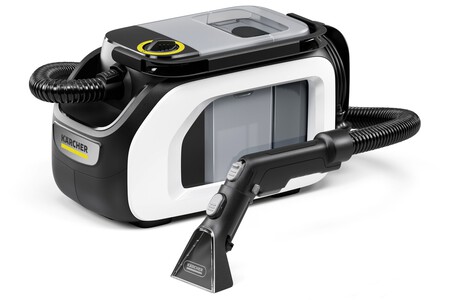
Before continuing, let me explain how a wash-and-vacuum works in case you don’t know: it’s essentially a vacuum that can inject clean water through a small diffuser into the hose. So as we pass over surfaces spraying water, we can also vacuum, pulling dirt from the textiles.
Bear in mind that they aren’t vacuums designed to operate dry, like a conventional vacuum. We can’t pick up debris as large as with a normal vacuum, and it will always be a handheld, hose-connected vacuum. In exchange, we have a product with a specific function to drag dirt and water.
And what if I already had one—why would I want another that’s basically the same? Well, firstly because I’ve caught the cleaning-product hobby bug. Secondly, this hobby is getting out of hand. I also bought a steam cleaner as a complement to tackle tougher grime, which is a perfect partner for a wash-vacuum. But let’s get to the point.
If you look at the raw specs, moving from the previous Bissell Spotclean to Kärcher seemed like a silly decision. To begin with, they cost about the same, with €20 in favor of the one I was using: €199.99 for the Bissell vs €219.95 for the Kärcher.
In return, I would lose some power, dropping from a 750W motor to a 500W one, and I would also lose capacity for clean water—from 2.8 to 1.7 liters, which is a big difference.
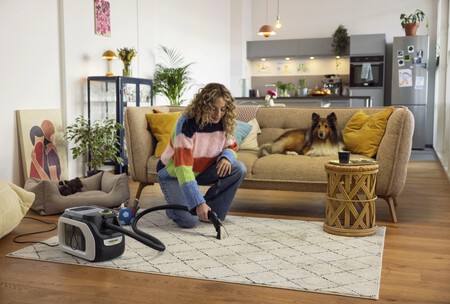
That said, as I used the first wash-vacuum, I realized there were many aspects to improve, such as the way the clean-water reservoir is filled, the capacity, extraction and cleaning of the dirty-water reservoir, and the length of the hose.
The Kärcher SE 3 improved all of these points. The dirty-water tank capacity is 2.9 liters, allowing longer suction of liquids (almost two full fills of clean water), the hose length is 1.9 meters, and it’s also lighter, weighing a little over 4 kg.
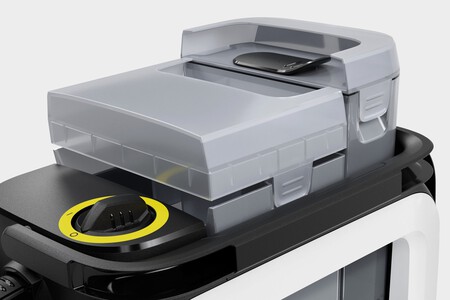
The big difference lies in the ease of handling the reservoirs. No tools or latches; you simply pull out the clean-water tank, remove a rubber plug, and fill it before placing it back in the device. The dirty-water tank is nearly the same.
When Cleaning Becomes an Addiction
Using this machine quite intensively I haven’t missed the power difference. Likely due to a nozzle design that channels suction more efficiently across the fabrics. The Kärcher doesn’t leave the upholstery any wetter.
The water-diffusion system can be accompanied by a smidge of detergent and/or fabric softener to improve cleaning and scent, but it’s crucial not to overdo it because otherwise you’d need to rinse with clean water to avoid soap residues.
Also, you should expect that nothing will leave a material completely dry. It will stay damp even after many passes, and you’ll need to ventilate well. Do not close the car completely after using it to avoid moisture odors.
The cleaning capacity is determined solely by how much the water drags; the more passes, the cleaner everything will be. What I did miss is perhaps a small brush to help loosen dirt as we pass the nozzle, as with the Bissell, though that might hinder suction. We can replace it with a handheld brush.
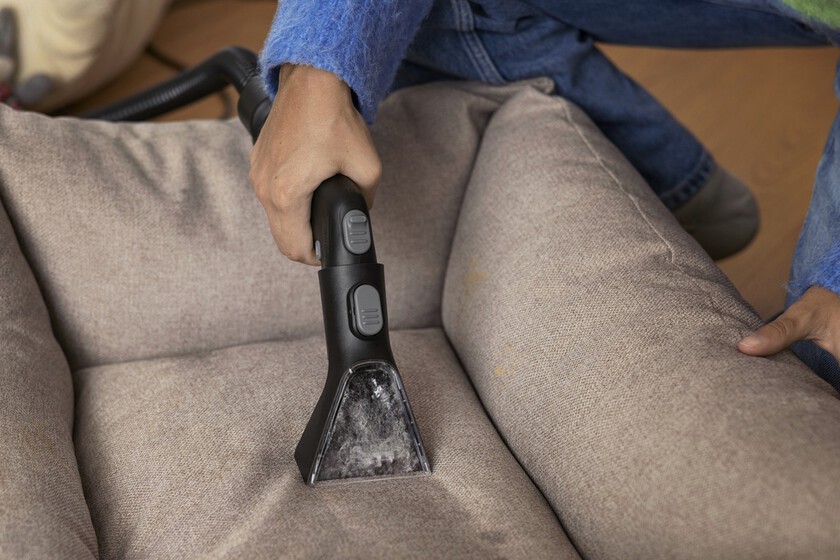
And yes, it vacuums very well. The transparent part of the nozzle lets you clearly see the dirty water and grime returning to the dirty-water tank, to the point that it becomes something incredibly addictive and satisfying.
The most tedious part of using this type of machine is the output we generate. The resulting sludge in the dirty-water tank is like a dirt smoothie. No matter how much or how little you vacuum, the water will always come out dirty, and you’ll wonder if you sit on that every day.
The dirty-water tank takes a bit more work but is easier to use than the Bissell. We remove it, take off the top lid, remove the filter, and pour the sludge down an appropriate drain. Don’t be dirty and dump it on the street or onto a plant, please.
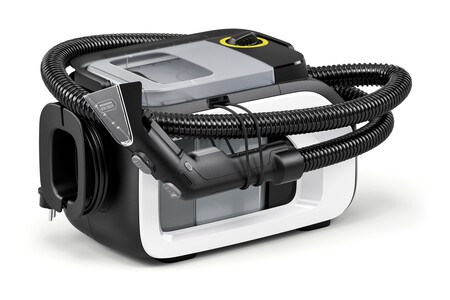
Something that I’ve found could be improved is the sensitivity of the dirty-water filter. It has a safety float that, when it detects the level rising, stops suction to prevent overflow. If, for any reason, the dirty liquid foams, the float rises too early and you end up needing to empty it frequently.
To clean the system and avoid odors, you can suction clean water before finishing, give the dirty-water reservoir a good flush, and leave everything open so it dries properly.
I’ve found that it stands out for its ease of use and effectiveness, especially once you get the hang of using it in succession and notice when the water starts coming out cleaner. It’s true that I’d improve some aspects, like cable management or the hose (which you wrap around and secure with a band), but I think it’s a very interesting product.
Especially because there will be many cases after the first intensive cleaning where you’ll only need a light mist and a superficial vacuum to keep the car clean, and fewer sprays means less drying time.
And when would I recommend a wash-and-vacuum instead of a conventional vacuum? I think I have a very clear answer: it depends on how much you like the feeling that the car is clean.