In Brief
The Maserati 5000 GT Frua, produced in only three examples, has carved its place in history as the first 5000 GT to receive the Maserati Classiche Authenticity Certification. Its singular journey carried it from the Persian royal court into the hands of eminent figures, undergoing notable mechanical and stylistic evolutions along the way. Its most famous instance, chassis 103064, belonged to the Saudi royal family before resurfacing on the international stage, restored. Rare, precious, and marked by a dramatic history, it embodies Maserati’s spirit of exception.
Produced in only 34 units between 1959 and 1964, the Maserati 5000 GT Frua stands among the Trident’s most prestigious creations. Today, one of its most remarkable examples, identified as chassis 103064, takes a new step in its story: Maserati Classiche has just granted it its Authenticity Certification, making this car the first 5000 GT to receive this official recognition.
Maserati 5000 GT Frua: the birth of an exceptional GranTurismo
The tale of the Maserati 5000 GT begins in the late 1950s. Enchanted by the 3500 GT, the Shah of Persia desired an automobile even more refined, more powerful, and more prestigious, worthy of his rank. Maserati rose to the challenge under the direction of Giulio Alfieri, then the marque’s technical director and one of the artisans behind its postwar development. The project, codenamed AM103, aimed to translate the competition experience into a GranTurismo form. The result did not merely meet expectations; it delivered a 5.0-liter V8 derived from the engine of the 450S. In its initial configuration, this unit produced more than 350 horsepower, a formidable figure for its era. To clothe the mechanicals, Maserati enlisted the era’s premier Italian coachbuilders. The first interpretation was entrusted to the Carrozzeria Touring. Unveiled at the Turin Motor Show in 1959, this two-door coupe would be produced in only three examples and would forever be associated with the Shah of Persia in reference to its royal patron. Subsequently, other studios joined the venture, including Allemano, Pininfarina, Monterosa, Ghia and Frua. Over the course of its career, the 5000 GT also benefited from mechanical evolutions, notably with the adoption of Lucas indirect injection and chain-driven camshafts. The power then hovered around 340 hp. In total, a mere 34 units were produced between 1959 and 1964, making the 5000 GT one of Maserati’s rarest offerings. Among them, the three Frua-bodied cars in 1962 hold a special place. Their elegance and unmistakable visual identity have made them highly sought-after interpretations. The first of them is today the model that has just been certified by Maserati Classiche.
Maserati 5000 GT Frua: a sculpted elegance in the details
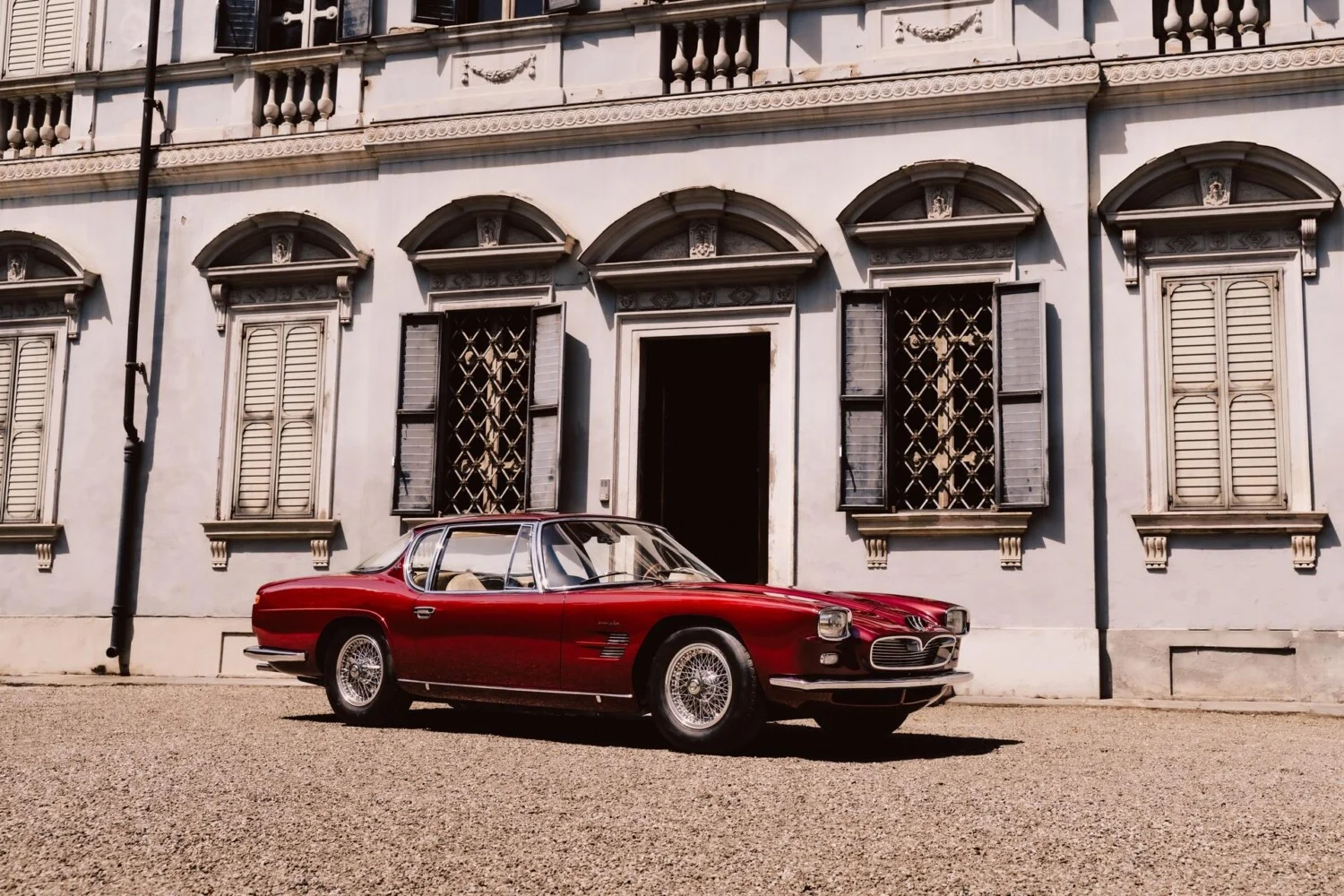
The first coupe stands out with its exclusive livery Luci di Mezzanotte paired with a refined interior in Camoscio suede. Before its debut, the automobile was employed by Maserati for testing and demonstrations, before making its debut at the Geneva Motor Show in 1963. Compared with the versions signed by Touring and Allemano, Frua’s interpretation favors a smoother, brighter silhouette with expansive glass surfaces, a lowered beltline, and carefully studied proportions. The bodywork is characterized by sculpted volumes, muscular shoulders, and sinuous curves that lead the eye toward the stern. Chrome accents emphasize the lines, while the Trident, placed in the recess above the grille, reminds onlookers of the marque’s identity. After Geneva, the exemplar joined the importer in France. It was there that Karim Aga Khan IV had the chance to take the wheel. The experience left such a mark on him that he subsequently commissioned a Maserati 5000 GT bodied by Frua for his own collection.
Maserati 5000 GT Frua: a story worthy of a novel
Chassis 103064 hides a dramatic journey. At the end of 1963 the prototype returned to Modena before being sold to Rome. In January 1966, its owner acquired a new Maserati and returned the 5000 GT to the factory. The following month, it underwent a comprehensive overhaul. At the request of its new owner, it was also repainted in a striking shade named Rosso Rubino Chiaro, a light ruby red. The new owner was none other than Saudi prince Magid bin Saud, who decided to present the car to his father, King Saud bin Abdulaziz Al Saud. The 5000 GT then began a new chapter. In 1967, following the Six-Day War and the departure of the Egyptian ruler, the car was seized by Egyptian authorities. It vanished for more than thirty years, kept in a warehouse in Cairo. Yet when the car resurfaced in 2000, its odometer read just 12,700 km, and its pristine original condition was remarkably preserved.
A Texas-based collector acquired it and decided to repatriate it to Modena for a full restoration. The work spanned four years. In 2004, the Maserati 5000 GT Frua rejoined the world stage at the Concorso d’Eleganza Villa d’Este. Its return to international prominence was celebrated with a special distinction, recognizing the revival of a car whose trajectory seemed almost scripted from a novel.
Source : Maserati
Comparison Table
| Model | Production Period | Units Built | Engine | Power (hp) | Notable Feature |
|---|---|---|---|---|---|
| Maserati 5000 GT (all bodies) | 1959-1964 | 34 | V8 5.0 L | 340-350+ | Very rare, multiple coachbuilders |
| 5000 GT Frua | 1962 | 3 | V8 5.0 L | 340-350+ | Frua coachwork, exclusive design |
| First Frua, chassis 103064 | 1963 | 1 | V8 5.0 L | 340-350+ | Certified by Maserati Classiche |
Key Takeaways
- The Maserati 5000 GT Frua is one of the marque’s rarest and most prestigious models, with only three examples built.
- Chassis 103064 is the first to receive the “Maserati Classiche” Authenticity Certification.
- This car has belonged to royal families and has undergone an exceptional arc including disappearance and restoration.
- Its 5.0-liter V8 engine develops over 350 horsepower, a feat for its era.
- The restored example was honored at the Concorso d’Eleganza Villa d’Este in 2004.
- The Maserati Classiche certification officially verifies the authenticity and historical value of the model.
FAQ
How many Maserati 5000 GT Frua units were produced?
Only three units of the Maserati 5000 GT Frua were built in 1962.
What makes the Maserati 5000 GT Frua so special?
Its rarity, its royal-family connections, and the Maserati Classiche certification make it a unique and highly sought-after model.
What is the engine power of the Maserati 5000 GT?
The 5.0-liter V8 initially develops more than 350 horsepower, a remarkable performance for its era.
What happened to chassis 103064 after 1967?
After being stored in Cairo for more than thirty years, the car was restored in the early 2000s and returned to the international stage in 2004.
Why is the Maserati Classiche certification important?
It officially attests to the car’s authenticity and historical compliance, thereby strengthening its heritage value.