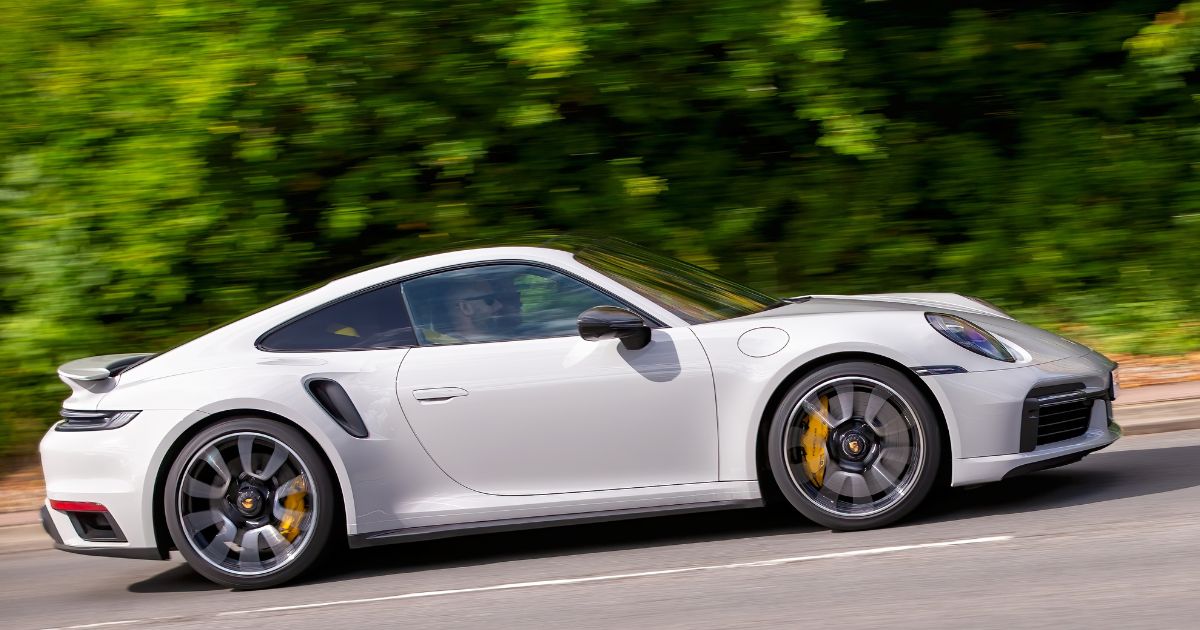
Two supercars, including a Porsche, sit side by side on a broad urban avenue, a green light turning, and a sprint to roughly 107 mph where the posted limit hovers around 35 mph. The scene feels cinematic, except this one unfolds after dark on Bridgeport Way W in University Place, Washington, and it ends with a tow truck—and handcuffs.
At the center of the tale are a Porsche 911 and an Audi R8, driven by two 25-year-old men suspected of street racing and reckless driving. Their mistake wasn’t just turning a once-33-meter-wide stretch into an improvised racetrack; it was also recording everything onboard on a dash cam. The onboard camera would become the sheriff’s department’s strongest ally….
A run at around 107 mph in the city, with no pursuit
According to the Pierce County Sheriff’s Office, the events occurred on September 8, 2026, around 9:30 p.m., on Bridgeport Way W in University Place. Deputies conducting a speed-enforcement operation spotted a Porsche 911 and an Audi R8 side-by-side in a downtown urban zone limited to about 35 mph. The two cars accelerated hard, and GPS data later showed one of them reaching nearly 107 mph, more than three times the limit on that stretch.
Then came a crucial decision: instead of chasing two aggressively driven sports cars, the deputies stood down from pursuit. The patrol briefly lost sight of the pair, only to locate them later parked side-by-side in a nearby lot. The two 25-year-old drivers were detained for street racing and reckless driving, and the vehicles—initially described as unlicensed—were towed under a 72-hour hold mandated by Washington’s new anti-street-racing law that took effect in 2024.
The dashcam as evidence, the anti-street-racing law in force
Once the vehicles were found, the investigation didn’t stop with the deputies’ eyewitness accounts. The sheriff’s office secured a warrant to seize the dash cam installed in the Porsche 911. The onboard camera records timestamps, the GPS-indicated speeds, and multiple angles of the scene. The footage clearly shows the two supercars accelerating in unison, with a peak around 107 mph on a portion of Bridgeport Way W that is posted at roughly 35 mph. This time, speed is not an impression—it’s quantified data, with time stamps and precise numbers that resist debate.
The 2024 anti-street-racing law in Washington provides a very clear framework for cases like this: any vehicle involved in a street race can be impounded for 72 hours on the first offense, and the authorities can seize and use onboard recordings as evidence under a warrant. On a second offense, the vehicle itself can be forfeited. In this case, both sports cars remained in the impound for at least three days while investigators sifted through the footage and completed the case file. The sheriff’s office has not yet released specifics about the charges that may follow for the two 25-year-olds beyond the tow, custody, and anticipated insurance increases. In France, a city-speed run of this magnitude would also be treated as a grave traffic offense with steep fines and potential vehicle confiscation, illustrating how passionately enthusiasts can blur the line between admiration and danger when performance moves from the track to public streets.