
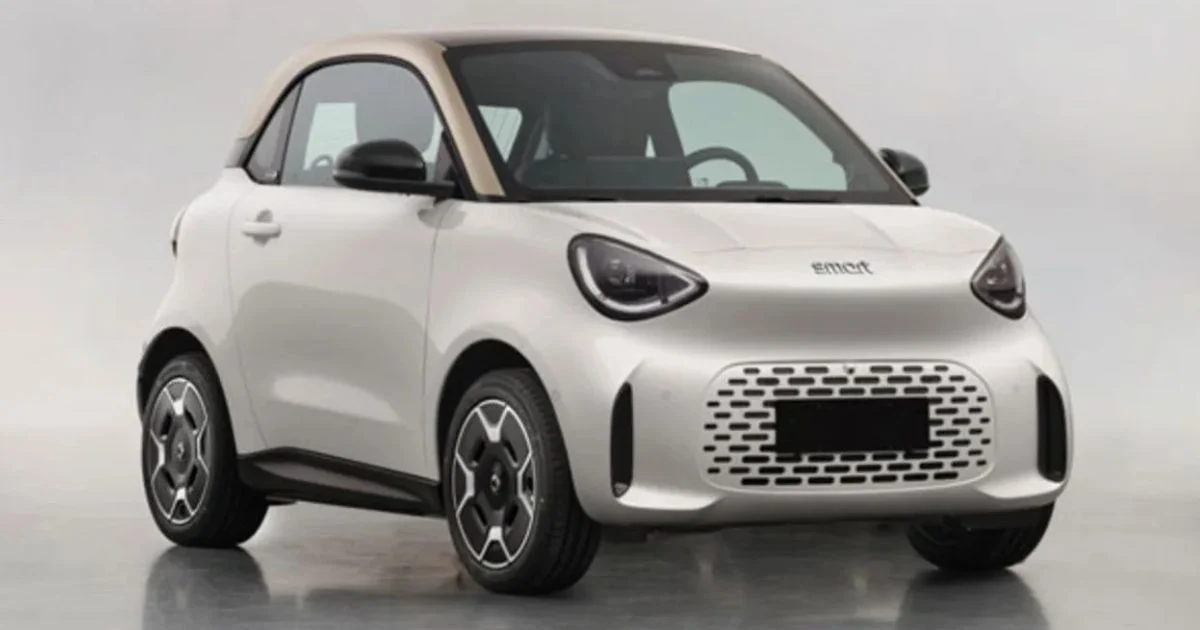
An ultra-compact car, two seats only, with the ability to turn on a dime. Many people thought this formula belonged to the past, replaced by much larger electric SUVs. And yet. The iconic city car that has defined European downtowns is staging a comeback in a 100% electric version, more technically refined than ever, while staying true to its tiny footprint.
Early details about the Smart #2 Electric confirm a genuine return to the Fortwo’s original philosophy, with a length under 2.80 m and a record-breaking turning radius. Across from it, the Renault Twingo E-Tech remains today one of the benchmarks in the micro city EV segment. But the new Smart, expected in 2027, already promises a longer range and faster charging than Renault’s small car, which could change daily life a lot.
Smart #2 Electric: Back to the Fortwo Spirit, with More Room Inside
At first sight, the Smart #2 adopts the design cues that made the Fortwo a success. The car was crafted by Mercedes-Benz’s global design team and stays faithful to the classic Smart proportions. Expect a simple, rounded front face, slim LED-signature headlights, a monovolume silhouette, and almost non-existent overhangs. The wheels hug the corners while pronounced wheel arches evoke the 2000s icon.
The dimensions back up this positioning. The Smart #2 Electric measures about 2,751 mm (about 9.0 ft) long, 1,669 mm (about 5.5 ft) wide, and 1,555 mm (about 5.1 ft) tall, with 15- or 16-inch wheels. It is therefore nearly a meter shorter than the new Renault Twingo, which sits around 3,790 mm (about 12.4 ft) long, while being a touch taller. A detail that matters in the city, where every centimeter counts for parking. The stated turning radius, around 6.95 m (22.8 ft), remains close to the old Fortwo’s and significantly smaller than the 9.87 m (32.4 ft) of an electric Twingo, making U-turns in tight streets easier.
At the rear, the roof visually appears to float thanks to a black belt along the C-pillar, a treatment already seen on other models from the brand. The rounded taillights stay simple, in the “friendly” spirit of the early Smart cars. Even the tailgate release button has evolved, now located above the license plate, in a more traditional position than on some other recent models. Everything is designed to feel familiar to old Fortwo drivers while updating the look for the electric era.
The interior, however, shifts its philosophy. The compact Smart adopts a two-seat bench instead of two separate seats, to give a sense of space and openness despite a sub-9-foot footprint. The dashboard takes on an S-shaped contour designed to maximize knee and foot room. The idea is to make the cabin feel more welcoming than before, even though the Smart #2 remains strictly two-seater, whereas the Renault Twingo E-Tech offers four seats and rear doors. The trade-off is clear: less family versatility, but a true salon-like experience for two in the city.
Range and Charging: the Smart #2 Takes the Lead Over the Renault Twingo
If the new arrival catches the eye with its tiny footprint, it’s mainly its technical spec that places it ahead of the Twingo. The Smart #2 Electric rides on a new platform dedicated to small, battery-powered cars, called Electric Compact Architecture, developed with Geely. It features a rear-mounted motor of about 60 kW (roughly 82 hp), driving the rear wheels. Target top speed is around 140 km/h (87 mph), enough for occasional highway hops. All of this with a curb weight of roughly 1,130 kg (2,491 lb), which remains reasonable for an EV.
Most notably, the battery is an LFP pack supplied by CATL, with a capacity of about 35.7 kWh. The homologation target sits near 300 km (about 186 miles) of WLTP range, a figure corroborated by various technical sources. In comparison, the current Renault Twingo E-Tech sticks to a usable pack of around 22 kWh for roughly 190 km (about 118 miles) WLTP. Even the upcoming Twingo E-Tech, advertised with a battery close to 27.5 kWh, aims at around 263 km (about 163 miles) WLTP. On paper, the compact Smart thus delivers better range, while remaining noticeably shorter and clearly urban-oriented.
The gap also widens on fast charging. The Smart #2 Electric targets 10–80% charging in under 20 minutes on a DC fast charger. The exact power isn’t yet disclosed, but the goal is clearly to allow a quick energy top-up during a brief coffee stop. The Renault Twingo E-Tech, when equipped with the Advanced Charge pack and DC charging up to 50 kW, requires about 28 minutes to move from 15 to 80%. The difference looks modest on paper, but it matters to those planning occasional suburban hops or a 150–200 km weekend round trip.
The calendar still has a bit of time left for decisions. The world premiere of the Smart #2 is scheduled for the Paris Motor Show in October 2026, with European sales expected in 2027. Early estimates place the starting price at around £20,000 to £25,000, which translates to roughly €23,000 to €29,000 at current exchange rates, putting it above a standard Renault Twingo E-Tech. The moment will come to learn the final specifications and French pricing to measure, with data, the place this two-seat micro-city will occupy against Renault’s four-seat city car on the streets of big cities and in their future low-emission zones.