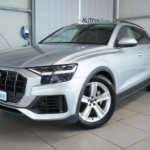
Seeing a carmaker go after its own brand name feels like a bad legal gag. Audi vs AUDI isn’t a joke, but a real case brought before German courts, set against the backdrop of two China-only electric models unexpectedly arriving in Europe.
These models, the AUDI E5 Sportback and AUDI E7X, should never have left the Chinese market. A German parallel importer, Auto China, nonetheless began selling them in Germany after getting them homologated locally, prompting Audi to react quickly. And that’s where the paradox takes shape: the same name on paper, different products, and a manufacturer determined to keep its own Chinese cars from circulating on its historic market.
Two Audis for One Name: Audi in Europe, AUDI for China
In Europe, Audi remains the brand everyone recognizes: the four rings, Ingolstadt, from the A3 to the Q8 in showrooms. In China, there is now a distinct entity, written in uppercase, AUDI, born from a joint venture with SAIC Motors and dedicated to electrics built specifically for that market. Audi itself describes it as a “sister brand” exclusive to China, with a separate visual identity and models that do not cross into Europe.
The AUDI lineup sits on the Advanced Digitized Platform (ADP), designed around a Chinese digital ecosystem. Infotainment, connected services, mapping, over-the-air updates—everything is tuned to local infrastructure and uses. Even the logo changes: these cars drop the four rings and carry a simple AUDI inscription on the grille. For a European customer, the risk of confusion remains evident, since the name stays the same and the aura of the German brand is instantly associated with it.
Why Audi Wants to Block the AUDI E5 Sportback and E7X Imported by Auto China
At the heart of the case is Auto China, a German parallel importer already known for bringing Xiaomi- and Huawei-branded vehicles onto German roads. Its approach is straightforward: buy the models in China, ship them by sea, then homologate them one by one so they can circulate in Germany. This time, the catalog offered the AUDI E5 Sportback and the large SUV AUDI E7X, two models the parent company had no plans to sell in Europe.
On its site, Auto China listed the E5 Sportback at €59,980 and the E7X at €72,900—prices that are well over double what the cars cost in China, where the E5 starts around €26,269 and the E7X around €34,407. Yet these numbers remained attractive when compared with official Audi EVs, with an electric S6 Sportback listed at €99,500 and a SQ6 at €93,800.
In response, Audi launched legal actions to halt these imports and reminded two key points. First, the AUDI models do not carry European type approval and do not appear in the official lineup. Second, neither the parent company nor non-Chinese dealers can service, diagnose electronics, provide software updates, or supply parts for these cars, effectively treating them as coming from a different manufacturer. The dealer networks are not equipped to handle a 900-volt architecture, 100- or 109-kWh batteries, more than 750 km of claimed range (Chinese CLTC), or 4C charging from 10 to 80 percent in 13 minutes, nor to support an E5 Sportback capable of up to around 787 horsepower and a 0–60 mph time of about 3.4 seconds. If a buyer arrives at a dealership with a problem and is turned away, the logo still looks identical to the customer, and it is precisely the four interlocking rings that the automaker seeks to protect by shutting the door on this parallel import.