SLOWLY but surely, the bird builds its nest! With plenty of help from eco-friendly incentives, social leasing, but also punitive taxes and fines for manufacturers that miss the CAFE standards, electric cars are taking root in the automotive landscape. These days, they account for as much as 30% of new-car sales.
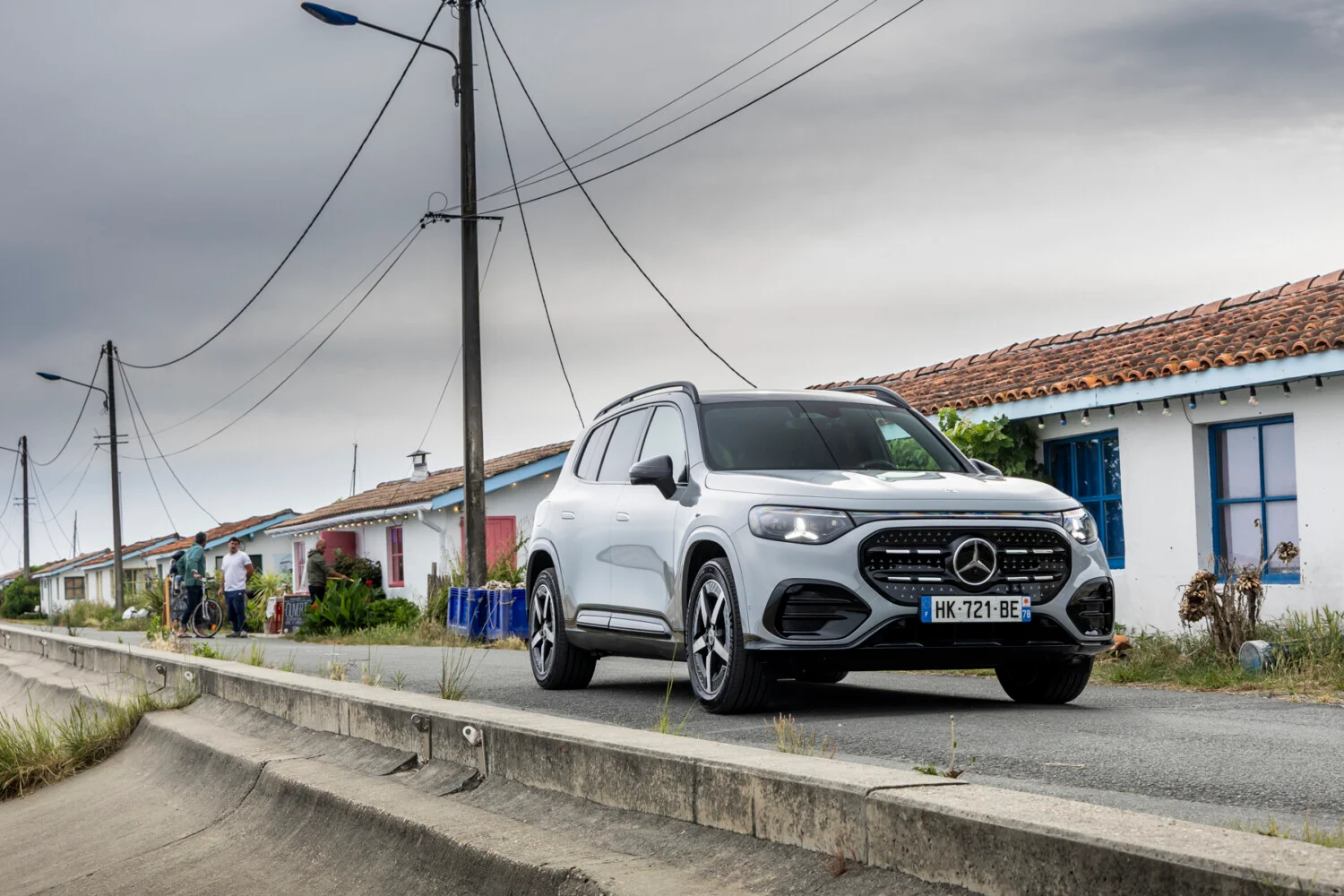
Mercedes GLB 250+ 272 hp / 85 kWh* Limited Edition: seven on board
Step by step, reluctance fades as the latest models have improved—driven, no doubt, by the lively Chinese competition, which also slashes prices. Yet Europeans respond quickly and effectively: bigger batteries to boost range, faster charging, and lower prices. Manufacturers often trim margins (just a bit, let’s be honest) to offer prices that qualify for purchase incentives, and even present their electric models as cheaper than their internal-combustion equivalents. Case in point: Mercedes, with its new CLA, CLA Shooting Brake, and GLB sharing the same “MMA” (Mercedes Modular Architecture) platform, capable of accepting both combustion engines (hybrids in this case) and electric powertrains. After initially pushing hard on EQ models and promoting a separation of segments, the German brand steps aside from those not ready to drop combustion engines. But clearly, everything is designed to push buyers toward electric, including the family vehicle—the large SUV (4.73 m long) that can seat up to seven people.
Mercedes GLB 250+ 272 hp / 85 kWh* Limited Edition: noEco boost
For the GLB 250+, there’s no eco incentive on the table—only the entry-level 200 version dips under €47,000 but with a 58 kWh pack—yet there is an 85 kWh battery that, on paper, promises up to 633 km of range: more than enough for family road trips. And most notably, a charging speed of up to 320 kW (thanks to the 800 V architecture) to avoid roasting in the sun while waiting at the charger. Mercedes claims 22 minutes: just enough time for a coffee break or to stretch the dog’s legs. And while this €55,900 version isn’t exactly a bargain—and the German maker tends to make up the price through optional equipment—it is ultimately cheaper than its hybrid 220 counterpart with 190 hp and 300 Nm, which suffers from double CO2 and weight penalties.
My teammate Yann Lefebvre and I—feeling pretty confident about driving back to Paris in our stylish, brand-new SUV—took our time on the Basque back roads to gauge what it can do both on the road and under the hood. After all, a SUV of more than 4.70 meters in length and nearly 2 meters in width (including mirrors) commands attention on secondary roads, and it isn’t exactly a nimble city cruiser.
Mercedes GLB 250+ 272 hp / 85 kWh* Limited Edition: an admittedly artificial-sounding feel
Additionally, the steering feel is rather artificial, which doesn’t help the driver get precise feedback. Still, given the size and mass of the vehicle, it remains planted on its corners and shows little body roll. With its family-leaning reputation and vocation, the comfort aspect is where it shines—both in suspension work and in sound insulation. For context, our test model rode on the standard Comfort suspension (as standard) and used the optional sound-damping glass, part of the Premium Plus package priced at a steep $4,600. That choice isn’t contradictory with AMG Line sport seats that offer better support than the base seats. Focusing on comfort, ride quality, and the cabin ambiance—especially with the panoramic glass roof as standard—fits perfectly with the GLB’s family-oriented mission. With 272 hp and 335 Nm of torque, performance isn’t a topic of debate: it isn’t breathtaking, but it’s more than adequate in every scenario, including when you want to tow—as the GLB can haul up to 3,300 pounds (about 1,500 kg).
Mercedes GLB 250+ 272 hp / 85 kWh* Limited Edition: a fairly tight turning circle
In city cruising, this big rig surprised us with its reasonably tight turning radius, making parking and maneuvering less stressful. I’m not saying you can nail a perfect 180-degree turn in a single move, but there’s no need to fear a crawl of maneuvers or multiple back-and-forths just to turn around. It’s time to hit the road again!
As we head north toward Paris, we don’t obsess over the claimed range—though its real-world figure is sometimes lower than Mercedes’ optimistic numbers. On the day we collected “our” GLB with the battery at 96%, the trip computer showed a bit over 500 miles of range, which isn’t bad at all. And as soon as we left the Basque country, the remaining charge didn’t cause anxiety about squeezing out another few hundred kilometers. The GPS warned us we would need two charging stops, but only about 22 minutes total. When we hit 17% battery, a massive 800 V charging station opened its arms to us—hallelujah! We could finally put the speed claim to the test. Done.
Mercedes GLB 250+ 272 hp / 85 kWh* Limited Edition: concerns about charging?
In the early minutes, we were charging at more than 300 kW. It only took a moment to study the charging curve and grab a quick coffee before continuing with over 90% in the bank. Under those conditions, there’s nothing to complain about. But during the second stop, a question crept in. Will we be able to charge at one of TotalEnergies’ 175 kW stations, i.e., 400 V charging? In theory, no, because the GLB ships standard with 800 V fast-charging and Mercedes charges a 700 € option for a 400 V converter—an odd limitation that could be a deal-breaker for long-haul travelers. For serious road trippers, that option seems essential.
Granted, the 800 V network is expanding, but for now, to plug into all available DC chargers, you need that option. Our car had it, so we thought we were golden—except the station had five stalls and all were occupied.
Mercedes GLB 250+ 272 hp / 85 kWh* Limited Edition: the cost remains…
And we’re not even in peak vacation season yet. In the queue, we got some friendly jabs from petrol-fueled drivers: “Nice, electric—patience, please.” It’s all in good humor. Another hiccup: a neighbor at the charger couldn’t disconnect—the typical bug that happens from time to time. The Xpeng assistant friendly advised him to turn the car off and back on, and the disconnect issue disappeared. It’s also possible that the charger itself was the culprit. In some cases, a call to the distributor’s help center is necessary. Despite these snags, which aren’t the GLB’s fault, the argument that charging times are unreasonably long doesn’t hold water anymore.
Cost, of course, looms large. Charging away from home isn’t free. Operator subscriptions reduce the per-kWh and per-kilometer cost to a level that’s typically more attractive than fueling with fossil fuels at over €2 per liter. In short, the economics are moving in favor of EVs for families who drive a lot.
Mercedes GLB 250+ 272 hp / 85 kWh* Limited Edition: the pros
- Range and fast charging
- Comfort
- Interior space
Mercedes GLB 250+ 272 hp / 85 kWh* Limited Edition: the cons
- Steering feel is less informative
- Cheeky options catalog
- Some wind noise at speed
The Auto Journal’s verdict: 4/5
By combining a “comfortably usable” range with rapid charging, the GLB breaks down the final barriers to buying an electric family car as a single-vehicle solution. It isn’t cheap, but it’s cheaper than its gasoline twin, which leaves it with fewer arguments in its favor.
Find our road-trip review of the Mercedes GLB 250+ 272 hp / 85 kWh* Limited Edition in The Auto Journal issue No. 1216, dated 09/03/2026.