In the race to bring AI to the wheel, Mercedes-Benz just landed a heavyweight ally. The German automaker signed a production agreement on September 22, 2026 with the British startup Wayve. The goal: weave Wayve’s driving software, Wayve AI Driver, into future models. The plan calls for rollout to customers of a production car within two years, packaged as a new generation of city and highway driving assist features.
Wayve bets on an end-to-end AI approach. It is designed to make driving decisions on the fly, rather than relying on highly detailed HD maps. Its software should handle point-to-point trips in urban settings as well as on freeways. It adapts to each situation in real time. On paper, integrating Wayve AI Driver into the Mercedes ecosystem promises a clear leap forward. Relative to current assistance systems, the ambition is substantial. But for drivers one question remains: What will this AI actually do in a Mercedes, and on what concrete timeline?
A Mercedes-Wayve deal for point-to-point driving AI
The production agreement extends an existing technical collaboration that has been building for several years between Mercedes-Benz and Wayve. The German group also participated in Wayve’s latest funding round, alongside other automakers like Nissan and Stellantis. Wayve is therefore not an exclusive partner of Stuttgart; it is one of several driving-AI suppliers aiming to equip multiple major brands. Tests have taken place in Stuttgart, London, and San Francisco. They demonstrated the software operating on production cars, in city traffic, on highways, and on secondary roads.
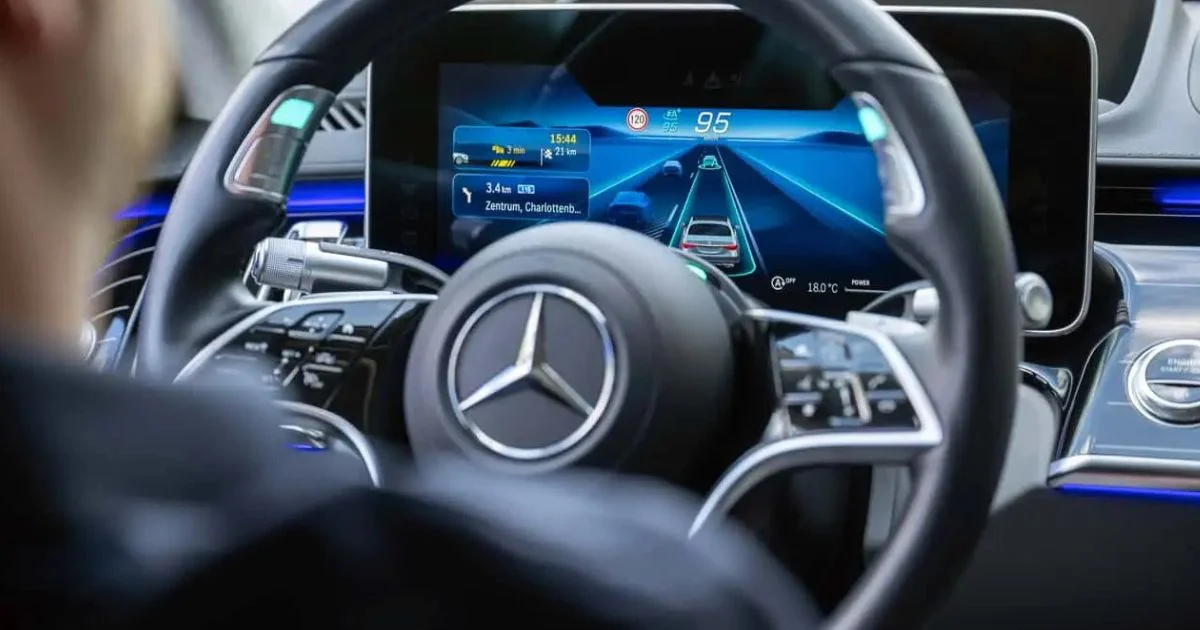
Technically, Wayve AI Driver stands out for its end-to-end approach. The system learns to interpret camera images and sensor data directly. It decides what action to take without leaning on detailed maps or city-by-city geofencing. The stated aim is point-to-point driving assistance, in both city streets and on freeways. In this setup, the car handles a large portion of tasks but remains under continuous human supervision. No official automation level has been published yet, and there is no publicly identified initial market for launch. The announcements only indicate an integration into production models within the next two years, with no model name or precise commercial date disclosed.
A new pillar in Mercedes’ driving-assist strategy
For Mercedes, this AI is not coming from a blank slate. The brand has trailblazed with the Distronic distance regulator in the 1990s. Since 2023, it has offered Drive Pilot, a Level 3 system that has been certified for use in the United States and Germany. This setup is already available on the S-Class and EQS. In parallel, Mercedes unveiled MB.Drive Assist Pro, an advanced Level 2 system. It runs on an Nvidia-based platform and the in-house MB.OS operating system. It has been demonstrated on the new CLA but is not yet in production. In China, the automaker is also working with Momenta, a partnership focused on parking-assisted driving that is adapted to local conditions.
The choice of Wayve AI Driver thus adds a third layer to this strategy. On one side, you have the classic Level 2 aids and the forthcoming MB.Drive Assist Pro. On the other, you have Drive Pilot, a Level 3 system for well-controlled routes. In addition, there is an online-learning driving AI designed to follow an entire trip under human supervision. For customers, the challenge will be less about which computer is in charge and more about understanding how these building blocks add up in daily use. Competitors are not standing still. Volkswagen’s IQ.Drive is already in dealerships. Wayve is also lined up for integration with Nissan and Stellantis, with launches slated from 2027. Until Mercedes confirms its first models equipped with Wayve AI, drivers will need to watch the technical specs closely. That will be one of the big themes for new products in the coming years.