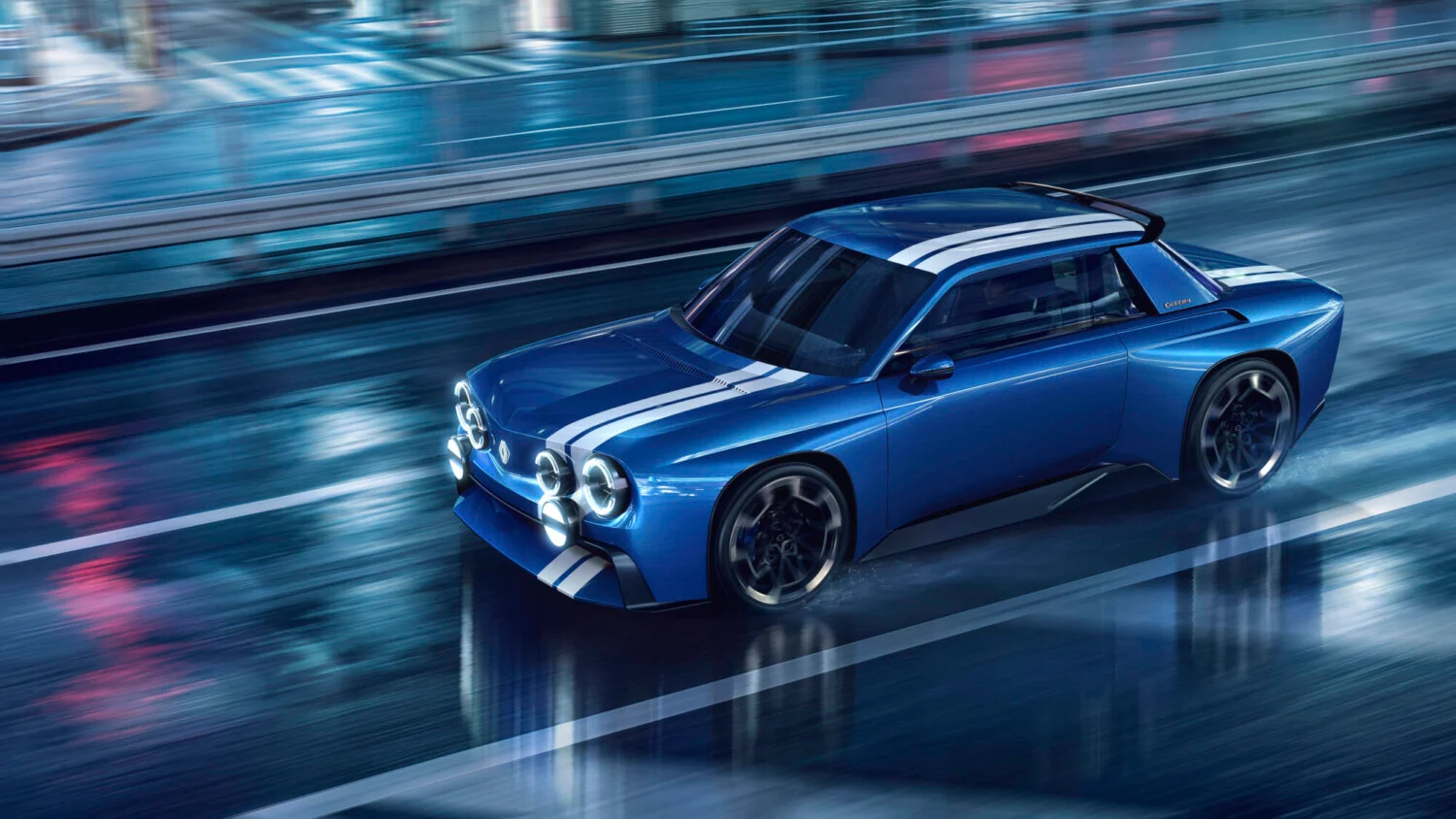
Renault keeps reviving the models that have defined its history. This time, the French automaker turns its attention to the iconic Renault 8 Gordini with a concept that blends 1960s references and modern technologies. The lineup features a two-seat coupé, a 270-horsepower electric powertrain, and rear-wheel drive. But this new R8 Gordini will not make it to series production.
Renault reimagines the legendary R8 Gordini
Following electrified versions of the Renault 4, Renault 5, and Twingo, not to mention the R17 concept, the lozenge-brand continues to mine its rich heritage. For this new creation, the brand selected one of its most famous historic sportscars.
The project mobilized the house’s designers through an internal contest. More than 300 proposals were imagined, with approaches ranging from very close to the historical model to much more modern interpretations.
After an initial screening, two projects were developed as 2/5-scale models. The final version ultimately blends elements from these two proposals.
Rather than simply modernizing the four-door sedan from the 1960s, Renault completely redefined its proportions. The R8 Gordini becomes a strictly two-seat coupé with a notably low profile.
At 13 feet 6 inches long, 6 feet 2 inches wide, and only about 4 feet 2 inches tall, this interpretation of the Renault 8 sportscar sports a silhouette that is far more muscular than that of its predecessor.
A 270‑hp electric coupé with rear-wheel drive
The wheel sizes amplify this impression. They measure 19 inches at the front and 20 inches at the rear. The mechanical revolution continues. The gasoline-powered rear engine of the historic R8 Gordini is, of course, no longer part of the program. A 270-horsepower electric motor replaces the old combustion unit.
An important detail from the original recipe has, however, been preserved. The rear wheels stay driven. This electric R8 Gordini remains a rear-wheel‑drive car, despite a technology that is completely different from what was used over six decades ago.
Impossible to reinvent Gordini without keeping some of its signature traits. Renault has therefore revived the famous Bleu de France bodywork, crossed by two white stripes.
These stripes play a more prominent role than on the historic model. They are integrated directly into the car’s design and extend into the cabin, where their color gradually shifts from white to blue.
Other details help signal the inspiration. The fender flares adopt a squared shape, just like the original R8 Gordini. Meanwhile, the round headlights reference the six lamps used on the era rally car. The small shell-shaped mirrors and the grille located at the base of the windshield are other nods to the past.
A retro cockpit with no giant screen for the modern Gordini
The old stepped beltline has also been reinterpreted. This time, it’s not purely cosmetic; it helps guide air toward an intake.
Inside, Renault deliberately avoids turning this Gordini into a digital showroom. The dashboard adopts a deliberately simple presentation with a brushed aluminum panel.
Instead of a massive central screen, several small circular digital displays evoke the original R8’s gauges. The bucket seats feature blue corduroy, while Alcantara completes the interior ambiance.
A red stopwatch button adds a sporty touch. The logo also received special treatment. The Gordini lettering takes on a more modern look, while the number “8” is now formed by eight segments.
Despite its neo-retro styling and the 270 horsepower sent to the rear wheels, this new R8 Gordini won’t join Renault 4, 5, or Twingo in showrooms. The manufacturer presents it as a design exercise aimed at exploring a potential modern reinterpretation of its historic models. No mass production is planned.
Fans will nonetheless be able to get up close soon. This electric Renault 8 Gordini will be on display at the Paris Motor Show 2026, running from October 12 to 18.