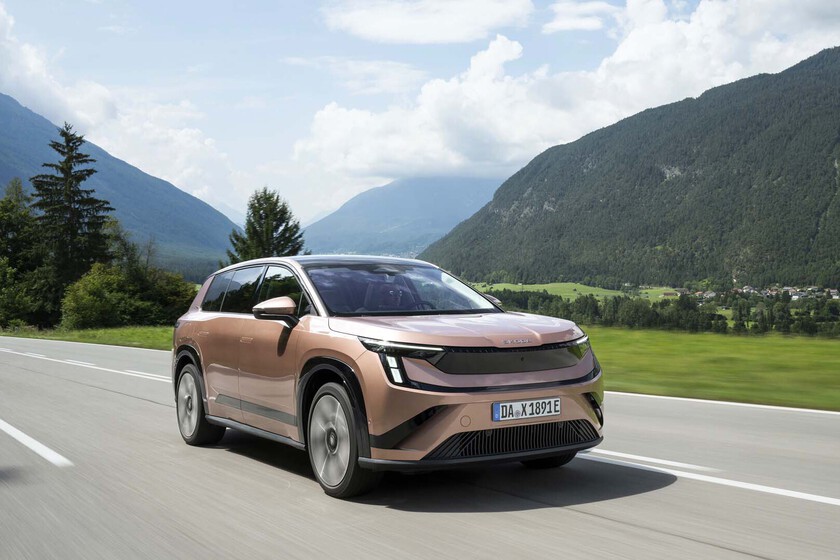
The year has started off strong for Skoda. While the first units of the Skoda Epiq are hitting the streets, the Skoda Peaq is about to land in Spanish dealerships.
This 4.87-meter-long SUV is the Czech brand’s new electric flagship, arriving in two variants: one with 286 hp and rear-wheel drive, and another with 299 hp and all-wheel drive, both offering more than 600 km of range, and with the option of five or seven seats.
A Step Forward in the World of Electric Cars
Like almost every brand within the Volkswagen Group, Skoda has been heavily investing in 100% electric vehicles for years. The first to arrive was the Skoda Citigo iV, back in early 2020, but it stayed on sale for a very short time; thus, the first serious commitment by Skoda to electric mobility really came with the Skoda Enyaq and Enyaq Coupé.
Later came its smaller sibling, the Elroq, aimed at a broader audience, but it is now that the folks from Mladá Boleslav have begun a particularly significant chapter in the race toward zero-emission vehicles because their electric family has just grown from both ends.

On the lower end, it has done so with the Skoda Epiq, a 4.17-meter-long urban SUV that is manufactured in Spain and which we mentioned a few days ago, while on the upper end the newly arrived Skoda Peaq stands as an SUV that becomes the Czech brand’s electric flagship.
With both models, Skoda begins a new era because they are part of Volkswagen Group’s new generation of electric cars that use the new MEB platforms. The Epiq sits on the MEB Entry platform and the Peaq on the MEB+, a modular architecture that, among other things, allows ranges of around 700 kilometers in WLTP combined cycle for sizeable cars.
In the case of the Skoda Peaq, it measures 4.87 meters in length. It doesn’t reach the Superb’s length by 4 cm, but it remains a large SUV, sufficiently roomy to offer interior configurations with five or seven seats, as is the case with the Kodiaq. More than that, we could say we are looking at the 100% electric equivalent of the Kodiaq in Skoda’s lineup.
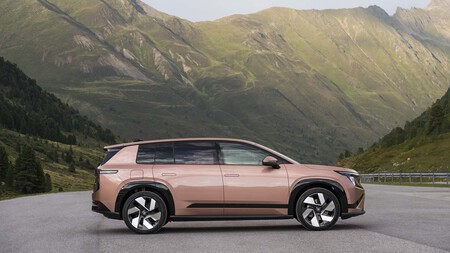
With that size and the possibility of seven seats, the Peaq competes in the same league as other electric vehicles such as the Kia EV9, the Hyundai IONIQ 9, or the Peugeot E-5008.
Within the Volkswagen Group, it is the only seven-seater electric vehicle, along with the Volkswagen ID. Buzz, but there is a major difference between that Volkswagen and this Skoda beyond design and the fact that VW is a minivan while Skoda is an SUV: the Czech car offers a lot more range.
The MEB+ platform has allowed Skoda to use the largest battery it has mounted to date in an electric car, an NMC pack with a capacity of 91 kWh (86 kWh usable), and that is enough for the Peaq to homologate 646 km of range in the WLTP combined cycle, at best, while the most capable ID. Buzz tops out at 467 km.
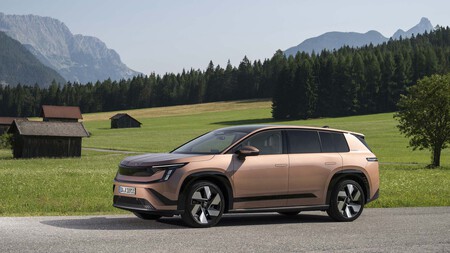
Clearly, they are very different cars, but in any case Skoda makes a statement within the Volkswagen Group because it has the family electric car with the most range in the group.
Skoda Peaq: Inside Look
That said, the seven seats are optional because it is available with five or seven seats. The good news is that, with either configuration, the boot is gigantic: 935 liters for the five-seat variant and 890 liters for the seven-seat version (this capacity is with the two rear seats folded).
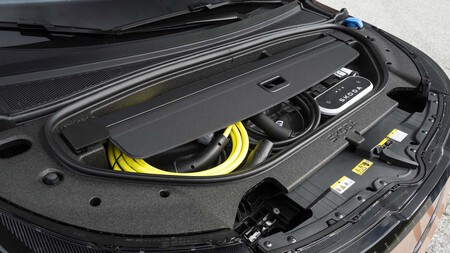
As if that weren’t enough, under the hood there is another small boot of 37 liters that is perfect for storing charging cables. And whenever more space is needed, all the seats except the front ones can be folded to achieve a total volume of 2,150 liters in the five-seat Peaq and 2,075 liters in the seven-seat version.
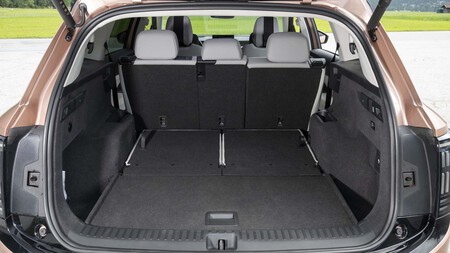
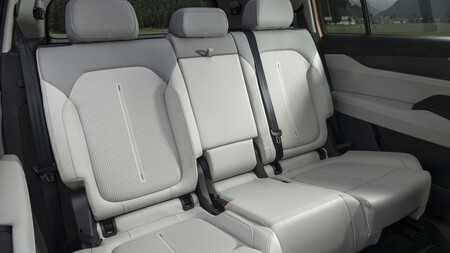
But it isn’t just luggage space. In both the five-seater and the seven-seater Peaq, second-row legroom is outstanding across the board.
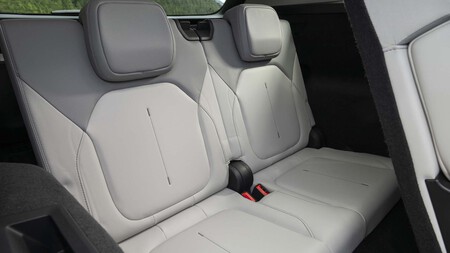
In the seven-seater, the third row of seats is spacious enough only for children or occasional use, given the limited space and access, which is not as comfortable as in a minivan and requires a certain level of agility to enter and exit.
And although it is very family-oriented, Skoda has done a good job with the driving position, as it is easy to find a good seating position behind the wheel, especially with the ‘ErgoSeat’ seats because they offer multiple adjustments and are incredibly comfortable, even including a headrest pillow.
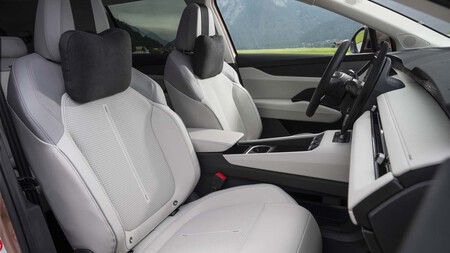
As you would expect in 2026, it is fully digital, yet it has practical physical buttons for key functions, such as managing the climate control, adjusting the audio volume, and turning the emergency lights on and off.
The wheel controls are also traditional push-button ones, which is good, as are the window controls and the adjusters for the exterior mirrors. The balance between screens and buttons is good.
There are plenty of storage pockets, and the screens are well resolved because both are large. The digital cluster displays a lot of information clearly, the Head-Up Display is very complete, and the infotainment works flawlessly, with total fluency and a design that is easy to get used to because it is highly intuitive. Like the Epiq, it uses a navigation system that rivals Google Maps or Waze.
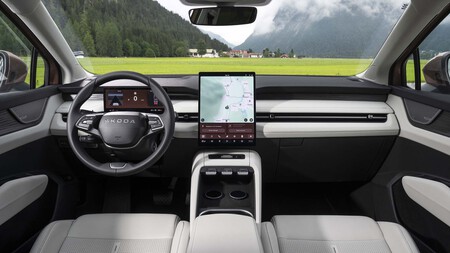
If you talk about quality, the Czech brand has done a good job, but it is its electric flagship and that’s warranted. The fit and finish are very good, and all materials feel high quality.
There are differences depending on the trim level; for example, in the Sportline finish the dashboard is trimmed in suede rather than faux leather, but the overall quality is good across all versions, both in appearance and touch.
Skoda Peaq: How It Goes
The experience is also satisfying when it’s time to start moving. In short, it is a car that is comfortable, easy to drive, pleasant, and frugal. But let’s go a bit deeper.
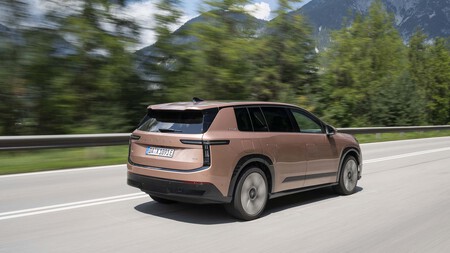
Although it is fast (the 90x version accelerates from 0 to 100 km/h in 6.7 seconds) and moves with great agility thanks to its 286 hp (90 version with rear-wheel drive) or 299 hp (90x version with all-wheel drive), considering it is such a large and heavy car (over 2,300 kg), it never conveys a sense of speed and there is no hint of sportiness in its character.
It is entirely focused on comfort and is one of those cars that invites long stretches of driving. With 647 km of WLTP range for the 90 and 613 km for the 90x, you cannot make as long trips as with the diesel Kodiaq, but these ranges are more than acceptable for traveling without any issue. Moreover, if you travel with family, you’re more likely to need a break for someone to use the bathroom than to drain the battery.
Additionally, it charges at a maximum DC power of 199 kW, so from 10% to 80% only takes about 28 minutes. At this point, travelling by electric car is no longer a problem, and the Peaq is another demonstration of that.
In fact, at the reveal, I did many kilometers on German Autobahn with no speed limit, maintaining cruises around 185 km/h in a 90 model, which is the speed at which it is limited, and I only saw one drawback: not being able to go faster. Of course, with such a large electric car, going faster would indeed impact its range.
At legal speeds, I haven’t had the opportunity to test as many kilometers as to verify the official range numbers, but everything points to the real-world range being very similar, because the car’s consumption is exceptionally low.
That is what impressed me the most while driving it, beyond how comfortable it is and how well it handles. Before reaching the Autobahn and pressing the accelerator, I drove a long stretch on secondary roads and through towns, always at the maximum speed allowed on each road: the onboard computer logged an average consumption of less than 13 kWh/100 km (the official WLTP cycle is 15 kWh/100 km for the 90 and 15.8 kWh/100 km for the 90x). It is a figure more typical of a small electric car than of a large SUV.
At the end of the day, after more than 50 km of high-speed Autobahn driving included, the average was a little over 18 kWh/100 km.
Just as I mentioned earlier that the balance between screens and buttons is good, I must say that the balance between performance and consumption is excellent, enough for a family to consider it as a single car because it is a daily performer and excels when traveling.
In other markets there is a 60 version that consumes even less (homologates a combined consumption of 14.7 kWh/100 km), but it also moves slower because it makes do with 204 hp and has less range since the battery is 59 kWh and only reaches up to 459 with a full charge. For now, Skoda will not bring this variant to Spain.
Skoda Peaq Price
Meanwhile, the 90 and 90x are already on sale, and the first units will reach our country in November. The starting price of the Skoda Peaq is 54,550 euros (MSRP) for the 90 with the Selection trim.
With campaigns, financing, and incentives, such as the Auto+ Plan, it drops to 41,900 euros, while with discounts and subsidies it starts at 44,950 euros paid upfront. The Peaq 90 with the Sportline trim starts at 62,450 euros (MSRP).
The Skoda Peaq 90x Selection is on sale from 58,050 euros (MSRP) and the Skoda Peaq 90x Sportline starts from 62,450 euros (MSRP).
Images | Skoda

Looking for your next electric car and feeling overwhelmed by the options? You’re not alone.
More than 45,000 readers have already tried it. And you?
Advice offered by the brand