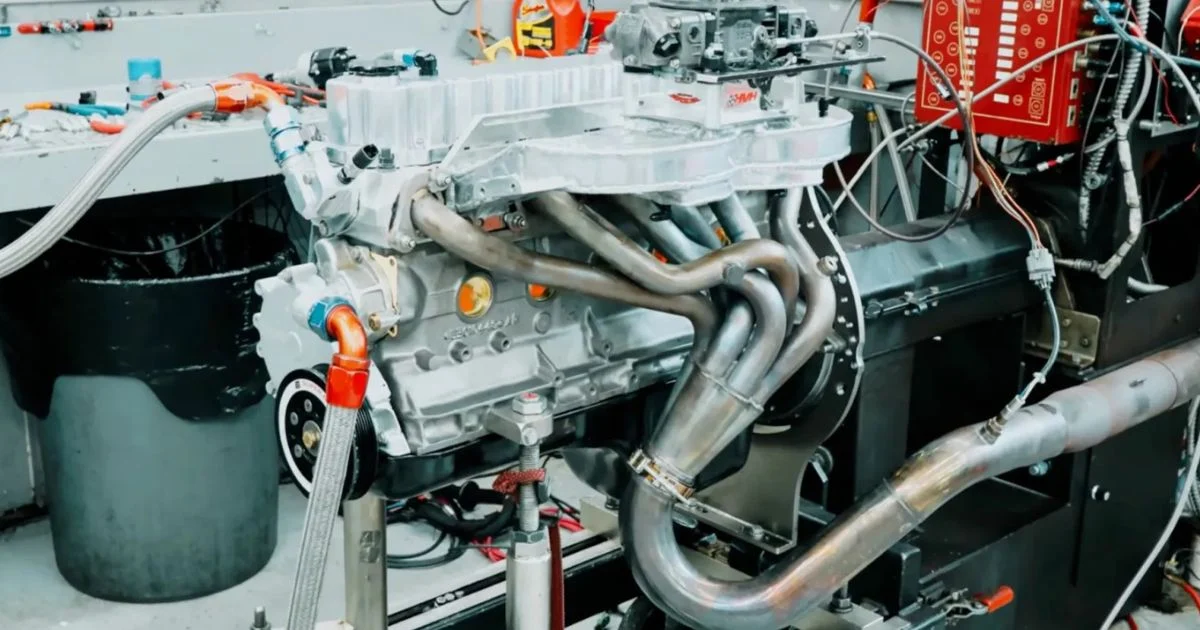
Before the arrival of the twin-turbo inline-six Hurricane, the big Jeeps settled for a plain inline-six — Jeep’s 4.0L, a 4.0-liter workhorse. Reliable, rugged, but not exactly thrilling.
And then an American tuner decided to shake up that image. By adding a full liter of displacement and taking a deep dive into this legendary block, they coaxed up to 434 hp from a motor that wasn’t designed for outright performance, and it even outperforms some versions of the modern Hurricane inline-six. This remarkable engine, built by Newcomer Racing for a competition-ready Cherokee XJ, demonstrates just how far a “dated” 4.0L can go… without a single turbo or supercharger.
Jeep 4.0L: An Old Inline-Six That Outperforms the Hurricane
Jeep’s 4.0-liter inline-six was produced from 1987 through 2006 and ended up powering a large portion of the lineup. It’s best known for its low-end torque and unbreakable character. “A no-nonsense, truck-grade engine,” sums up Caleb Jacobs, per The Drive, a description that fits this iron block built to last longer than it shines on a dyno.
That very groundwork is what Newcomer Racing used as the base to transform the engine into a 5.0-liter, bored and stroked, with a compression ratio of 13:1. The result is 434 hp on naturally aspirated fuel—more than double the 190 hp a stock 4.0L in a Cherokee XJ would have rolled off the line with, and 14 hp more than the standard Hurricane six powering today’s Grand Wagoneer. It’s a striking illustration of how much hidden potential this block holds.
Newcomer Racing Transforms the Jeep Inline-Six into a 5.0-Liter Naturally Aspirated
The North Carolina shop, already renowned for pushing a Jeep inline-six beyond 1,000 hp with turbo and carburetion, took on a new client aiming for a mud-racing-ready Cherokee XJ from 1996. Keith Newcomer describes the project in a video from EngineLabs: a engine with a broad rev range to keep wheel speed in mud, with big, torsion-locked tires and a careful balance between massive torque and extended top-end revs.
The engine was first assembled with a carburetor and a bespoke intake, then converted to EFI (electronic fuel injection). Both setups produced nearly the same peak power, showcasing what pure mechanical work can achieve. The client insisted on keeping the Cherokee’s original wiring harness, so Newcomer removed everything non-essential, shedding some weight and delivering a package that’s lighter and far more powerful than the stock 4.0L ever was.
Jeep built this inline-six through 2006, the year that the first truly performance-oriented Jeep, the Grand Cherokee SRT8 WK with a Hemi V8, arrived—just as the 4.0L was being phased out. Seeing today this block, intended as a rugged, down-and-dirty utilitarian engine, become the basis for a 5.0-liter, 434-horsepower naturally aspirated Monster underscores how robust the design is. It makes the Jeep’s stalwart 4.0L a prime playground for tuners, especially when the goal is to extract high power without resorting to forced induction.