Possibly you’re reading this and you’re a cleaning nerd like me, or maybe you’re not. Perhaps you simply enjoy keeping things clean, especially your car. In any case: welcome. Today we’re going to clean things.
What I take for granted is that you’ve at some point thought it would be a good idea to stop wasting money on car washes at gas stations and get yourself a pressure washer. I took that step and got a Kärcher K5 and I’m going to tell you whether it’s worth it. Or not.
Kärcher K5 Comfort Connect: why own a pressure washer?

Maybe you enjoy cleaning, maybe you don’t, but you surely know that satisfying feeling of cleaning something and watching the grime fade away. That’s perhaps the main reason I’ve always liked the idea of owning a pressure washer.
Let me speak as an old-tart, but I remember when one of my first jobs was helping with garden maintenance that included a pool. To get it ready every summer we had to do the whole thing by hand and clean it completely, for which they would give us a pressure washer.
That sensation of seeing the greenish slime and dirt disappear as the high-pressure jet passed by, and the pale blue of the tiles emerging from nowhere, was hypnotizing. I could stand there for hours, moving from the pool edges to the walls, to the curb, to the dirty tool that water pressure was totally discouraged for… It didn’t matter. I was possessed by the cleansing spirit.
View this post on Instagram
From there we move on to motocross bikes, cars, trucks, and industrial machinery, all with the same common denominator: brute-force cleaning. You probably experience a similar thing, and the habit of dropping coins into the gas station wash tunnel becomes a bit addicting.
Therein lies the issue: when is it worth abandoning the coin-operated gas station wash and getting your own pressure washer.
For me the answer is simple: always. That said, there’s a base condition that must be met, namely that you have a proper place to use it. If you live in an apartment, obviously it isn’t worth it. If you have a house with a small area to wash your car (which is what we’re after), then yes.
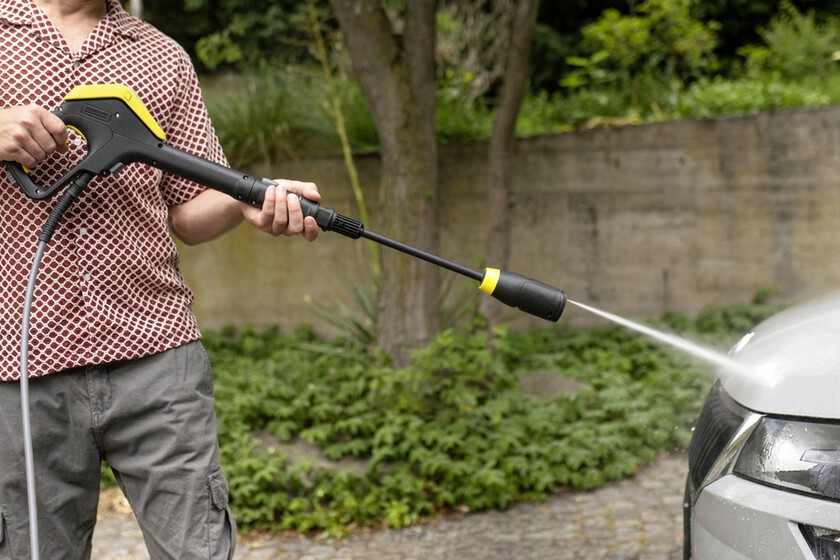
First, because you could wash the car on the street but that is completely prohibited by Article 4.2 of the General Traffic Regulation, which contemplates sanctions ranging from 30 to 3,000 euros for discharging water and waste onto public roads. So be careful with that.
On the other hand there are objective reasons to use a pressure washer. For example, a traditional garden hose can deliver around 5 bars of pressure with a consumption of up to 3,500 liters per hour, while a cleaner (depending on the model) can deliver water at between 100 and 180 bars and with a maximum flow of up to 600 liters per hour.
If we consider the environmental angle, we save up to 80% of water, plus save time and effort. They also use between 20 and 30% recycled material in their construction.
By the way, have you ever gone to a pressure wash and the grime doesn’t come off the car? Among other reasons, that’s because at gas stations the pressure is around 80 bars.
Which pressure washer should I buy?
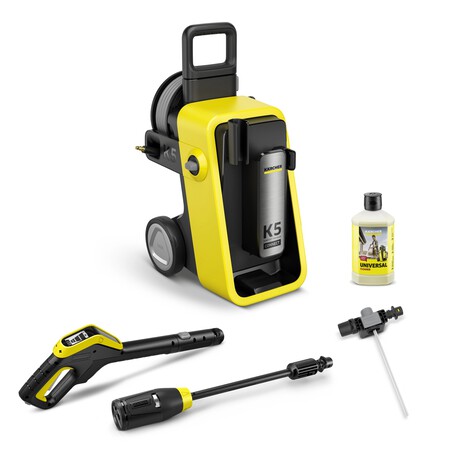
Okay, let’s suppose you’re already hooked and it’s time to decide what kind of pressure washer you need, because there’s a whole universe of models and features. In Kärcher there’s a comprehensive range that goes from the K2 up to the K7.
Here’s the quick summary:
- K2 and K3: They’re light and compact, designed for occasional use with simple tasks that require low pressure and flow, where pressure washing is more a means to clean than a goal. The cheapest starts at 59.95 euros on the official site.
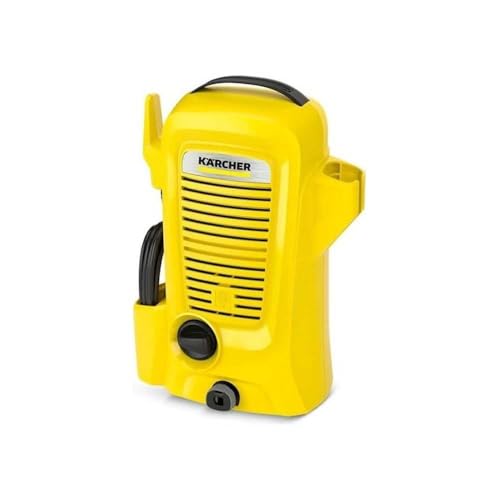
Kärcher Hidrolimpiadora de Alta presión K 2 Universal Edition, presión 110 Bar, caudal 360 l/h, Pistola y Manguera de Alta presión, Boquilla Turbo, Peso 3,8 kg
Today on Amazon — 59,00 €
- K4 and K5: For regular use in homes with a garden or patio, balancing ease of use, power, and flow with a higher price but not reaching professional-grade products. They range from 239 to 519 euros.
- K6 and K7: The top Kärcher models designed for intensive semi-professional use. Much more powerful but heavier and pricier, with prices above 600 euros.
In our case we’ve tested the K5 Comfort Premium Connect, which is the top model within the K5 range because it’s the most interesting for a keen amateur user. It’s a balanced model and incredibly easy to use with features that seem to fit an average user looking to clean stuff.
I’m not going to bore you with all the specs of the K5 Comfort Premium Connect, but here are a few technical notes.
The maximum pressure is 145 bars and it’s adjustable in three levels depending on the spray mode, with a maximum flow of 500 l/h and a power of 2.1 kW. These are reasonable figures for a price of 419.95 euros, now with an 11% discount.
But beyond the technical data, what I’ve found most interesting about this model are a few things it had before and others that are new in this evolution, which have made its use very comfortable.
Comfortable, powerful and quick
One of the main goals when using a pressure washer or any machinery is that it shouldn’t be a hassle to start it up or put it away. In recent years pressure washers have improved a lot, and in particular Kärcher has listened to its customers.
When it comes to storing and transporting, usability has improved dramatically. To begin with, the rubberized wheels are a good size and make the machine easy to move along with the telescopic handle, although because of the wheel angle the machine moves well when pulling it, but not when pushing it.
To transport it, it is admittedly a bit large but easy to carry. The different attachments have a place where they stay securely fastened; you don’t have to carry anything extra and it’s easy to drop it into the trunk by lifting it with the handle beneath the loading area where I usually keep various hose connectors.
The 5-meter power cable is lengthened by a reel that we can rotate to unwind the cord fully when setting it up. But more importantly in this model is the adoption of a 10-meter hose reel.
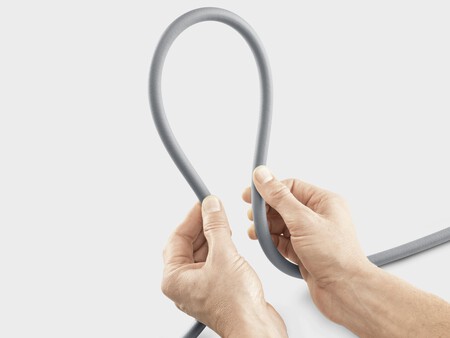
This hose is flexible and while you have to watch out for loops when walking around the car, the extension and retraction are much better than having to move the machine to reach a much shorter hose. You can clean an entire car (or van in my case) without moving the machine.
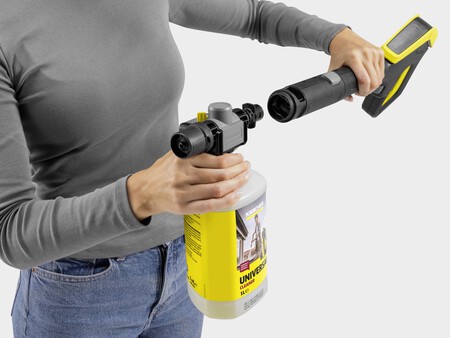
Another plus is that you only need one lance for the four jets (concentrated, fan, misting, and one I call the turbo-rotating jet) and something that was essential for me to use it with cars: a foam applicator.
Getting everything cleaned with pressure
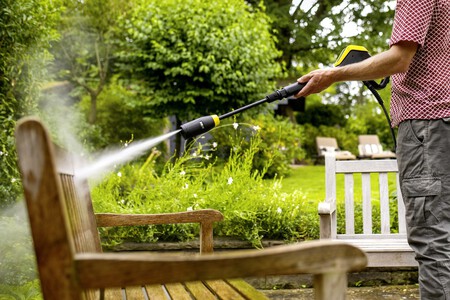
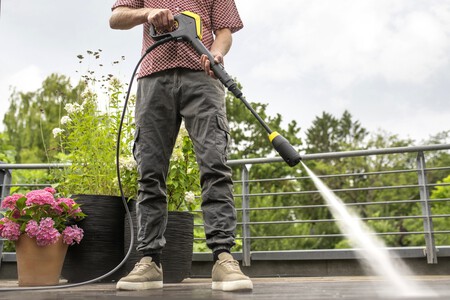
Once you start working with a pressure washer you can’t help but think of all the things you can clean. It’s almost an obsession; you might even consider washing the dog with it. Kidding, but almost. I’ve cleaned cars, courtyards, façades, vans, trash bins, carpets, artificial grass, drains, a tree… I’ve used it quite compulsively.
The most frequent tasks have been washing cars first with low-pressure spray to moisten and cool the surface and the dirt, then with high pressure using the concentrated jet and finally rinsing with the fan jet after scrubbing. All without changing the wand, just rotating the position.
Also, of course, the foam sprayer that comes with a liter bottle of generic detergent (which I later replaced with the car shampoos I usually use) is very useful and produces a dense, consistent foam.
It has a regulator for how much soap we want to use and although it isn’t perfect I’ve found it acceptable. That said, I think it would improve with better foam generation using less product, because the consumption seems quite high and at times I preferred hand-lathering.
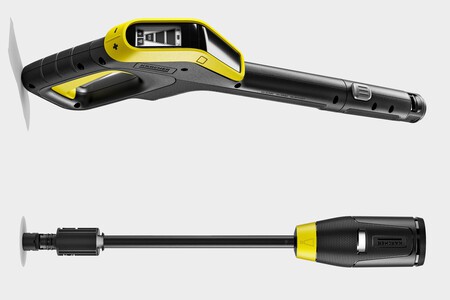
Pressure regulation is done with the + and − buttons on the pistol, which also includes an LCD screen because it has Bluetooth connectivity with Kärcher’s app to monitor the product and receive usage tips as a guide if you’re new to it. It hasn’t been practical for me, but perhaps for someone who’s fully cleaning a car it could provide step-by-step instructions on how to proceed.
It doesn’t have a lock button for the trigger, so you have to squeeze to apply pressure, but it does have a button that reduces the required pressure to actuate the trigger. The brand claims 50% less, but I couldn’t compare it side-by-side, so I can’t assess exactly how much the experience improves.
What it does have is a button to rotate the lance so you can vary the spray angle and switch from horizontal to vertical to avoid contorting your wrist.
I would have liked to spray soap without having to swap between the lance and the sprayer, but the sprayer only works at low pressure and the lance at high. Still, nozzle changes are quick because they’re pressure-fed and rotate 90º, but if you’re cleaning a car on multiple sides you have to swap nozzle-sprayer-nozzle for each section.
And how does it clean? Very well, actually. It removes grime well and quickly, and the perfect companion after soaping is scrubbing with a microfiber glove to really lift the dirt before the rinse. The wheels with a good cleaning product look amazing without much scrubbing, and if you scrub, even better.
And then there’s the turbo-rotating jet that I strongly recommend using with great care. It’s entirely not recommended for any car application because when used on façades and floors it can fling dirt and grime off, but it also aggressively erodes cement, so be careful. I once hit my foot and, I’ll tell you, that hurts.
After a few weeks of heavy use and tackling very dirty areas, I did have a problem with the lance and two of the modes became clogged, but Kärcher quickly sent me a full replacement lance. Other than that, no issues.
All in all I think it’s a product that isn’t cheap, but it’s a justifiable indulgence if you’re going to use it regularly. The results are very good and they minimize the effort needed for cleaning tasks.
In any case, as we mentioned at the start, I consider it a fundamental cleaning tool, but only if you have a place to use it. And considering you might spend 3 or 5 euros per wash, you’d need around 100 washes to amortize it, depending on how much you spend.