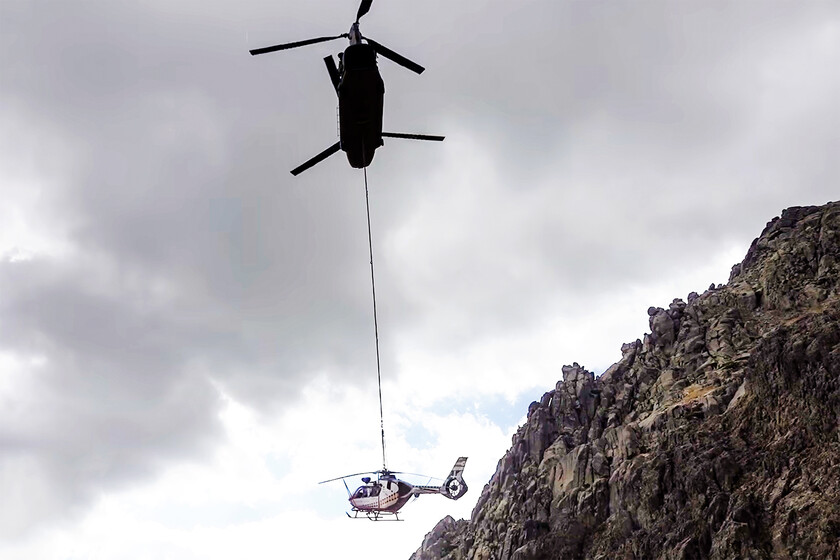
Who rescues the rescuers? The Mountain Rescue and Intervention Group (GREIM) and the Air Service (SAER) of the Civil Guard were dispatched this week to the Victory Refuge in Guisando, Ávila, within the Gredos Mountain Range. This operation culminated in a spectacular rescue of a Civil Guard helicopter by a Chinook from the Army.
Beside the Victory Refuge there is a narrow ledge used as a makeshift helipad for rescue missions, and it was there that a Civil Guard EC-135 was damaged on landing. One rotor blade broke after brushing the rock, leaving the EC-135 unable to fly.
How to move heavy gear where there are no runways or roads
A second EC-135 remained a few meters below the refuge, not to repair the aircraft on site but to prepare it to be hoisted by a heavy-lift helicopter, a CH-47F Chinook from the Transport Helicopters Battalion V (BHELTRA V), based in Colmenar Viejo, which operates 17 aircraft.
The Chinook carried away the Eurocopter as if it were nothing, despite the complexity of the operation. To this day, the Boeing CH-47 Chinook remains one of the world’s best heavy transport helicopters thanks to its raw power and its unique twin-rotor design.
The Chinook stands out for its absence of a tail rotor, its two large rotors turning in opposite directions to cancel the torque. Thus, all engine power is directed solely to lift and speed, capable of exceeding 280 km/h. This unique twin-rotor design arises from a physical limitation.
In the late 1950s, the United States Army sought a transport helicopter capable of moving artillery, vehicles, and troops in a single flight, using turbine engines instead of pistons that hampered the previous generation. Boeing Vertol won the contract with the Model 114.
The prototype, designated YHC-1B, flew for the first time on September 21, 1961, entered service as CH-47A in 1962 and was deployed to Vietnam from 1965, where it demonstrated its ability to carry artillery pieces to positions on mountain tops and to rescue downed aircraft.

Its technical edge lies in the two counter-rotating rotors. By canceling the torque, almost all the engine power goes to lift rather than being consumed by a tail rotor—which stabilizes the aircraft—unlike conventional configurations.
Why the CH-47 remains the benchmark
The tandem design gives the Chinook a vast rotor disc surface split across two points, translating into stability at low speed and during hover, even with bulky loads hanging from the hook, a critical factor in high-altitude rescues like Gredos. It can lift 10,900 kilograms in the CH-47F version, and its maximum speed sits around 315 km/h, figures that no average European transport helicopter matches.
To that, add the rear ramp, which enables wheeled vehicles to be boarded and simplifies logistical operations that would require disassembly with a helicopter equipped with side doors. The ramp allows for vehicle and personnel boarding, as well as facilitating complex logistical operations, and in the FAMET they often fly with it open precisely to speed up loading and unloading.
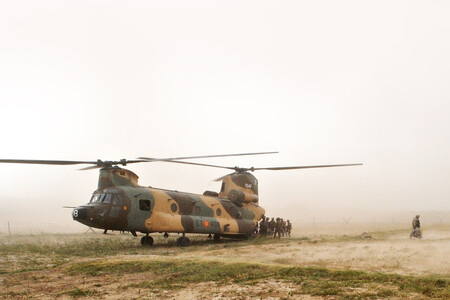
The Chinook was designed for heavy military transport—troops, pulled artillery, light vehicles—but its versatility has driven it far beyond that role. In Spain we have repeatedly seen it in mountain rescues like Gredos, where it substitutes civil means that lack sufficient lifting power. It is also used to support other units, NATO exercises, international deployments, and the evacuation of damaged equipment, including the Guardia Civil helicopter itself.
The Army has deployed the CH-47F in Iraq within the Toro Task Force, part of Operation Inherent Resolve against Daesh. Outside Spain, variants of the Chinook operate in wildfire suppression, commercial logging, and heavy cargo transport in civilian missions, in addition to special operations variants such as the MH-47G.
The Boeing CH-47 Chinook made its first flight on September 21, 1961, at a time when John F. Kennedy was president and the Berlin Wall had stood for only two months. Yet it remains in production and in frontline service across a dozen Western air forces, including Spain. Germany chose it in 2022 to renew its heavy transport fleet, while the U.S. Army plans to operate it beyond 2060, which would mark a century since its first flight.
Nothing has replaced it because nothing has surpassed its design. More than 60 years later, no one has found a better way to transport ten tonnes to a location without a runway.
Images | Army, ISAF