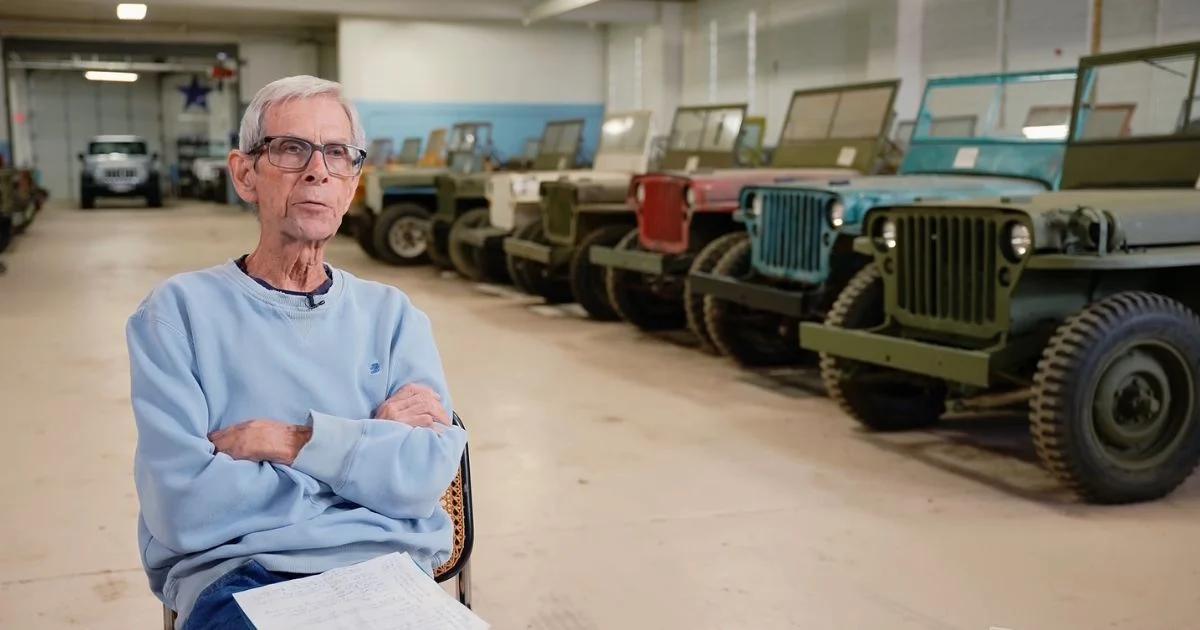
In an unassuming building a few blocks from Main Street in a small Nebraska town, lies what’s billed as the world’s largest collection of Jeeps. Behind unmarked doors, more than 400 military and civilian Jeeps, almost all with their hoods up, wait in neat rows, shielded from rain and curious eyes for decades.
The treasure sits in Scottsbluff, a city of fewer than 15,000 residents, and it belongs to Mick Mitchell, an 85-year-old architect who has been collecting Jeeps since junior high. It’s a Nebraska Public Media video, titled “Over 400 Jeeps… and Counting | Weird. Wonderful. Collected!” that just revealed this incredible automobile cave of wonders. Nebraska Public Media describes itself as “the public television and radio network for the state of Nebraska, delivering reliable information, cultural programming, and educational resources.” And behind the images, one discovers the entire life of a man laid bare in metal, oil, and patina.
Mick Mitchell, the architect who built his own Jeep paradise
In the video, the passion goes back a long way. “I got my first Jeep in eighth grade,” Mick Mitchell tells Nebraska Public Media, before noting that he himself designed the buildings that house his vehicles. “I never let them get wet, so they don’t rust more than they already do.” A former head of a commercial architectural firm based in Denver, he converted a former used-car lot into a true Jeep sanctuary, conceived to protect them and keep them accessible.
Mitchell also explains his choice to keep the vehicles in their “as‑is” condition. “If I restored everything, they would all end up looking exactly the same. And after you’ve seen a few, who would come back?” He ties his attachment to childhood. “World War II was happening. I was a kid at the time,” he recalls. “Newsreels showed nothing but the war and what we were doing. And there were Jeeps and trucks and tanks and planes, but a lot of Jeeps. And I got hooked right away.” Later, on the family farm, the Jeep became a daily tool: “We could drive with a restricted license to go to and from school and for farm errands.” The collection, though, has surpassed anything he imagined. “I stopped counting at 263, and I suppose there are more than 400 now.” Amid the hundreds of vehicles, he offers a simple wish: “I’d like them to keep living here.”
A treasured M38, a ripped engine, and museum-worthy rarities
Among all these open Jeeps, one holds a special place for the collector: the Jeep M38, the postwar military version built after World War II. Mitchell considers it his favorite, even ahead of more famous models like the M38A1 or their civilian derivatives. This model stands out for a reinforced design: sealed air intake and ignition, a 24‑volt electrical system, a grille that swings forward to facilitate mechanical access, and a large hatch in the floor to reach the transmission and transfer case. In the video, he even recalls an old film where the American Army drives an M38 underwater, a dramatic demonstration of its waterproofing. And that’s just a glimpse of what lies inside Scottsbluff’s hangars.
The collection isn’t limited to complete Jeeps. There’s also a training chassis outfitted with a cut Go-Devil engine, mounted with a flywheel bolted directly to the crankshaft. “This was developed for training,” Mitch Mitchell notes. “You had GIs who were used to a horse team and had never seen one of these. So they cut it all away so they could see what made it run, and then they could work on it.” Next to Willys and later derivatives, there are incredibly rare pieces, such as a pre‑production Willys MA listed under MA78904 in Mitchell’s name, or four‑by‑four Jeeps inspired by the classic Jeep, including a British Army Austin Champ and a Suzuki Samurai. A collection of variants that each, in its own way, tells how a simple wartime Jeep spawned a whole universe of off‑roading, all stored here in a small American town that almost no one outside the area has ever really heard of.