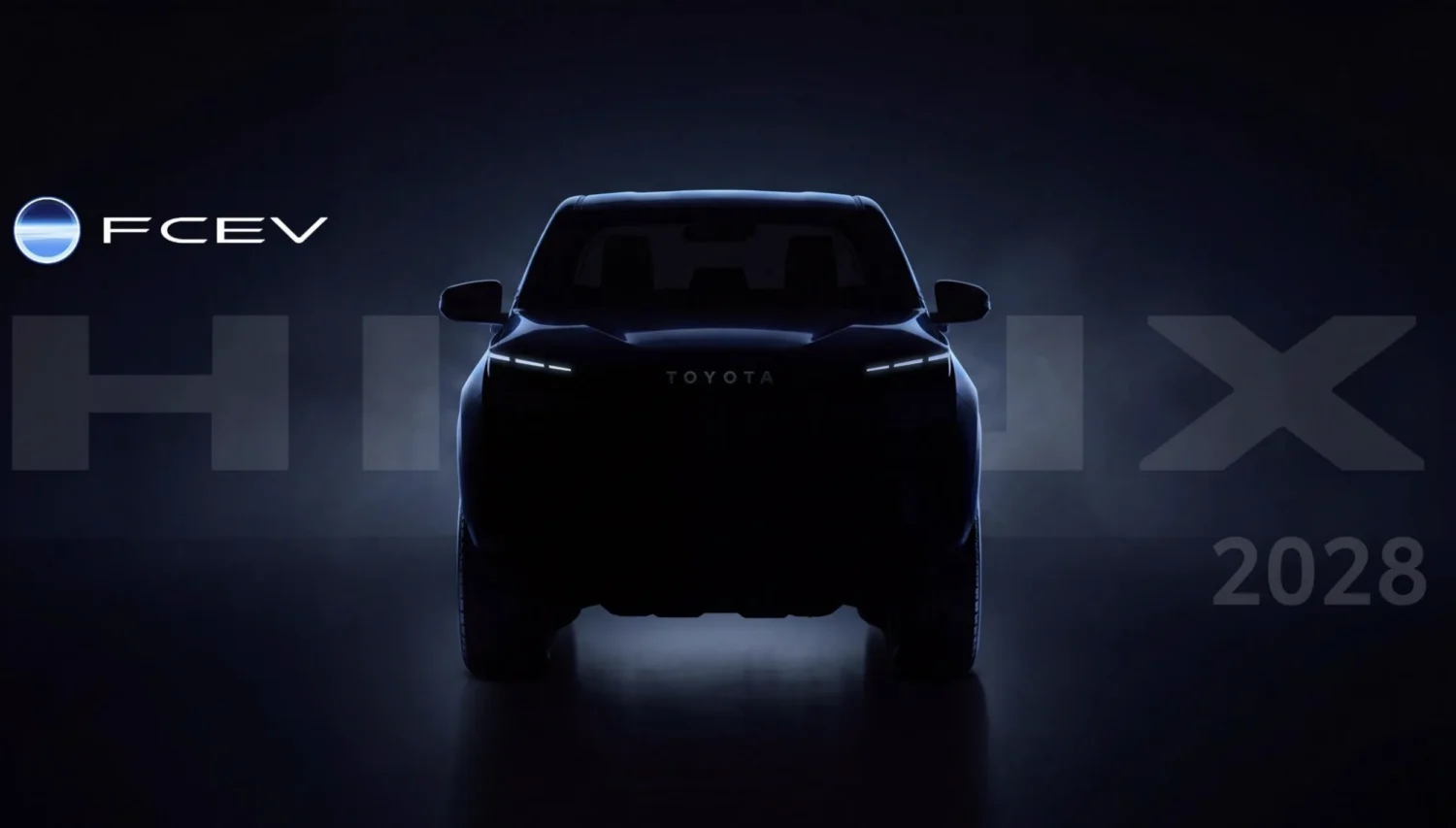
Toyota continues to bet on multiple technologies to secure the future of its commercial vehicles. After electrified diesel and 100% electric power, the Japanese automaker is preparing another variant of its iconic pickup. The hydrogen fuel-cell Toyota Hilux is slated to join the European lineup in 2028. A first teaser image already offers a glimpse of its silhouette.
The Toyota Hilux Hydrogen Will Arrive in 2028
This time, the project won’t be limited to a handful of experimental vehicles. Toyota has confirmed its intention to market a Fuel Cell Electric Vehicle (FCEV) version of the Hilux starting in 2028. It will complement a European lineup that already includes a diesel with mild hybridization and the fully electric Hilux.
The automaker also released a first teaser image of this hydrogen-powered pickup. The image stays deliberately dark, but it reveals a distinctive lighting signature made up of segmented daytime running lights. For now, it is impossible to determine whether Toyota will significantly alter the vehicle’s styling.
The front end could, in particular, resemble the electric version, with a more closed grille. But no further details have yet been confirmed.
Toyota is keeping much of the technical specification under wraps. The brand does, however, set two important targets. WLTP range above 400 km (roughly 250 miles) and a towing capacity up to 2,500 kg (about 5,500 pounds).
Still a Proper Utility Vehicle
Those figures would place this FCEV Hilux well ahead of its electric counterpart on both metrics. The Hilux BEV offers, in fact, 257 km of WLTP range (about 160 miles) and can tow between 1,600 and 2,000 kg (roughly 3,500 to 4,400 pounds) depending on configuration and regulations.
Hydrogen also has a fueling advantage. Refueling can be completed in as little as five minutes when the appropriate infrastructure is available. A key point for a professional vehicle, even if the current number of hydrogen stations remains a hurdle to widespread adoption.
This forthcoming production model is the culmination of a program started several years ago. A first hydrogen-powered Toyota Hilux prototype was shown in 2022, incorporating Mirai’s fuel-cell technology.
In 2024, Toyota then assembled ten prototypes in the United Kingdom to continue testing. These vehicles carried three hydrogen tanks integrated into the ladder-frame… as well as a lithium-ion battery installed under the bed. Their range reached about 600 km (roughly 373 miles). A rear-mounted electric motor delivered 180 horsepower and 300 Nm of torque.
Toyota Wants to Multiply Solutions for Its Cargo Vehicles
With this FCEV Hilux, Toyota continues its strategy of offering multiple powertrains rather than a single technology. The automaker is aiming for more than 165,000 commercial-vehicle sales in Europe in 2026, for a market share above 7%. Its goal is to reach 200,000 units per year and 8% of the European market by 2030.
The hydrogen Hilux will thus strengthen this offensive in 2028. The remaining questions are the final technical specifications, the price, and especially which European markets Toyota will choose to market it in.