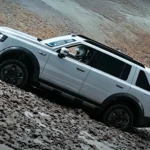
A surcharge approaching 30% on electric SUVs manufactured in China can send a chill down anyone’s spine. Especially when you’ve just plowed heavily into a 100% battery-powered model. That’s the situation for Lotus, the Geely-owned brand that had promised a fully electric future. The company is pivoting the focus back to the plug-in hybrid for Europe. And the spearhead of this shift is the Lotus Eletre X plug-in hybrid, a large SUV assembled in China. It’s already designed to mitigate the impact of European tariffs.
The Eletre X PHEV pairs a 2.0-liter turbocharged four-cylinder gasoline engine with a substantial 70 kWh battery. The combined output is billed at 939 hp. All-electric range sits around 350 km (about 217 miles) according to WLTP. Total range exceeds 1,200 km (about 745 miles). Fast charging on high-power stations is expected to be up with the best, thanks to a 900 V architecture. Lotus claims a 20% to 80% charge in nine minutes. In Europe, the price starts at €96,990 (roughly $106,000 at current rates) and first deliveries are planned for October or November. Meanwhile, the 100% electric version of the Eletre is seeing sales dip in Europe. The automaker moved 633 units through July, down 34% from a year earlier. Lotus, speaking through CFO Daxue Wang, is already preparing for a possible extension of European tariffs. Those duties would target plug-in hybrids manufactured in China. The executive even floated the possibility of absorbing part of the duty himself instead of passing it on to the sticker price.
A strategic pivot: Lotus Eletre X plug-in hybrid in the face of European tariffs
This pivot isn’t just a technical adjustment. Lotus incorporates it into a broader plan called Focus 2030. The program breaks with the short-term promise of a 100% electric lineup. The brand now aims for a mix of roughly 60% plug-in hybrids and 40% 100% electric models. The target is around 30,000 sales per year. The message is clear for customers: the transition will be guided by real demand, and the Eletre X is expected to become one of the pillars of this volume.
The regulatory backdrop also explains this choice. Since fall 2024, the European Commission has imposed additional anti-subsidy duties on battery-electric vehicles manufactured in China. For Geely, Lotus’s parent company, that represents roughly an 18.8% surcharge. This surcharge sits on top of the usual 10% customs duty. All told, a Chinese-made EV SUV faces nearly 28.8% in duties. Meanwhile, plug-in hybrids from China currently carry only the base 10% duty. As a result, Chinese automakers have massively strengthened their European PHEV offerings. In the first seven months of 2026, these brands accounted for about 30% of plug-in hybrid SUV sales.
Eletre X plug-in hybrid, a SUV designed as a tariff shield
Behind this strategy lies a very specific product positioning. The Eletre X remains a SUV built primarily as an electric vehicle, with its sizable 70 kWh battery. It adds a 2.0-liter turbo engine that serves as a generator and provides occasional boost to acceleration. The combination yields about 350 km of electric range and more than 1,200 km of total range. Performance remains in the realm of supercars, with 0 to 60 mph in just over three seconds. On paper, Lotus’s plug-in SUV pits itself against rivals such as the Volvo XC90 or the Porsche Cayenne PHEV. Dataforce notes that, in the first seven months of 2026, plug-in hybrids approached 36% of premium SUV sales.
The price positioning also plays a role in this “shield” strategy. In Europe, the Eletre X starts at €96,990. The Eletre 100% electric turns out to be slightly more expensive in Germany, by roughly €1,000. Lotus notes that the plug-in hybrid carries a higher margin than the pure electric variant. This margin level gives the company latitude to adjust margins without altering the price displayed to customers. According to Daxue Wang, the manufacturer is preparing for an extension of European anti-subsidy duties to plug-in hybrids manufactured in China. This issue is being championed by several German groups keen to defend their Audi, BMW, Mercedes-Benz, or Volkswagen PHEV offerings. No exact figure for those new duties has been disclosed yet. Lotus is considering absorbing part of the additional cost to keep prices aligned with European premium SUVs, even if that means trimming some of its unit margin.