
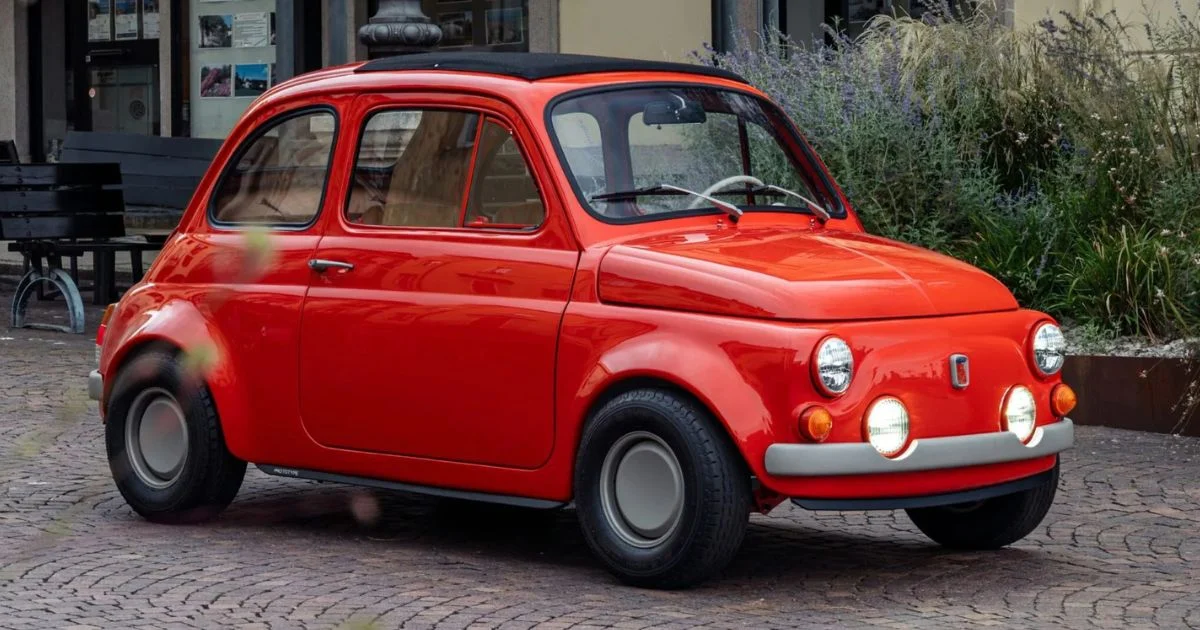
A barn‑find Fiat 500, left to languish for a quarter of a century, could it become one of the hottest builds of the moment without losing its cheeky, pint-size urban charm? That’s the bet being pursued by a small British workshop that has decided to grab hold of the Italian icon—not to turn it into a miniature supercar, but to produce a highly polished, sharper, and far more technically serious version.
Behind this project is La Cinquecento, a young outfit based in the United Kingdom, which signs here a highly developed Fiat 500 restomod built on a 1970s 500 R. Exterior design entrusted to the Italian studio BorromeodeSilva, a completely redesigned chassis, and a twin‑spark, two‑cylinder engine sourced from a Fiat 126: the preparation, named Fiat 500 Scattante, keeps the irresistible look of the 1957 city car while elevating it to a far more modern level of engineering, enough to intrigue enthusiasts who come across its photos.
From the family barn to the La Cinquecento–built Fiat 500 Scattante
The base for this very special 500 is a 1973 Fiat 500 R, the latest evolution of the classic 500. It sat in a barn for about 25 years, provided by La Cinquecento’s founder, Max Kindersley, who pulled it from its long slumber to serve as the workshop’s prototype. The car was completely stripped and rebuilt, right there in the same barn that now serves as the workshop, before heading to Italy for its first public appearance.
The Fiat 500 Scattante La Cinquecento restomod indeed broke cover at the Tutto Bene Hillclimb on the Mottarone, in Italy, on September 9, 2026. Max Kindersley sums up his approach with unmistakable clarity: “I’ve always loved what the Fiat 500 stands for. It’s simple, light, full of character, and it makes people smile. The idea was never to change that. We wanted to take everything that makes the original so special and see how far we could push it, to make it faster, sharper, and better engineered, without losing the very reason you wanted a 500 in the first place,” he told Carscoops. The entire project revolves around this balance between honoring the DNA and doing deep technical work.
Race-car look, real engineering, and an ultra‑limited run
For its styling, La Cinquecento partnered with Milanese studio BorromeodeSilva, already seen on other prestigious restomods. The little 500’s silhouette remains instantly recognizable, but widened fenders, deeper sills, and disk-style full wheels give it a much more planted stance—nearly a toy racing car. Up front, rally‑inspired additional lights reinforce that hill‑climb vibe, while the bright red bodywork is paired with cream accents and interior elements painted to match the exterior, vintage‑style carpets, and saddle‑colored leather on the racing seats and door panels.
Under that familiar face, the technical sheet moves well away from a period‑correct 500. The engine stays a rear‑mid mounted two‑cylinder, but sourced from a Fiat 126 and equipped with twin‑spark ignition and a displacement increased to roughly 802 cm³, with work focused on response and torque rather than peak power, though no horsepower figure has been released. The chassis follows the same philosophy: suspension, braking, steering, cooling, and electrical systems have been extensively reworked to sharpen the driving experience. The target weight is around 650 kg, about 150 kg more than a 1957 500 nicknamed at 499 kg, a consequence of the reinforced structure and the modern hardware. Production remains ultra‑confidential, with a numbered run limited to a handful of units per year, each developed in close collaboration with its owner via the 500.design platform, and with an unofficial price tag estimated around £150,000 (about €175,000). The exact cost of upgrades has not been disclosed at this time.