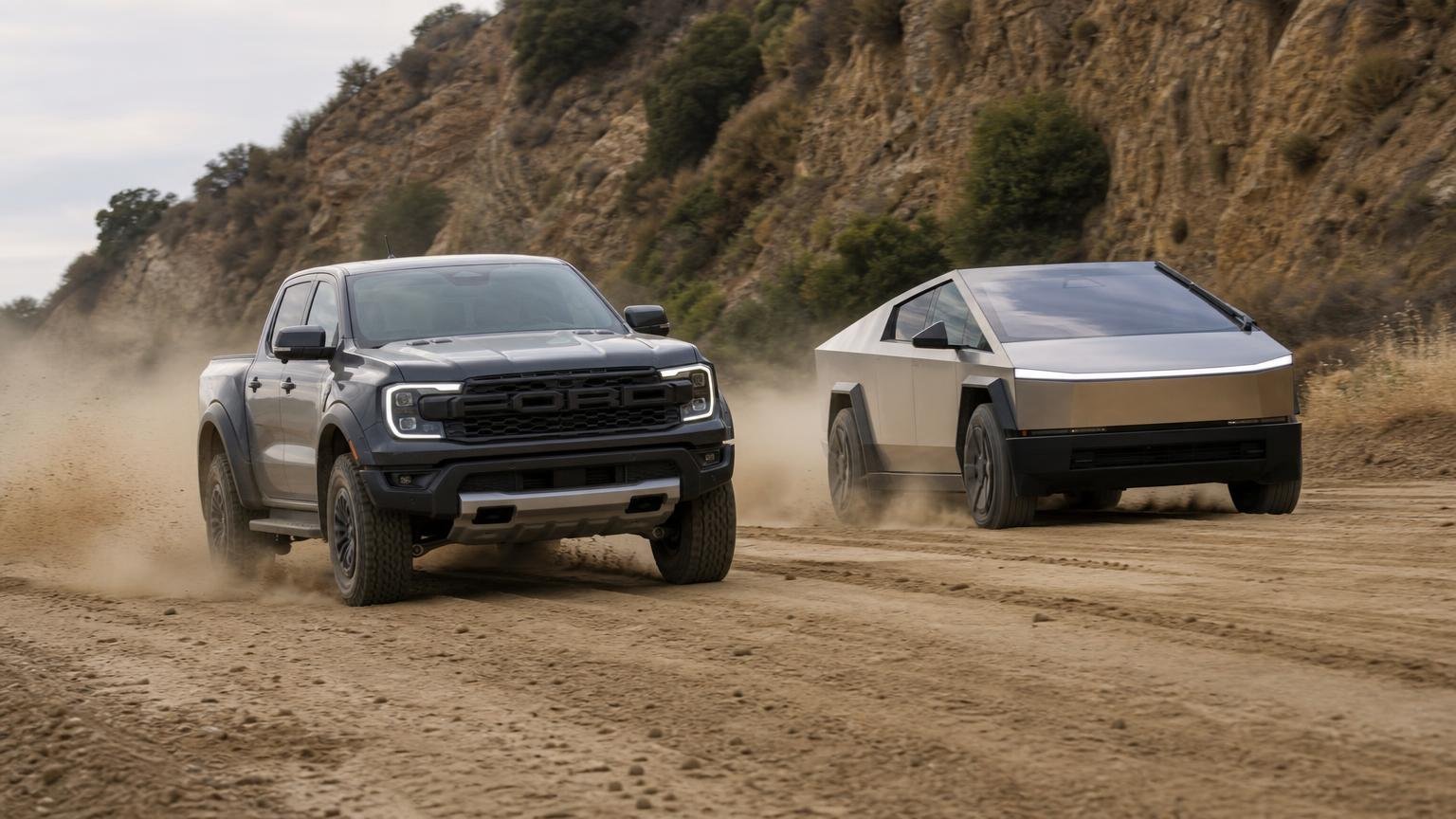
The dust hung in the air like static, and two hulking shapes rolled to the line: a factory-fresh Ford Raptor and a brand-new Tesla Cybertruck. The crowd went quiet, save for the faint whir of electric motors and the Raptor’s muted growl. An arm dropped, the earth snapped awake, and the result wasn’t merely decisive—it was lopsided.
Staging on loose dirt
Both trucks stayed stock, right down to the tires that still smelled like showroom. The surface was coarse, sun-baked dirt, scattered with pebbles that made every contact patch feel nervous. No timing lights, just an arm-drop start and a measured stretch that felt like an eighth-mile strip, except this one fought back with slip.
Temperatures sat in the high 70s, the wind ran left to right, and the tire pressures were left at street norms. “Keep it simple, keep it fair,” someone said, and everyone nodded like they’d seen this movie before.
Launch control meets instant torque
The Raptor’s twin-turbo V6 inhaled and then pounced, but on dirt, spooling up means managing a dance between throttle and traction. The Tesla didn’t wait for anything—it just pressed torque into the ground like a stamp. The weight that hurts an EV on pavement helps in the loose, and the Cybertruck’s AWD brains divvied torque with surgical calm.
Where the Ford sought a clean hook, the Tesla found one in silence. Every correction in the Raptor cost a heartbeat of thrust, while the Cybertruck’s systems blended tiny micro-adjustments into one long shove. It wasn’t violent; it was inevitable.
The run that broke the stalemate
At the hit, the Tesla stepped forward by a tire’s width, then two, then a hood’s length. By sixty feet, the Raptor’s rear tires had carved two agitated ribbons, but the Tesla had already straightened its future. “I was still finding second,” the Raptor driver admitted, “and he was already a postcard.”
Mid-run, the roles didn’t change. The Ford clawed and rallied, the turbos finally in song, but the Cybertruck never gave back oxygen. The gap grew until it looked like a production edit—cut, jump, wide shot, and then the finish.
At the line, the space between them felt almost awkward, a hush across the rowdy crowd. “That wasn’t a race,” someone murmured. “That was a tutorial.”
Why it wasn’t close
- The Tesla’s instant torque ignored lag and turned throttle into momentum without negotiation.
- Weight helped the EV bite into the dirt, trading mass for precious traction.
- Smarter AWD torque vectoring made tiny, rapid adjustments the human foot can’t match.
- The Raptor’s gears and turbo spool introduced brief pauses that multiplied across the run.
- On loose surfaces, clean launches beat horsepower, and the Cybertruck made clean happen by default.
The quotes that told the story
“I never saw him again after the launch,” the Raptor driver said, half laughing. “I heard my truck make all the right noises, but the dirt kept cashing my checks.”
The Cybertruck pilot was more clinical: “You point it straight, and it does the math for you.” Then a grin: “It feels like you’re hacking the terrain.”
The uncomfortable arithmetic
There’s a narrative that trucks win the wild by personality and pluck, and in plenty of ways that’s still true. The Raptor rides like a desert couch, soaks whoops with superhero joints, and makes chaos feel curated. The Tesla, by contrast, is all algorithm, less dirt cowboy and more appliance with fists.
But on this one, very specific test, the tech was the bulldozer. The Raptor’s strengths—the composure, the suspension travel, the rally-bred balance—didn’t get to sing a full verse. The Cybertruck demanded an early solo, and the song ended before the chorus ever hit.
Could the script flip?
Change the variables, and you change the ending. Give the Ford more distance, deeper ruts, or a whooped-out, high-speed section, and its suspension wizardry starts cooking. Fit paddle tires, tweak tire pressures, and practice launches until the dirt says uncle, and the spread shrinks from gaping to arguable.
Bring a Raptor R with supercharged thunder, and the first fifty feet get more interesting. The Tesla still plays the numbers, but raw thrust under a sharper right foot can pull a different kind of drama from the dust.
What the gap really means
This wasn’t just an EV beats ICE headline, nor was it proof that one truck is a better life choice. It was a pointed reminder that on low-grip surfaces, instant torque plus smart software is a devastatingly simple strategy. The finish-line gap looked harsh, not because the Ford forgot how to be great, but because the Tesla made traction feel like a shortcut.
Back in the pits, the Ford idled with steady pride, and the Tesla cooled in gentle whirs. The dirt kept their secrets, but the crowd didn’t: sometimes the new math writes the old myths, and sometimes it just underlines the ending.