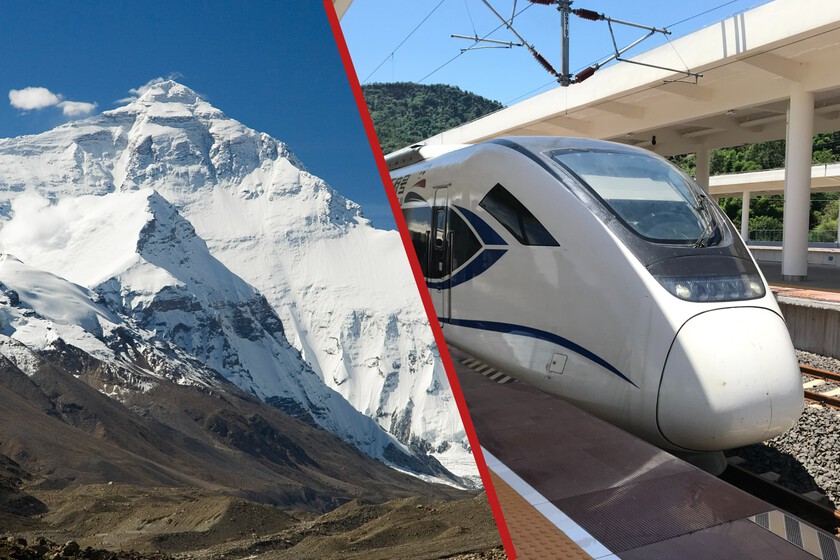
China, home to infrastructure as wild as it is complex to build, is undertaking its most pharaonic project of the decade: a railway line that cuts through the world’s highest mountain range, home to the “eight-thousanders.” It is the Sichuan-Tibet rail link, connecting Chengdu with Lhasa, the capitals of Sichuan and Tibet respectively. When we say “to traverse” we mean it literally: it entails drilling through the Himalayas.
This new rail line spans more than 1,500 km, and several sections are already finished. Yet the most challenging part remains: the central segment, surpassing 1,000 km, and currently under construction. It is precisely the portion that passes through the mountain range, with about 70 tunnels that will cover more than 800 km beneath the mountains. Like Moria, but with train tracks.
840 km beneath mountains and the ‘King of Tunnels’
The Sichuan-Tibet line, or the CZ Railway project, runs for 1,543 km and is absolutely colossal: it involves crossing more than 40 geological faults, surpassing anything ever attempted in this country and perhaps in history. After all, we are talking about tunneling the Himalayas. The Chengdu-to-Ya’an section (in Sichuan) was completed in 2018 and has been in operation since then. The Nyingchi, or Linzhi in Chinese, nicknamed Tibet’s Switzerland and extending to the capital Lhasa, was completed in 2021.
Thus the Ya’an-Linzhi segment remains, the keystone of this colossal project, budgeted in full at 319,800 million yuan, about 41 billion euros at the exchange rate.

This stretch, the longest and most difficult to realize, passes 1,018.6 km almost entirely along the chain. It goes essentially underground: with a total of 69 tunnels that, collectively, total 841.7 km. It is more than 80% of the route. Put differently: of every 10 km of track, 8 km will be inside the mountains. The remainder is completed by 104 bridges that span another 113 km. In short, nearly 955 km will be tunnels and bridges.
To these dizzying figures is added a tunnel that defies all logic: the Yigong Tunnel, nicknamed by the Chinese government as the ‘King of Tunnels’. It is the longest on this section and one of the great engineering feats of the Sichuan-Tibet railway project: it stretches 42.5 km, buried 1,400 m beneath the Himalayas. When finished, it will be China’s longest railway tunnel. It will also be the highest-altitude tunnel on the planet, far surpassing the current holder: the Shengli Tunnel of the Tianshan.
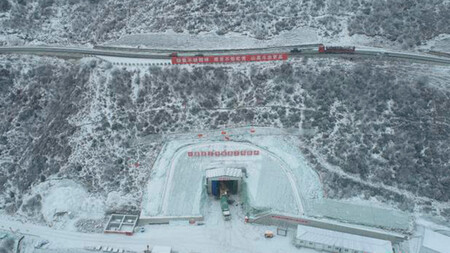
This railway pass runs at a railway elevation between 2,400 and 2,750 meters above sea level. The zone it crosses includes peaks over 5,000 m. It’s important to remember that the Himalaya houses the earth’s highest mountains, with up to 14 exceeding 8,000 m. It is also noted that about six tunnels in this section will exceed 30 km.
Engineering against geology: extreme heat, underground water, and collapses
This Ya’an-Linzhi segment began construction in late 2020 and was initially slated for completion in November 2030. Yet the project’s financial documents released in 2026 now place the finish around 2032. It was thus a mostly indicative date given the scale of a project operating in one of the world’s harshest regions.
The tracks must cross active geological faults or zones where rock is subjected to enormous stresses and extreme geothermal temperatures. The Linzhi-Lhasa section already built provides a glimpse of what may be found: workers faced temperatures close to 90°C inside the tunnels due to underground heat sources. During excavation there were multiple problems, such as overheating of the engines of heavy machinery or brakes failing. Moreover, about 70% of workers suffered physical issues from the high temperatures, including vomiting or loss of consciousness.
The supervision team of the Yigong tunnel has identified similar risks for this colossal undertaking: potential landslides and soil slides, high temperatures, incursions of groundwater, and the presence of noxious gases. The complex, changing, and unpredictable geological conditions will translate into unprecedented challenges to complete this stretch.
For the moment, construction continues in 2026. The latest government tender documents call for new tunnel-specific works, including water protection systems and safety materials for gas-prone zones. In March, too, specific components for the waterproofing of tunnels were put out to bid.
A new rail line with two faces
The aim of this Chengdu-Lhasa line, which connects Sichuan province in central China with Tibet, is to improve communications across a region flanked by the planet’s highest mountains. When the final stretch is completed, the journey is promised to drop from the current roughly 48 hours to just 13 hours. The challenging Ya’an-Linzhi segment plans 15 intermediate stations and nine stops, connecting with several communities.
Although this extreme stretch will not host high-speed trains surpassing 300 km/h, the segment is specifically designed for speeds between 160 and 200 km/h. A notable figure given the terrain, and it will dramatically reduce travel times once it’s finished.
The potential of this infrastructure is already evident in the Linzhi-Lhasa segment, operating since 2021. For its 435 km, about 75% of which consists of tunnels and bridges, more than 6.2 million passengers and nearly 2 million tons of freight have traveled. Furthermore, the monthly number of travelers in the region has risen from around 59,000 to nearly 154,000, according to data from the China State Railway Group.
Nevertheless, beyond this immense feat of engineering there is a downside. China has for decades relied on infrastructures to reinforce its presence in Tibet. This new rail line will facilitate tourism and trade, but it will also improve connectivity with a border region of enormous strategic importance. The Sichuan region hosts a key command of the People’s Liberation Army, responsible for military operations along the border with India. This means the connection will also enable the swifter movement of troops, supplies, and weapons.
Images | Wikimedia, Zangguiyunt, The Cover