
In Brief
The new Dacia Striker has undergone extreme-condition testing, including in the Sierra Nevada up to 3,000 meters (about 9,843 feet) above sea level, to stress its resilience to temperature swings, changes in air pressure, and varied road conditions. The prototype, still camouflaged during the test, stands out for numerous technical and ergonomic optimizations, notably in climate control, aerodynamics, and noise management. Dacia’s teams have also worked on innovative features such as a hands-free tailgate. The final Striker will not be revealed until 2026.
Automotive press enthusiasts, you’ve all seen photos of camouflaged cars rolling through snow for so-called “cold weather” tests, meant to verify that the car functions properly at extreme temperatures. The opposite exists as well: “hot tests,” with the same objectives. Many manufacturers take prototypes of their future models to Andalusia, more precisely to the Sierra Nevada—Europe’s highest mountain range after the Alps, peaking at 3,479 meters.
Dacia Striker: at the wheel at 3,000 m altitude
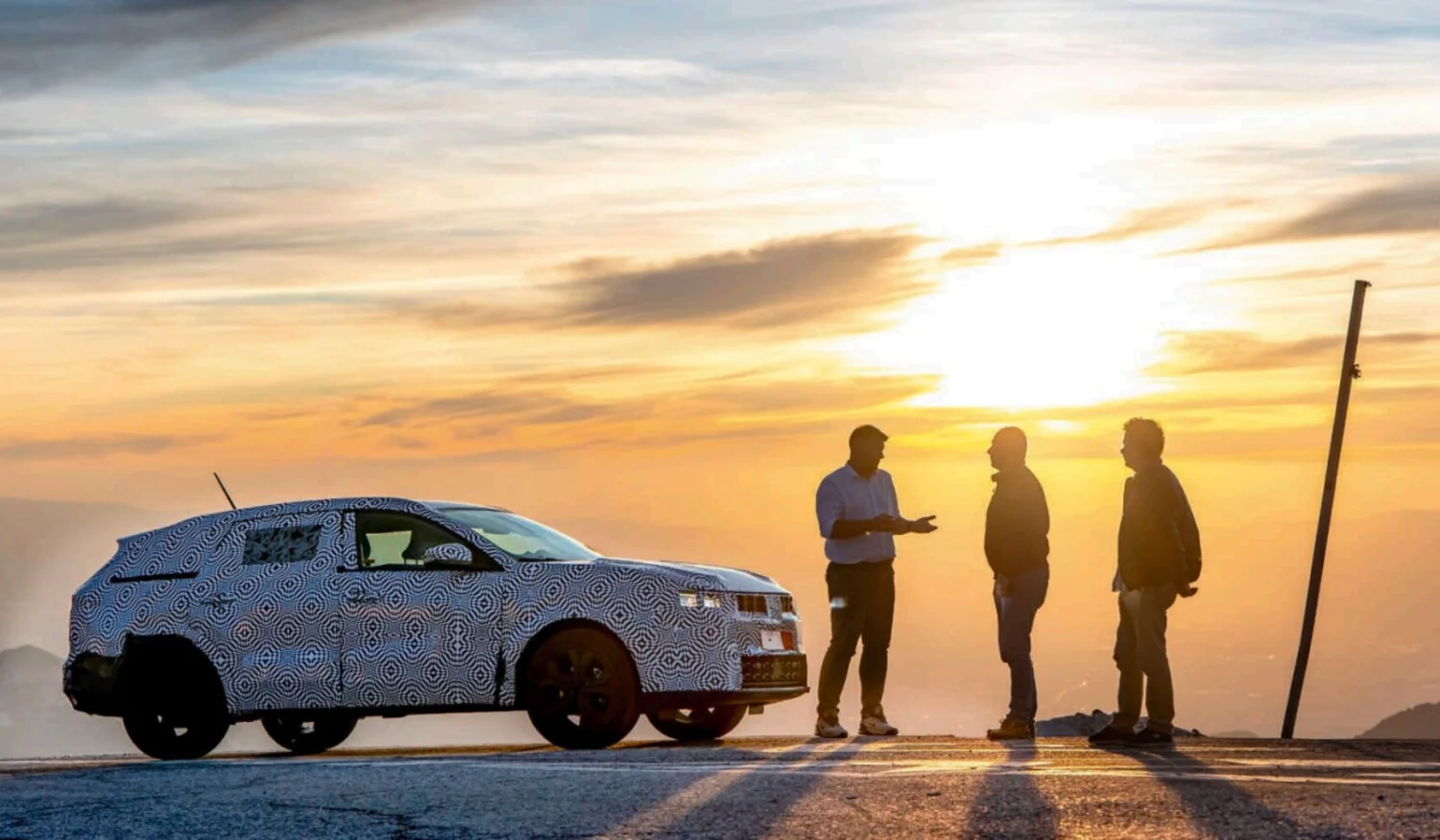
Why there? Because in two hours you can go from Málaga by the sea to Granada, a city that’s blisteringly hot in summer, then to one of Europe’s highest roads, with stretches above 3,000 meters. A perfect terrain to stress a prototype by drastically varying temperature, air pressure, and road type—from flat highway to tight, steep switchbacks. Just by the altitude alone, a gasoline engine loses about 10% of its power for every 1,000 meters of elevation, so the electronic management is put to the test when climbing from sea level to 3,000 meters in two hours. At the time of our test, the Striker had not yet been publicly revealed: its lines were therefore “secret” and the camouflage still heavy. The “vinylization” (the internal term) takes specialized teams between half a day and a full day to apply, but must comply with the country’s laws where the prototype will run: the front and rear lights, indicators, and plates must be visible. Likewise, care must be taken with cooling openings and to ensure that the additions do not generate noise at high speed.
Dacia Striker: propor tions easy to grasp, but everything else… not so much
As I touch different zones, I notice that the taut, psychedelic vinyl wrap covers soft areas—padding that alters the car’s shapes and makes it harder for scoop-hunters to pin down the final design. The overall proportions are easy to gauge, but the rest isn’t…
That’s Andrei Popa, a synthesis-performance engineer, who introduces the car we will drive: a Striker Hybrid 155 with 17-inch wheels, with the option to go up to 19 inches. Andrei has been working for more than a year and a half on the Striker and is at his twentieth prototype of the model, and it isn’t the last, even though development is nearing completion.
Because the Striker uses the Bigster’s platform and powertrain, one could think it’s just a matter of reusing those technical elements, leaving little to do. Andrei would set us straight. For example, regarding climate control: the windshield is more sloped on the Striker than on the Bigster, so the entire air-diffusion pathway in the upper part of the dashboard had to be redesigned; otherwise, the defogging wouldn’t work well. The compressor is the same, the cabin volume is similar between the two cars, but the way the air is distributed is different. Andrei mentions a new function related to the hands-free tailgate: if you have the hands-free card with you and stand within about 1 meter behind the car without moving for two seconds, the tailgate opens on its own.
To develop this function, multiple sensors and a computer (there are about thirty controllers talking to each other in the car) had to be integrated, and crucially, it had to be checked that it didn’t create regressions elsewhere, in other systems that were already working well. This is one of the typical tasks of synthesis.
Dacia Striker: compact concerns, not a city car
Other things are less visible: the team has heavily redesigned the outer mirror housings to optimize aerodynamic flow and reduce highway noise. Indeed, Dacia positions the Striker in the C segment, where the automaker’s studies show that noise and vibration rank fifth among customer criteria, while in the B segment they rank twenty-first, so this parameter deserves careful attention. In the invisible category, there are also gearbox ratios—slightly longer on the Striker with a manual transmission than on the Bigster, because the Striker sits lower and is a touch lighter: a clear benefit for fuel economy, but it required addressing a small resonance issue, so the engine’s average RPM ended up a touch lower.
What is visible, however, is that the dashboard differs not only in its design but also in its materials. The instrument cluster isn’t the same, but we don’t yet have the final version: fortunately, because our prototype’s cockpit isn’t exactly doing it favors. For the final product, it’s hard to judge, as several parts are not yet finalized. Andrei mentions, for example, sending back recently the small piece that closes the lid of the central front armrest: it required too much force to close or open. It comes down to a few tenths of a millimeter! On the Striker revealed officially and shown in previous pages, all visual elements are final and all tiny details like the armrest have typically been adjusted. There’s only one thing left to try in reality, but that won’t be until the end of 2026.
Find our test of the Dacia Striker prototype in l’Auto-Journal no. 1214 dated 23/07/2026.
Key Takeaways
- The Dacia Striker was tested in extreme conditions in the Sierra Nevada up to 3,000 meters above sea level.
- The prototype’s camouflage, nicknamed “vinylization,” shrouds its design while complying with road-laws requirements.
- Specific technical changes focus on climate control, the hands-free tailgate, and aerodynamics.
- The Striker is positioned in the C-segment and targets customers who pay attention to noise and vibration.
- The final version of the Striker will only be tested at the end of 2026.
FAQ
Where did the Dacia Striker’s testing take place?
The tests were conducted in Andalusia, notably in the Sierra Nevada, to assess the car under “hot weather” conditions.
What does the “vinylization” mean on a car prototype?
“Vinylization” refers to the camouflage applied to the prototype to mask its design, while meeting legal constraints such as visibility of lights and license plates.
What notable innovation is being tested on the Dacia Striker?
The Striker is testing a hands-free automatic tailgate that opens when the nearby hands-free card is detected for two seconds.
Which aspects were particularly revised on the Dacia Striker?
The team notably optimized the airflow around the exterior mirrors and adjusted gear ratios for better fuel efficiency and reduced noise.
When will the Dacia Striker be available for a test drive?
An official test drive of the final Dacia Striker is planned for the end of 2026.