
In Brief
Mazda continues to actively develop the rotary engine, a signature technology for the brand. A new patent hints that the automaker is trying to tackle the problem of oil overconsumption, a major reason behind the cessation of mass production of these engines. The patented system envisions recovering oil to limit polluting emissions without compromising the essential lubrication the engine requires. While no new rotary-era sports car is announced at present, Mazda demonstrates a willingness to keep this technology alive, particularly through hybrid applications or as an endurance-extending power source in electric vehicles.
Few manufacturers maintain as strong a bond with a single engine technology as Mazda does with the rotary. From the iconic 787B that won Le Mans to the RX-7 and RX-8, Mazda of Hiroshima has built a genuine specialty around it. But the constraints tied to emissions, fuel consumption, and especially oil usage have greatly contributed to its retreat from under the hoods of sports cars. A new patent today suggests Mazda is still looking to address some of its weaknesses.
Mazda Tackles Oil Consumption in the Rotary Engine
The Wankel, or rotary engine, operates with a mechanism that is markedly different from a conventional piston engine. And this architecture entails specific lubrication needs.
In Mazda’s older rotary engines, a small amount of oil is deliberately injected into the combustion chamber to lubricate the apex seals located at the ends of the rotor. A portion of this oil is thus burned along with the fuel.
This principle contributes to the oil consumption characteristic of these engines and also generates undesirable emissions. Two elements that became particularly problematic, especially as pollution standards tightened.
The patent filed by Mazda aims to reduce this phenomenon without sacrificing the lubrication essential to the engine’s longevity. The idea conceived by the Japanese engineers is to modify the way oil circulates inside the rotary block.
A Brand-New Lubrication System
The device envisions passages that allow recovering a portion of the lubricant instead of letting it inevitably end up in the combustion chamber.
The system would use the centrifugal force generated by the rotor’s rotation to guide the oil toward specific channels. That oil could then be recovered and reused in the lubrication circuit.
The objective is twofold. First, to ensure proper lubrication of the rotary engine’s more sensitive components. Then, to reduce the amount of oil actually burned during operation.
On paper, this solution could therefore allow Mazda to cut both the lubricant consumption and some of the polluting emissions associated with this architecture.
Mazda has not completely abandoned the rotary. This technology has recently resurfaced with the MX-30 R-EV, but in a role quite different from what it used to play in the RX-7 or RX-8.
In this electrified SUV, the rotary engine does not directly drive the wheels. It serves as an range extender, producing electricity when needed.
Toward the Return of a Mazda Rotary-Powered Sports Car?
This use allows taking advantage of some of the Wankel’s strengths, notably its compactness and relatively smooth operation, without asking it to carry the vehicle’s propulsion by itself.
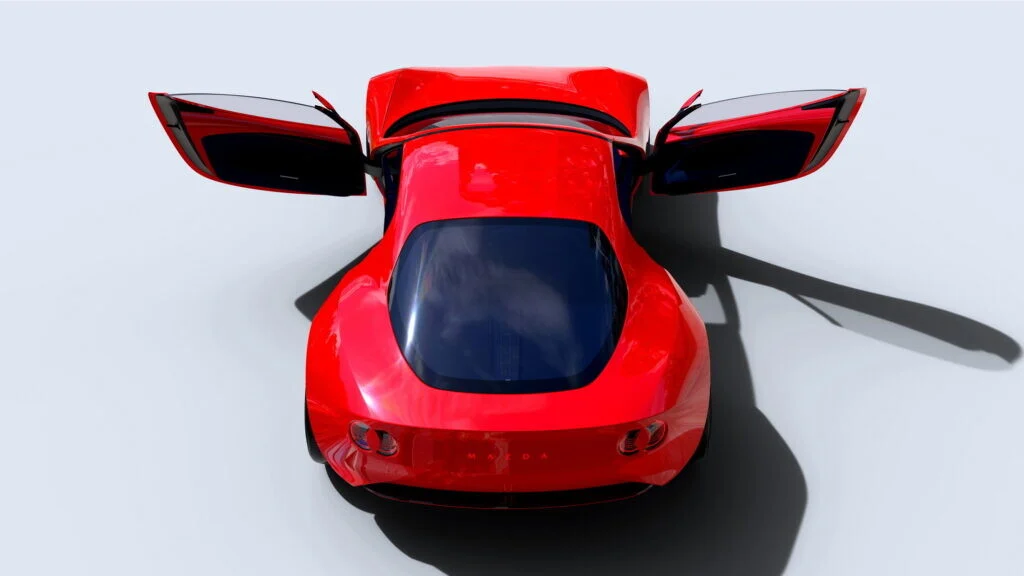
Mazda continues to hint that this engine could have a more ambitious future. The automaker has already shown several electrified sports concepts that use the rotary engine, proof that this architecture remains present in its engineers’ work.
This new patent does not automatically mean that an RX-8 heir will appear on dealers’ lots soon. Automakers routinely shield technologies that never make it to a production model.
It does, however, confirm that Mazda continues to refine the rotary engine rather than retire it permanently to the museum. Reducing its oil consumption would address one of the weaknesses that has complicated its survival in the face of modern environmental standards.
The question remains how Mazda could leverage this breakthrough. As a range extender, as a hybrid propulsion, or as a true engine to drive the wheels of a future sports car. Various scenarios remain on the table. For rotary enthusiasts, one thing is certain: in Hiroshima, the rotor keeps turning.
The Key Takeaways
- Mazda persists in developing the rotary engine despite its technical challenges.
- A new patent aims to reduce oil overconsumption, a major weakness of the Wankel.
- The patented system recovers and reuses oil, thereby cutting unwanted emissions.
- The rotary engine is currently used as a range extender on the MX-30 R-EV.
- Mazda does not rule out a return in sports cars or as a hybrid-electric propulsion.
- No production-model announcement, but the technology remains central to Mazda’s research efforts.
FAQ
Why does Mazda’s rotary engine pose a problem?
The rotary engine suffers from high oil consumption and emissions, which complicate its ability to meet environmental standards.
What solution does Mazda propose in its new patent?
Mazda proposes an oil-recovery system using centrifugal force, allowing part of the lubricant to be reused instead of being entirely burned off.
Is the rotary engine still used in Mazda vehicles?
Yes, it appears in the MX-30 R-EV where it serves as a range extender to generate electricity, without directly driving the wheels.
Does Mazda plan to bring back a rotary-powered sports car?
There is no official announcement, but Mazda continues to study the technology and has showcased electrified sports concepts using the rotary.
What are the advantages of the Wankel engine mentioned?
The Wankel engine offers compactness and smooth operation, which Mazda still values for certain applications.