
In Brief
The Citroën C5 Aircross Plug‑in Hybrid 225 hp Max stands out for its exceptional comfort, well‑executed ergonomics, and notable on‑road versatility. With a 17.8 kWh battery, it offers up to about 50 miles of electric range and an announced total range of roughly 435 miles, based on topping up the 13.2‑gallon gas tank. Its efficiency rests on its dual hydraulic‑stop suspension and Advanced Comfort seats, while preserving a roomy interior and a practical cargo area. The main appeal of the model lies in the regular use of electric energy to keep the gasoline engine in check.
The Strait of Hormuz is blocked, oil prices bounce daily: it’s against this backdrop of rising fuel costs that we begin our 10,000‑km test behind the wheel of the latest Citroën C5 Aircross.
Citroën C5 Aircross Plug-in Hybrid 225 hp Max: Heading to Spain
Nevertheless, we head toward Spain, where the government has unlocked 5 billion euros to cushion the impact of the Middle East conflict for all its citizens. Despite a 17.8 kWh (net) lithium‑ion battery promising a little over 50 miles of electric range and a total range of about 435 miles once the 50‑liter gas tank is topped up, we aren’t certain we’ll reach the small port town of Guéthary—first stop on our journey, chosen for a purely subjective criterion…
Drive Assist 2.0 nudges us to tune our pace to the road signs, and speed limits are observed to the decimal point up to the area around Bordeaux, where we do our first fill‑up. On this predominantly highway stretch, the C5 Aircross devours 7.1 L/100 km. This consumption will naturally fluctuate along the test depending on tempo, terrain, and charge level, eventually settling around 7 L/100 km by the end of our 10,000‑km trek.
Once the battery is depleted, the C5 Aircross switches to a “simple” hybrid mode and uses decelerations to harvest the few kilowatt‑hours needed by the electric motor to assist the 1.6‑liter, 150 hp petrol engine. Quick accelerations and high‑speed overtakes make it an excellent long‑haul companion that never shies away from a surge of power, even without engaging Sport mode.
Citroën C5 Aircross Plug-in Hybrid 225 hp Max: 1000 km Covered with Two Refuels, No Recharging
On the highway, the steering, a touch too light, keeps a steady line, even when gusts threaten to topple the body. More annoyingly, the C5 Aircross—regardless of trim level—skips laminated side glass. While not intolerable, aero wind noise becomes noticeable around 80 mph. For a car built for road tripping, that’s a touch early. Arriving in the far southwest, we locate a reinforced Green’Up charger. In the MyCitroën app, the charging time is estimated at 10 hours. That duration never drops below 6 hours, even on a wallbox. It’s long, which makes charging during a lunch break almost futile. To optimize these stops, one would have chosen the 7.4 kW onboard charger rather than the 3.7 kW unit fitted as standard. We’ll skip the upgrade, but we will plug in each night to play the plug‑in game and measure the usefulness of this option against the 100% electric and the micro‑hybrid variants with 145 hp. In Spain, gasoline 95 octane ranges from about €1.60 per liter in the north to €1.40 in the far south.
Full speed ahead to Almería and the stunning Cabo de Gata route. In a single long day of driving, we cover 1,000 km with two fills and no charging. If the SUV’s appetite swings from 6 to 8.5 L/100 km depending on road profile, traffic, and driving style, the ride quality remains superb. Not only do the Advanced Comfort seats deliver a plush welcome, but they also provide solid torso support and excellent leg support.
Citroën C5 Aircross Plug-in Hybrid 225 hp Max: The Real Strength lies in its Dampers
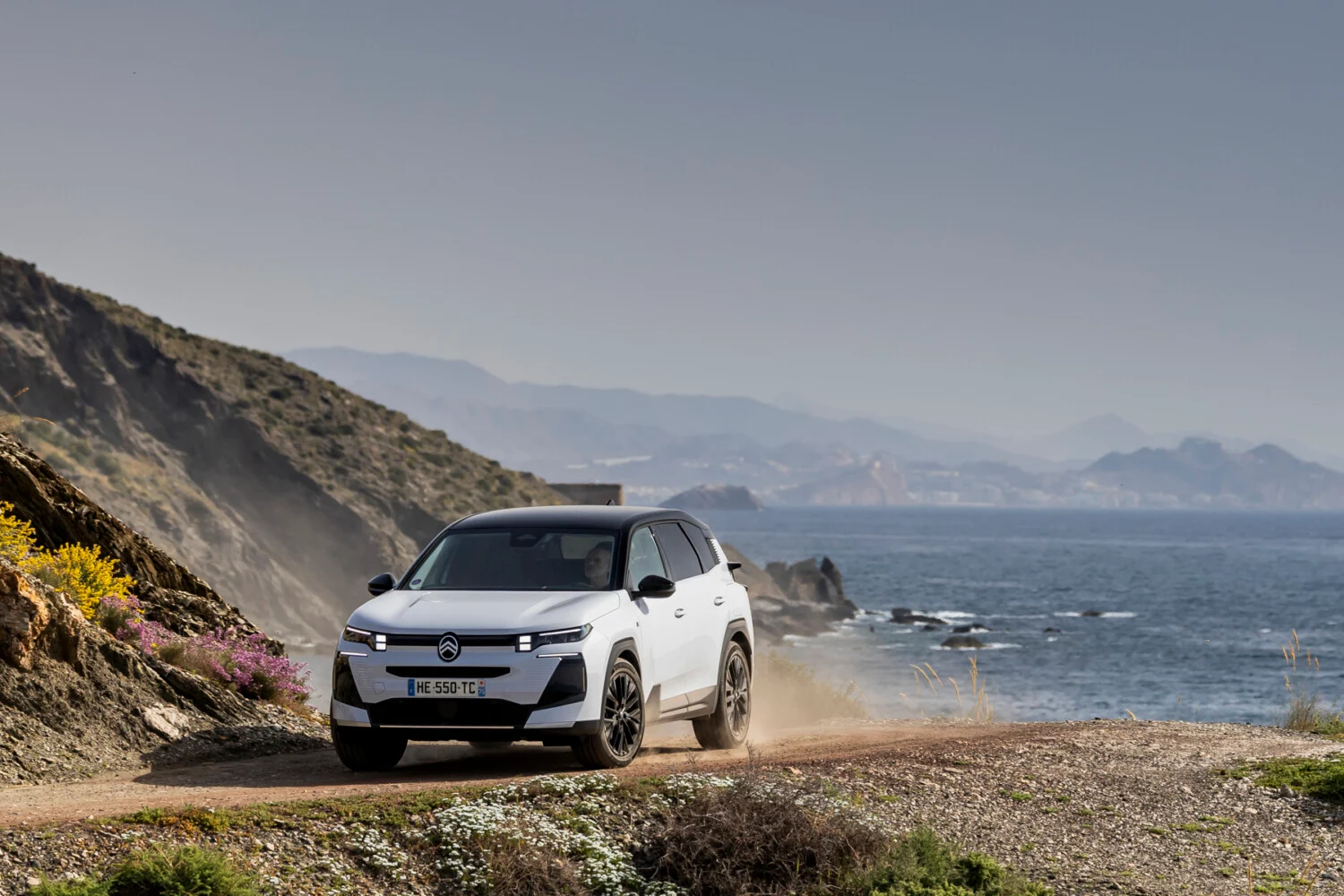
However, the standout feature of the C5 Aircross lies in its double‑acting hydraulic dampers. Recent technical advances have allowed Citroën to better quell body movements without compromising filtration. While this is obvious on the 100% electric version with a multi‑link rear suspension, it’s a trickier balancing act for our plug‑in hybrid, which has to manage the weight of the 160 kg battery while keeping a semi‑rigid rear axle. Although the ride remains high‑quality, certain road imperfections—crossed ruts or a succession of small potholes—can jolt the suspension. Along the Cabo de Gata coastline, the car’s weight makes itself felt. The front end stays precise in the bends, but the rear axle soon shows its limits as speeds rise. Braking remains effective, but pedal feel can be a bit disconcerting. The ABS kicks in a touch too quickly, especially in 100% electric mode when the battery is full or regeneration is low. It’s not the most agile car in its class, even within the Stellantis family. But that’s not what it’s primarily asked to do. Above all, it shines for comfort and versatility. While it currently lacks (for now?) all‑wheel drive, the brochure highlights its approach and departure angles and ground clearance—aptitudes that tempt a few dirt tracks in the Tabernas Desert.
Citroën C5 Aircross Plug-in Hybrid 225 hp Max: 80 km Real‑World Electric Range
Leaving the desert behind, we miss the sea. Off to Portugal. After a nocturnal stop in Zafra, a charming border town, we take advantage of a 22 kW charge point to replenish our 18 kWh battery in six hours. To reach Porto by the end of the day, our route climbs Portugal’s highest point, the Serra da Estrela, at nearly 2,000 meters. In Auto mode, the C5 Aircross prioritizes electric propulsion before engaging the two engines. The lack of highways confirms the model can flirt with an 80‑mile electric range in real life. Before tackling the switchbacks of the col, the consumption never exceeds about 4 L/100 km after more than 200 km on the road. The steep grade then forces the petrol engine to work hard, the battery no longer offering support. Once the summit is cleared, the descent begins. By maximizing the B regen mode, which works effectively below 60 mph, we managed to regenerate nearly 30% of the battery, which will later assist the hybrid mode. After 300 km, consumption climbs to 5.1 L/100 km, and after 400 km it sits at 5.7 L/100 km. A clear demonstration of how vital regular recharging is to justify this plug‑in’s purchase against other powertrains. Porto, like many European capitals, is grappling with overtourism. By enabling Save mode ahead of time to reserve about 20 miles of electric range for the historic center, the approach is more relaxed. This feature is useful in this case, but it does push the step’s consumption beyond 10 L/100 km.
Citroën C5 Aircross Plug-in Hybrid 225 hp Max: a Reasonable 7.7 L/100 km
We correct course the next day after a full night charge. The refueling along the Douro confirms that Portugal is facing the same inflation as France, with gas above €2 per liter. Rain appears in Biarritz, the final leg of our journey. After 4,000 km, the overall average remains around 7 L/100 km. For the first time on this trip, we decide not to recharge the battery and depart at dawn, hungry. The initial kilometers are alarming, with the trip computer quickly showing more than 13 L/100 km. Fortunately, the system quickly recovers enough energy to sustain a conventional hybrid operation. After 400 km, we discover we’ve managed about twenty kilometers in all‑electric mode without realizing it, pulling the average down to a reasonable 7.7 L/100 km. This reassures the more forgetful among us: even without charging, the vehicle’s appetite remains controlled. From then on, the plug‑in’s purpose—to be plugged in as often as possible—became a habit for a week, with only short daily trips to keep the gasoline engine in check. After five days: 300 km on pure electric and an overall average consumption under 4 L/100 km.
Citroën C5 Aircross Plug-in Hybrid 225 hp Max: How Do its Comfort Virtues Hold Up?
On this front, the French SUV nearly nails it. At the rear, three adults can ride comfortably without elbowing one another, and there’s ample legroom. The rear seatbacks are reclinable, allowing a flexible balance between passenger comfort and cargo space. The rear door bins swallow large water bottles, while pockets above the upper nets are designed for tablets. Up front, storage volumes are even more generous. The lower console under the touchscreen multiplies the pockets and cup holders, while a deep storage bin under the central armrest is cooled. The wireless charging pad sits high‑up with ventilation, but its modest power lengthens the charging times, especially when Apple CarPlay or Android Auto are used simultaneously. The vertical center screen earns praise for its fluidity, readability, and ergonomics. Just below, a physical control provides direct access to shortcuts for the driver‑assist features. The digital instrument cluster is more minimalist, though it offers several display modes and customizable shortcuts. It’s a pity the head‑up display remains a box‑ticked option.
Citroën C5 Aircross Plug-in Hybrid 225 hp Max: a Respectable Trunk Volume
The powered tailgate features a convincing hands‑free function. The usable volume is adequate, even if the height under the parcel shelf is somewhat restricted. Under the floor, a large compartment houses charging cables or a full spare wheel, available as an accessory in the dealer network. Priced in Max trim at €46,490, our test unit avoids the CO2 penalty but incurs a weight tax of €2,750. With the Internet discount applied and options included, the bill climbs to over €47,200, i.e., about €650 per month without a down payment. That’s notably more expensive than the entry‑level version and not very competitive with the all‑electric variant, whose monthly rate is a little over €400 thanks to various subsidies (with a down payment of €6,600). Still, the plug‑in hybrid, when used judiciously, remains the only option that can cover daily electric miles during the week while letting you tackle cross‑country trips (France or Spain) over a weekend, all with an average consumption around 7 L/100 km. Worth considering.
Citroën C5 Aircross Plug-in Hybrid 225 hp Max: Pros?
- Comfort and refinement
- Ergonomic center screen
- Average consumption
Citroën C5 Aircross Plug-in Hybrid 225 hp Max: Cons?
- Electric range below expectations
- Wind noise on highways
- 7th gear too long
The Auto‑Journal Verdict: 3.5/5
More comfortable than it is fun to drive, the C5 Aircross reveals its best side on long journeys. Despite some wind noise at higher speeds, a not‑so‑clear braking feel, and a steering feel that’s a little too light, it offers an excellent balance between road handling and comfort.
Read the full 10,000‑km road test of the Citroën C5 Aircross Plug-in Hybrid 225 hp Max in Auto‑Journal issue no. 1214, dated 25/06/2026.
Comparison Table
| Feature | Value |
|---|---|
| Plug‑in hybrid power | 225 hp |
| Battery (net capacity) | 17.8 kWh |
| Real electric range | 80 km (about 50 miles) |
| Total claimed range | 700 km (about 435 miles) |
| Gas tank capacity | 50 liters (13.2 gal) |
| Consumption over 10,000 km | 7 L/100 km (about 33.6 mpg US) |
| Minimum electric consumption | 4 L/100 km (about 58.8 mpg US) |
| Maximum observed consumption | 13 L/100 km (about 18.1 mpg US) at battery‑empty start |
| Charge time (enhanced outlet) | 10 h |
| Charge time (wallbox) | 6 h (min) |
| Additional battery weight | 160 kg |
| Price (Max trim) | €46,490 |
| Price with options | €47,220 |
| Monthly lease (no down payment) | €650 |
| Weight tax | €2,750 |
| Electric version lease (down payment €6,600) | about €400 |
| Used charging station | 22 kW |
The Essentials
- The Citroën C5 Aircross Plug-in Hybrid 225 hp Max offers very high comfort and versatile interior space.
- In plug‑in hybrid use, real electric range reaches about 80 km, provided you recharge frequently.
- Average consumption over 10,000 km landed around 7 L/100 km, depending on trip profile and charging habits.
- The SUV benefits from advanced suspension and ergonomic seats, suitable for long distances.
- The cost gap remains sizeable compared with the all‑electric version, especially without regular recharging.
- Drawbacks persist: electric range below expectations, wind noise on highways, steering is a touch light, and braking feel can be inconsistent.
FAQ
What is the real electric range of the C5 Aircross Plug-in Hybrid?
It reaches roughly 80 km in real‑world conditions, provided you optimize recharging and driving habits.
What is the charging time for the C5 Aircross Plug-in Hybrid?
Charging time ranges from 6 hours (wallbox) to 10 hours (enhanced outlet), depending on available power.
What about long‑distance consumption?
Consumption stabilized around 7 L/100 km during the 10,000‑km test, with variations based on terrain and pace.
What are the strong points for interior comfort?
The car shines with its double‑acting hydraulic dampers and Advanced Comfort seats, delivering excellent comfort, especially on long trips.
Is this model economical next to the all‑electric version?
The hybrid remains more expensive to operate if you don’t recharge regularly, particularly compared with the electric version that benefits from subsidies.