
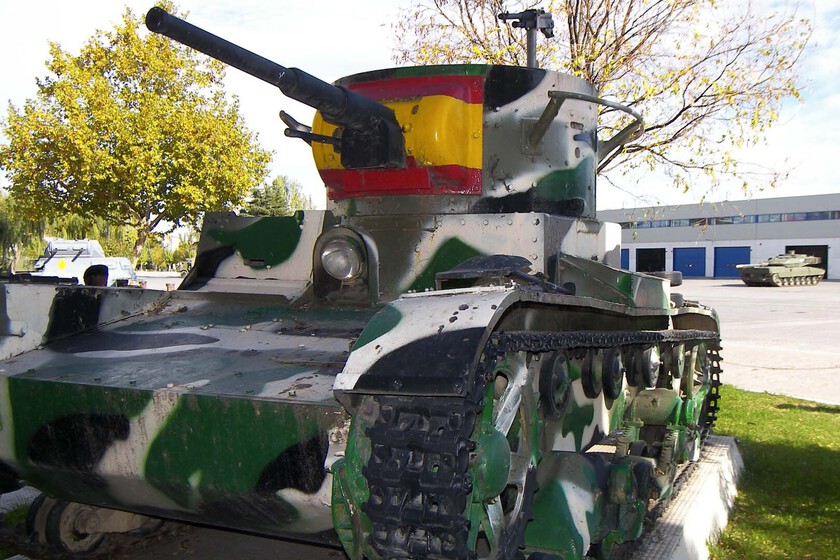
Since the early 2000s, the Leopard 2E has been a source of pride for the Spanish Army because it is a national battle tank that can hold its own against tanks from other countries. But long before the Leopard 2E existed, Spain tried to have its own battle tank.
The first truly serious attempt was the Verdeja, a light armored tank born in the midst of the Civil War to end Spain’s dependence on German, Soviet, and Italian tanks.
Born at the Wrong Moment
Today, the Spanish army has its own tank, the leading Leopard 2E, but it hasn’t always been this way. For decades, our armed forces depended on tanks developed by other countries, although there were attempts to change that many years ago. That said, without success.
Almost a hundred years ago, Spain improvised a combat vehicle that came to nothing, the Trubia Naval, but it represented the first attempt by Spanish industry to develop its own military vehicles and opened the door for us to take this matter more seriously.

In 1937, amid the Civil War, Captain Félix Verdeja Bardales of the rebel side, aware of Spain’s problem with armored vehicles, with only a handful of Italian and German tanks that did not have an easy time opposing the Soviet T-26s of the Republican army, realized that he could design a Spanish battle tank.
In 1938, Verdeja officially presented the project for a light tank and received permission to build a first prototype in a warehouse in Cariñena, Zaragoza. To shape it, armor remnants and used parts from other light tanks were employed, while the engine, a Ford V8, was taken from a civilian car and combined with the transmission of a German Panzer I.
Between January 10 and January 20, 1939, tests with this prototype were successful, so Captain Verdeja received the green light to construct the final model.
Its advantages included simplicity, a compact size (notably its low height), its relative agility, strong firepower, and ease of maintenance. One of its key features was the ability to mount a 45 mm cannon sourced from captured Soviet material (from the T-26), which proved extremely useful at the time.
The fact is that, right at that moment, the Civil War ended and priorities shifted.
Nevertheless, as years passed, a more advanced second prototype, the Verdeja 2, was developed, but the circumstances did not allow it to go into production: one thing is to build a prototype and another entirely is to manufacture hundreds of identical units. Spain did not have an industry capable of doing that after 1939.
Furthermore, at that time World War II was underway, and that conflict drove the evolution of tank design at an extraordinary pace. Models such as the Panzer III, Panzer IV, T-34, Sherman, Panther, and Cromwell appeared, and all of them rendered the Verdeja 2 obsolete as the main battle tank.
Nevertheless, there was an attempt to create a significantly more modern Verdeja 3, but it came to nothing. Today, a few prototypes of the Verdeja family remain. Simply put, this battle tank was born at a bad moment.
Images | Wikipedia