
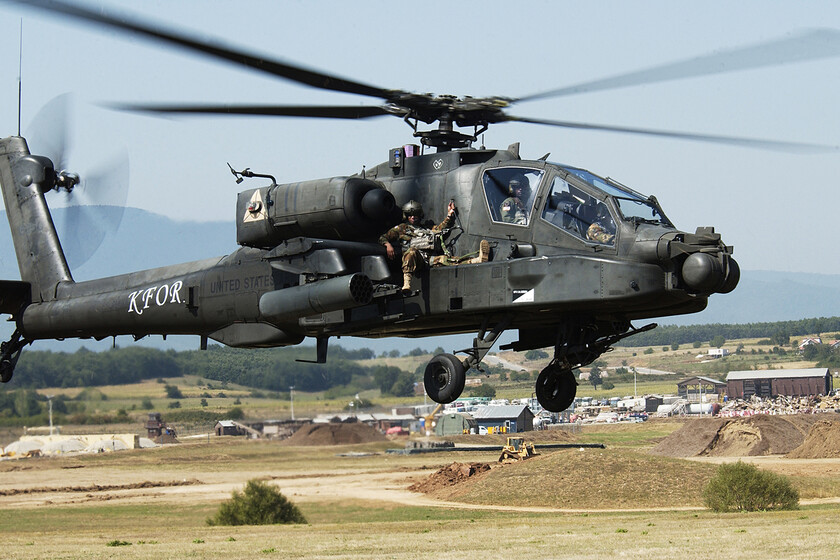
Born during the Cold War, it was deployed against insurgents in Afghanistan after 9/11 and today it returns to hunting armored vehicles, following the lessons learned in Ukraine. The Apache AH-64, with almost fifty years on its back, continues to make headlines. A new modernization plan foresees keeping it in active service until 2060, with versions more connected, precise and lethal.
It is one of the helicopter models with the longest active service in the world. And it still has plenty of life left.
From Tank Hunter to AI-Driven Drone Launcher
The ‘Advanced Attack Helicopter’ program was born in 1972 with a very specific obsession: to halt the Warsaw Pact’s armored columns before they could reach the Channel. The U.S. Army had just retired the AH-56 Cheyenne, too costly and fragile, and sought a craft capable of withstanding infantry fire while destroying tanks at range. Hughes Helicopters won the competition, and the YAH-64 prototype took its first flight in September 1975 at Palomar, California.
It entered service in 1984 as AH-64A. Its technical edge rested on two systems: the TADS/PNVS and the IHADSS. The first enabled day-and-night target acquisition, while the second allowed the gunner to designate a target with a simple head movement. When combined with the 30 mm M230 cannon and Hellfire missiles, the Apache became the antithesis of the Soviet T-72 tank: fast, low-altitude stealthy, and capable of striking before being seen.

The Gulf War confirmed the concept in spectacular fashion. On January 17, 1991, eight Apaches from the ‘Task Force Normandy’ penetrated Iraqi territory at an altitude of just 15 meters and destroyed two early warning radar teams in under five minutes, opening the air corridor for the rest of the coalition.
During the conflict, 277 Apaches destroyed 278 tanks, with no combat losses for the brigade that initiated the hostilities. The Cold War-era aircraft proved its worth in a conflict that the Cold War had not anticipated.
The following decades saw the Apache transform, with no replacement in sight. The AH-64D Longbow introduced a rotor-mounted radar with electronic scanning, capable of detecting multiple targets simultaneously without exposing the aircraft.
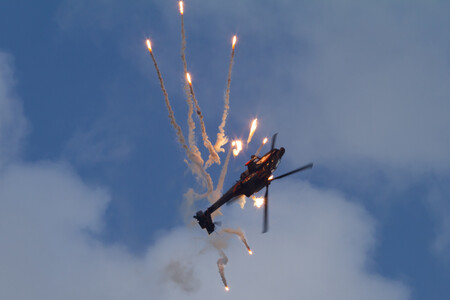
The AH-64E Guardian, in service since 2011, features a fully digital cockpit, integrated Link 16 data link and doubled the radar range from eight to sixteen kilometers. Boeing added a maritime mode capable of identifying ship classes regardless of sea state and a drone-control capability that extends sensor reach without putting the crew at risk.
This longevity has forced Boeing into industrial compromises. Keeping production active for forty years requires renewing the supply chain several times, and at some point Boeing decided that expanding capacity in India was cheaper or more convenient (cost, access to the Indian market, industrial offsets of the export contract to India) than doing so in the USA.
Thus, since 2018, all Apache fuselages delivered worldwide, including those for the U.S. Army, come from a single factory: Tata Boeing Aerospace Limited, in Hyderabad. The joint venture, born from an agreement signed in 2015 between Boeing and Tata Advanced Systems, delivered its hundredth fuselage in July 2021 and the three hundredth in February 2025.
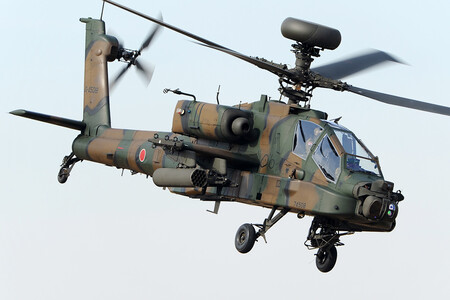
AH-64DJP Apache Longbow Japanese.
More than 90% of the components making up the Apache’s structure are now manufactured in India, where more than nine hundred engineers and technicians work at a fourteen-thousand-square-meter facility.
Economically, it undoubtedly can make sense. However, it means that a helicopter designed to contain the Russian army today depends, for its industrial survival, on India’s defense autonomy strategy. The Indian Air Force already operates 22 Apache E, and the Army has ordered six more. Boeing has found in the subcontractor, who also supplies its own end customer, an industrial solution that would have seemed unthinkable in the era of the AH-64A.
More than 2,875 units have been built, exported to between seventeen and nineteen countries, accumulating more than five million flight hours, of which 1.3 million were in combat operations.
Boeing is now preparing the 6.5 version, which integrates the Launched Effects (munitions and sensors deployed at a safe distance) as well as an open architecture intended to outfit future ITEP engines, more powerful and efficient. Export production should continue into the early 2030s, and the U.S. Joint Chiefs of Staff already talk about keeping the Apache in service through the 2060s.
The cancellation of the FARA program, which was meant to provide a successor, has done nothing but reinforce this outlook: in the absence of a credible short-term alternative, the U.S. Army consolidates what it already has.
A machine born to endure as long as a conflict that never arrived persists to be ready to celebrate a century of operational service with no replacement in sight.
Images | U.S. Army Sgt. Stephen Proctor, Nicky Boogaard, Martin de Witte, Toshi Aoki (JP Spotters)