

Common barriers to adopting an electric car point to the cars themselves (price, range) or the shortcomings of public charging infrastructure (few high-power points). Yet buyers’ habits and routines can also stand in the way.
A study precisely argues that the main reason delaying the adoption of the electric car is that users turn their garage into a kind of storage room where parking the car is impossible. This is in the United States, where almost 80% of homes have a garage. In our country, it’s even more challenging: few households have their own parking space.
Sin espacio para instalar un punto de recarga en casa
It is the main conclusion of this analysis signed by Telemetry, a consultancy specialized in the automobile and motoring. It starts from the fact that more than 80% of electric-car recharges are done at home, which means having a Wallbox in the garage. And space. Or, to begin with, simply a parking space.
The car parked outside. According to this study, and based on data from the US National Renewable Energy Laboratory, 42% of households can charge in their garage, but this figure would rise to 68% if it were cleared of clutter. Thus, the number of households ready to house an electric car would rise from 31 million to 50 million.
And it is common to see the car parked in front of single-family homes in American residential suburbs, even when there is a garage. While the garage is a storage room full of tools, bikes, belongings, or whatever doesn’t fit in household closets.
Tant il est vrai que certains choisissent d’acheter un véhicule électrique, mais finissent par tirer un câble de l’intérieur pour le charger devant la porte du garage comme solution provisoire. D’autres solutions plus raisonnables sur le plan technique existent, comme des points de recharge extérieurs avec une isolation IP65/IK10.

Without proper electrical installation or without a garage. The study points to two other main impediments affecting charging electric cars at home. The second is the electrical installation: nearly 40% of single-family homes cannot install a charger without changing the entire electrical system of their house, which implies an investment of thousands of dollars that will take a long time to recoup compared to the savings on fuel with an electric. Many US homes have old installations that would not support the power of a Wallbox.
On top of this investment comes the electric car itself, which in the US typically costs around $40,000; they remain more expensive than gasoline. And in the North American market, it isn’t exactly a market of small cars that would help reduce that price.
The third barrier is simply not having a garage. While the percentage is lower than in Europe, 23% of Americans live in an apartment building. In these, only 11% have a parking space. Some states have tried to mitigate this barrier by requiring new constructions to include parking, but according to Telemetry the supply remains very limited.
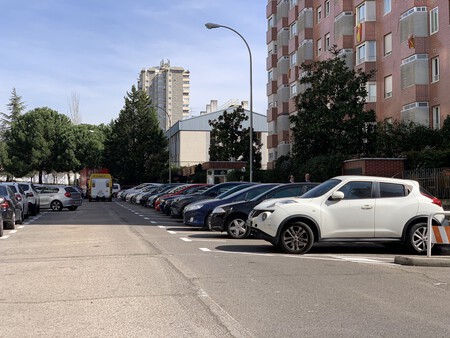
Foto: Carlos algora i+a en X (Twitter)
In Spain, less than half of homes have a parking space. In our country there are even fewer homes with private garages. Single-family homes account for just over a third of the total (33%), according to data from the National Institute of Statistics (INE) compiled by La Vanguardia. And that does not mean they have a garage: only 53% of these chalets or semi-detached houses actually do.
According to a study by Idealista, including flats in communities, more than half of Spanish housing (55%) lacks a parking space, making it impossible to install a charging point at home. If we look at the big cities, where an electric car makes the most sense today due to anti-pollution plans, in Madrid only 40% have a parking space and in Barcelona barely 30%.
And yet having a garage isn’t always a guarantee of parking the car inside the house. I live in a Madrid commuter town, surrounded by detached houses: many neighbors opt to park on the street, in front of their homes. As with the Americans in many cases, the garage is more of a storage area than a garage, as I have noticed when I’ve seen some open. They are also quite small and low, so squeezing a car into there is far more awkward than leaving it on the street.
Encuentra tu coche eléctrico ideal
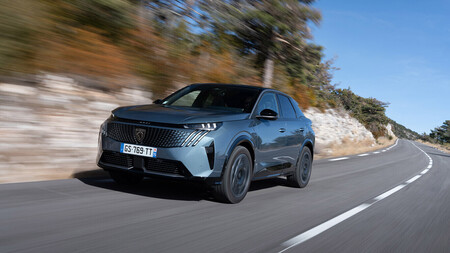
If you’ve considered buying an electric car, this will interest you. We’ve created the Personalized Electric Car Recommender, where in addition to seeing models that fit your needs you’ll also get answers to the questions that are most likely to concern you, such as price, range, or nearby charging points.

Looking for your next electric car and overwhelmed by so many options? It’s normal.
More than 45,000 readers have already tried it. And you?
Advice provided by the brand